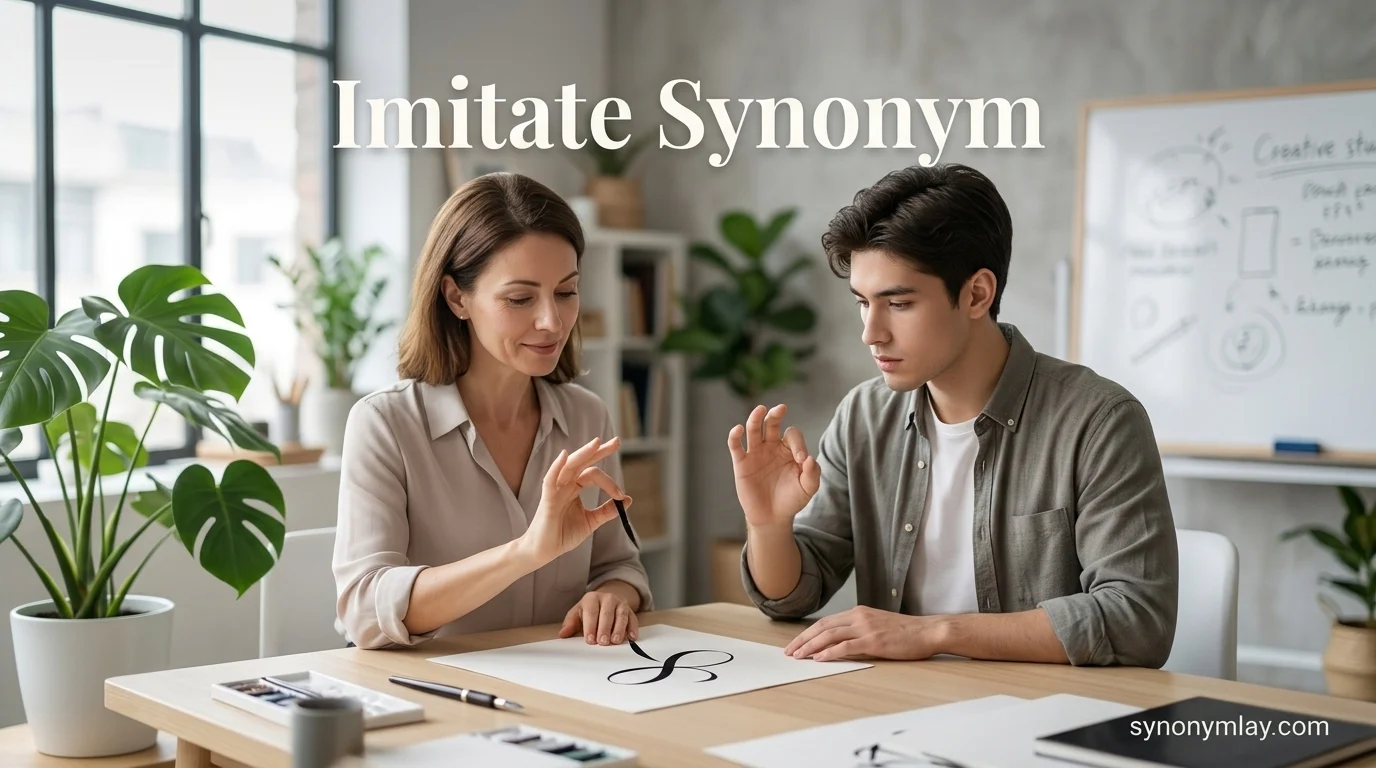
Finding the right imitate synonym can make your writing clearer, more precise, and more natural. The word imitate generally means to copy someone’s actions, behavior, appearance, style, speech, or methods. Depending on the situation, however, words such as mimic, emulate, replicate, and mirror can communicate slightly different ideas.
For students, ESL learners, writers, and content creators, understanding these differences is useful. Saying that a student “emulates” a successful teacher, for example, can suggest admiration and a desire to achieve similar results, while saying someone “mimics” another person may suggest copying their voice or mannerisms.
This guide explains useful alternatives to imitate in simple English. It also includes practical examples, usage notes, a comparison guide, and a detailed section explaining demure and its synonyms.
What Does “Imitate” Mean?
Imitate means to copy the way someone or something looks, behaves, speaks, moves, or works.
Simple definition
Imitate = to copy someone or something deliberately or closely.
For example:
- Children often imitate their parents.
- The comedian imitated the actor’s voice.
- This machine imitates the movement of a human hand.
The word can be neutral, positive, or negative depending on the context.
Common Imtitate Synonyms
Here are some of the most useful synonyms and related words for imitate:
- Mimic
- Copy
- Emulate
- Mirror
- Reproduce
- Replicate
- Recreate
- Echo
- Follow
- Model
- Parrot
- Simulate
- Duplicate
- Reenact
- Reflect
- Match
- Resemble
- Reproduce
- Pattern
- Borrow
- Adapt
- Parody
- Mock
- Mirror
- Approximate
- Shadow
- Echo
- Take after
- Follow the example of
- Model oneself on
Not every word has exactly the same meaning. The best choice depends on what kind of copying you want to describe.
1. Mimic
Meaning: To copy someone’s voice, movements, expressions, or behavior.
Example sentence:
The comedian could mimic the politician’s voice perfectly.
Best usage context:
Use mimic when someone copies a person’s mannerisms, speech, sounds, or actions.
2. Copy
Meaning: To do something in the same way as another person or thing.
Example sentence:
The younger student tried to copy his brother’s drawing.
Best usage context:
Use copy for everyday, simple situations involving imitation.
3. Emulate
Meaning: To copy someone because you admire them and want to achieve similar success.
Example sentence:
Many young athletes emulate successful professionals.
Best usage context:
Use emulate when the imitation is usually positive or motivated by admiration.
4. Mirror
Meaning: To closely reflect or behave in a similar way to someone or something.
Example sentence:
Her presentation style mirrored that of her experienced manager.
Best usage context:
Useful for behavior, actions, appearance, attitudes, or patterns.
5. Reproduce
Meaning: To create something that is very similar to an original.
Example sentence:
The artist tried to reproduce the colors of the original painting.
Best usage context:
Common in art, science, manufacturing, research, and technical writing.
6. Replicate
Meaning: To make an exact or very close copy.
Example sentence:
Scientists attempted to replicate the experiment.
Best usage context:
Best for scientific, technical, professional, or highly precise contexts.
7. Recreate
Meaning: To make something again in a similar form.
Example sentence:
The museum worked to recreate the appearance of the ancient room.
Best usage context:
Useful when reproducing an event, setting, design, experience, or historical scene.
8. Echo
Meaning: To repeat or strongly resemble an idea, style, sound, or feeling.
Example sentence:
The new building echoes the design of the old theater.
Best usage context:
Good for writing, ideas, sounds, artistic styles, and designs.
9. Follow
Meaning: To use someone else’s example, method, or behavior as a guide.
Example sentence:
She decided to follow her mentor’s approach.
Best usage context:
Useful when imitation involves adopting a method or example.
10. Model
Meaning: To base your behavior or work on another person or example.
Example sentence:
The students modeled their project on a successful community program.
Best usage context:
Common in education, leadership, professional development, and behavior.
11. Parrot
Meaning: To repeat someone’s words without necessarily understanding them.
Example sentence:
He simply parroted the opinions he heard online.
Best usage context:
Usually negative and useful when someone repeats information mechanically.
12. Simulate
Meaning: To imitate the conditions, behavior, or appearance of something.
Example sentence:
The software simulates real-world driving conditions.
Best usage context:
Common in technology, education, science, medicine, and training.
13. Duplicate
Meaning: To make an exact copy of something.
Example sentence:
The designer duplicated the original file before making changes.
Best usage context:
Best for objects, documents, files, designs, and technical material.
14. Reenact
Meaning: To perform an event again, especially a historical event.
Example sentence:
The students reenacted an important historical battle.
Best usage context:
Use this for historical events, performances, or previously experienced situations.
15. Reflect
Meaning: To show characteristics or qualities similar to something else.
Example sentence:
Her writing reflects the influence of classic literature.
Best usage context:
Useful for ideas, qualities, styles, attitudes, and influences.
16. Match
Meaning: To be similar to or correspond closely with something.
Example sentence:
The new curtains match the style of the room.
Best usage context:
Useful when describing similarity rather than direct copying.
17. Resemble
Meaning: To look or seem similar to someone or something.
Example sentence:
The painting resembles the artist’s earlier work.
Best usage context:
Best when focusing on similarity in appearance, style, or characteristics.
18. Pattern
Meaning: To develop or arrange something according to an existing example.
Example sentence:
The organization patterned its program after a successful model.
Best usage context:
Useful in formal and professional writing.
19. Borrow
Meaning: To take an idea, style, technique, or feature from another source and use it.
Example sentence:
The designer borrowed several ideas from traditional architecture.
Best usage context:
Useful when an idea or feature is adopted rather than completely copied.
20. Adapt
Meaning: To change an existing idea or method so it works for a new situation.
Example sentence:
The teacher adapted the activity for younger students.
Best usage context:
Use adapt when copying involves meaningful changes or improvements.
21. Parody
Meaning: To imitate something in an exaggerated or humorous way.
Example sentence:
The comedian parodied the famous advertisement.
Best usage context:
Common in comedy, entertainment, satire, and social commentary.
22. Mock
Meaning: To imitate someone or something, often to make fun of it.
Example sentence:
The students mocked their friend’s dramatic way of speaking.
Best usage context:
Usually negative and often connected with humor, ridicule, or criticism.
23. Approximate
Meaning: To be close to something without being exactly the same.
Example sentence:
The model approximates the shape of the original structure.
Best usage context:
Useful when an imitation is similar but not exact.
24. Shadow
Meaning: To follow or copy someone’s actions closely.
Example sentence:
The new employee shadowed the manager to learn how the department worked.
Best usage context:
Especially useful for workplace training and learning by observation.
25. Take After
Meaning: To resemble a family member in appearance, personality, or behavior.
Example sentence:
She takes after her mother in both personality and appearance.
Best usage context:
Mostly used for family resemblance.
26. Echo
Meaning: To repeat or reproduce a similar idea, style, or quality.
Example sentence:
The author’s latest novel echoes themes from his earlier books.
Best usage context:
Particularly useful in literary and analytical writing.
27. Model Oneself On
Meaning: To use another person as an example for your own behavior or development.
Example sentence:
The young athlete modeled himself on a famous champion.
Best usage context:
Useful when someone deliberately chooses another person as a role model.
28. Follow the Example Of
Meaning: To behave or act similarly to someone who provides a model.
Example sentence:
Many new employees follow the example of experienced colleagues.
Best usage context:
Clear and beginner-friendly, especially in educational writing.
29. Shadow Closely
Meaning: To observe and closely follow another person’s actions in order to learn from them.
Example sentence:
The trainee shadowed the technician for several weeks.
Best usage context:
Useful for professional training and practical learning.
30. Recreate
Meaning: To make something that closely resembles an original experience, design, scene, or event.
Example sentence:
The filmmakers recreated the historic village for the movie.
Best usage context:
Best for scenes, environments, experiences, and historical settings.
Imitate Synonym Comparison Guide
| Synonym | Main Idea | Tone | Best Context |
|---|---|---|---|
| Mimic | Copy actions or speech | Neutral | Voices, gestures |
| Copy | Make something similar | Neutral | Everyday situations |
| Emulate | Copy with admiration | Positive | Role models |
| Mirror | Closely reflect | Neutral | Behavior and style |
| Replicate | Make an exact copy | Formal | Science and technology |
| Recreate | Make again | Neutral | Scenes and experiences |
| Parrot | Repeat without understanding | Negative | Speech and opinions |
| Simulate | Reproduce conditions | Formal | Training and technology |
| Parody | Copy humorously | Playful | Comedy |
| Mock | Copy to ridicule | Negative | Teasing and criticism |
| Adapt | Modify an existing model | Positive/Neutral | Ideas and methods |
| Resemble | Be similar | Neutral | Appearance and style |
How to Choose the Right Imitate Synonym
Choosing the right synonym depends mainly on why something is being copied and how closely it is being copied.
For simple copying
Use:
- Copy
- Mimic
- Reproduce
These are straightforward choices for everyday English.
For positive imitation
Use:
- Emulate
- Model
- Follow
- Model oneself on
These work well when someone admires another person’s success or behavior.
For exact copying
Use:
- Replicate
- Duplicate
- Reproduce
These are especially useful in technical, scientific, and professional contexts.
For humorous imitation
Use:
- Parody
- Mimic
- Mock
Be careful with mock, because it can suggest ridicule rather than harmless imitation.
For professional or technical writing
Use:
- Simulate
- Replicate
- Reproduce
- Approximate
These words sound more precise than the general word copy.
Imitate vs. Mimic
Although imitate and mimic are closely related, they are not always interchangeable.
Imitate is broader. You can imitate someone’s behavior, work, style, method, or appearance.
Mimic often focuses on copying sounds, speech, facial expressions, gestures, or mannerisms.
Example:
- The student imitated her teacher’s study habits.
- The comedian mimicked her teacher’s voice.
Imitate vs. Emulate
These two words are particularly important for ESL learners.
Imitate simply means to copy.
Emulate usually means to copy someone because you admire them and want to reach a similar level.
For example:
She imitated her friend’s hairstyle.
This simply describes copying.
She emulated her mentor’s work ethic.
This suggests admiration and a desire to achieve similar success.
Imitate vs. Replicate
Imitate does not always mean an exact copy. It can describe something generally similar.
Replicate usually suggests producing something extremely close or exact.
For example:
- The child imitated the dancer’s movements.
- The researchers replicated the experiment.
The second sentence sounds more precise and scientific.
What Does “Demure” Mean?
Demure is an adjective that describes someone who behaves in a quiet, modest, reserved, or somewhat shy way.
In simple English:
Demure = quiet, modest, and not wanting to attract too much attention.
The word is commonly used to describe a person’s behavior, appearance, expression, or manner.
For example:
She gave a demure smile when everyone complimented her.
The word can have a positive or slightly old-fashioned tone. In modern writing, it often suggests modesty, elegance, restraint, or quiet confidence.
30 Synonyms of Demure
1. Modest
Meaning: Not showing off or seeking attention.
Example: She wore a modest outfit to the formal event.
Best usage: Clothing, behavior, personality, or attitude.
2. Reserved
Meaning: Quiet and not very open with feelings.
Example: He was reserved when meeting new people.
Best usage: Personality and social behavior.
3. Shy
Meaning: Nervous or uncomfortable around other people.
Example: The shy student rarely spoke in class.
Best usage: Social behavior and personality.
4. Quiet
Meaning: Not loud, talkative, or attention-seeking.
Example: She has a quiet and gentle personality.
Best usage: Everyday English.
5. Retiring
Meaning: Avoiding attention and preferring to stay private.
Example: Despite his talent, he remained retiring.
Best usage: Formal or literary writing.
6. Unassuming
Meaning: Not trying to impress others.
Example: The successful author was surprisingly unassuming.
Best usage: Personality and behavior.
7. Modest-Mannered
Meaning: Behaving in a humble and restrained way.
Example: She was polite and modest-mannered throughout the interview.
Best usage: Describing polite behavior.
8. Bashful
Meaning: Shy or easily embarrassed.
Example: The bashful child hid behind her mother.
Best usage: Informal and warm descriptions.
9. Timid
Meaning: Lacking confidence in social situations.
Example: The timid student hesitated before answering.
Best usage: Personality and confidence.
10. Gentle
Meaning: Calm, kind, and not aggressive.
Example: She had a gentle manner when speaking to children.
Best usage: Personality and behavior.
11. Meek
Meaning: Quiet and unlikely to argue or demand attention.
Example: His meek personality made him reluctant to complain.
Best usage: When emphasizing submissive behavior.
12. Mild
Meaning: Gentle and not extreme.
Example: She responded with a mild smile.
Best usage: Behavior, reactions, and personality.
13. Soft-Spoken
Meaning: Speaking quietly and gently.
Example: The soft-spoken teacher made everyone feel comfortable.
Best usage: Voice and communication style.
14. Unobtrusive
Meaning: Not attracting unwanted attention.
Example: The assistant had an unobtrusive presence during the meeting.
Best usage: Formal writing and professional settings.
15. Discreet
Meaning: Careful not to attract attention or reveal private information.
Example: She was discreet when discussing the sensitive matter.
Best usage: Privacy and careful behavior.
16. Dignified
Meaning: Calm, respectable, and controlled.
Example: She maintained a dignified manner during the ceremony.
Best usage: Formal situations.
17. Demure-Looking
Meaning: Having a quiet, modest, or reserved appearance.
Example: Her demure-looking style suited the traditional event.
Best usage: Appearance and fashion descriptions.
18. Coy
Meaning: Pretending to be shy or reluctant, sometimes in a playful way.
Example: She gave a coy smile before answering.
Best usage: Playful or flirtatious contexts.
19. Subdued
Meaning: Quiet, restrained, or not very noticeable.
Example: Her subdued expression showed that she was thoughtful.
Best usage: Emotions, colors, behavior, and atmosphere.
20. Composed
Meaning: Calm and in control of one’s emotions.
Example: She remained composed during the difficult conversation.
Best usage: Emotional control and formal situations.
21. Self-Effacing
Meaning: Not drawing attention to your own achievements.
Example: Despite winning the award, he remained self-effacing.
Best usage: Humility and personality.
22. Humble
Meaning: Not believing you are more important than others.
Example: The successful entrepreneur remained humble.
Best usage: Personality and achievements.
23. Restrained
Meaning: Controlled and not excessive.
Example: Her restrained reaction surprised everyone.
Best usage: Emotions, behavior, and formal writing.
24. Proper
Meaning: Respectable and socially appropriate.
Example: She maintained a proper manner at the formal dinner.
Best usage: Social behavior and traditional contexts.
25. Ladylike
Meaning: Traditionally considered graceful, polite, and refined.
Example: Her ladylike manners impressed the guests.
Best usage: Traditional or old-fashioned descriptions.
26. Refined
Meaning: Elegant, polished, and socially graceful.
Example: She had a refined manner of speaking.
Best usage: Style, manners, and appearance.
27. Elegant
Meaning: Graceful, attractive, and sophisticated.
Example: Her elegant behavior made a strong impression.
Best usage: Appearance, style, manners, and behavior.
28. Unpretentious
Meaning: Simple and not designed to impress others.
Example: The restaurant had an unpretentious atmosphere.
Best usage: People, places, styles, and attitudes.
29. Innocent
Meaning: Lacking experience or showing a simple, pure quality.
Example: She gave an innocent smile.
Best usage: Expressions and personality, depending on context.
30. Unaffected
Meaning: Natural and not deliberately trying to impress.
Example: Her unaffected manner made her easy to talk to.
Best usage: Personality and natural behavior.
Demure Synonym Comparison
| Word | Main Meaning | Tone | Best Use |
|---|---|---|---|
| Modest | Not attention-seeking | Positive | Behavior, clothing |
| Reserved | Quiet and private | Neutral | Personality |
| Shy | Uncomfortable socially | Neutral | People |
| Bashful | Easily embarrassed | Warm | Informal descriptions |
| Coy | Playfully shy | Playful | Social or romantic contexts |
| Unassuming | Not boastful | Positive | Personality |
| Refined | Polished and elegant | Positive | Style and manners |
| Subdued | Quiet or restrained | Neutral | Behavior and emotions |
| Composed | Calm and controlled | Positive | Formal situations |
| Humble | Not boastful | Positive | Character |
| Restrained | Emotionally controlled | Formal | Behavior and reactions |
| Unobtrusive | Not attracting attention | Formal | People and design |
How to Choose the Right Synonym for Demure
If you mean quiet and shy, choose:
- Shy
- Bashful
- Timid
- Reserved
If you mean modest and not attention-seeking, choose:
- Modest
- Unassuming
- Unpretentious
- Self-effacing
If you mean elegant and well-mannered, choose:
- Refined
- Elegant
- Dignified
- Ladylike
If you mean calm and controlled, choose:
- Composed
- Restrained
- Subdued
- Mild
If you mean playfully shy, choose:
- Coy
This distinction matters because synonyms often overlap without being perfect replacements.
FAQs:
What is the best synonym for imitate?
Mimic is one of the closest everyday synonyms, but emulate, replicate, copy, and mirror may be better depending on the context.
What is a positive synonym for imitate?
Emulate is often the best positive alternative because it suggests copying someone you admire and trying to achieve similar success.
What is a formal synonym for imitate?
Replicate, reproduce, and simulate can work well in formal, scientific, or technical contexts.
What is the difference between imitate and mimic?
Imitate is a broad word for copying. Mimic often refers specifically to copying someone’s voice, movements, expressions, or mannerisms.
What does demure mean in simple English?
Demure means quiet, modest, reserved, and not eager to attract attention. It can describe someone’s behavior, appearance, or manner.
Final Takeaway
The best imitate synonym depends on exactly what you mean. Use copy for simple everyday imitation, mimic for voices and mannerisms, emulate for positive imitation, and replicate when accuracy is important.
Words such as recreate, simulate, mirror, echo, adapt, parody, and model add more specific shades of meaning. Learning these differences can make your vocabulary stronger and help you communicate more precisely.
Remember that synonyms are not always interchangeable. Before choosing one, consider the purpose, tone, degree of similarity, and context. That small distinction can turn an ordinary sentence into a much more accurate and natural one.

I am Andre James, an experienced administrator passionate about language and clear communication. I manage SynonymLay to help readers discover accurate, useful synonyms and improve their vocabulary.