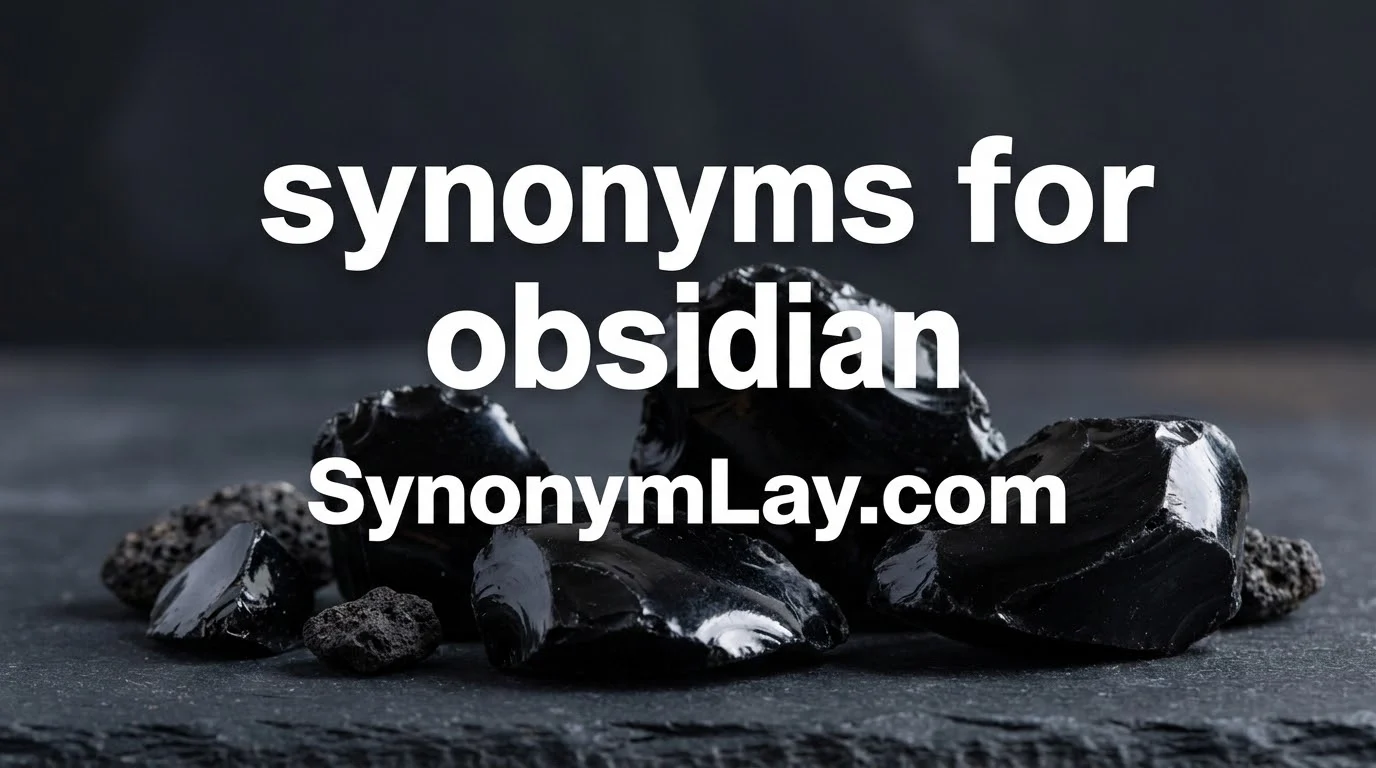
Synonyms for Obsidian: Meaning and Quick Answer
The best synonyms for obsidian depend on whether you are describing the natural material, its dark appearance, or its use in jewelry and decorative objects. Obsidian is a naturally occurring volcanic glass formed when lava cools rapidly.
Common alternatives and related terms include volcanic glass, natural glass, black glass, and dark volcanic glass. However, these expressions are not always exact synonyms. Volcanic glass describes the material more generally, while black glass emphasizes its appearance. Choosing the right term helps you describe obsidian accurately in scientific writing, everyday conversation, and creative work.
What Does Obsidian Mean?
Obsidian is a naturally occurring volcanic glass that forms when silica-rich lava cools quickly, preventing crystals from developing. It is usually black, although some varieties display brown, gray, green, or other colors.
The word obsidian is a noun. It commonly appears in discussions of geology, archaeology, jewelry, decorative materials, and ancient tools.
For example:
- The archaeologist discovered an obsidian blade at the site.
- Her necklace featured a polished obsidian pendant.
- The dark obsidian reflected the light from the window.
Obsidian is often associated with a glossy surface, a dark appearance, and sharp fracture edges. These qualities make it useful in descriptions of natural landscapes, historical artifacts, and ornamental stones.
Synonyms for Obsidian: A Useful List of Alternatives
Obsidian does not have many exact synonyms because it names a specific natural material. Some alternatives describe the material itself, while others refer to its color, appearance, or broader geological category.
| Synonym or Alternative | Meaning | Best Used For |
|---|---|---|
| Volcanic glass | Glassy material formed by rapidly cooled lava | Geology and educational writing |
| Natural glass | Glass that forms through natural processes | Scientific descriptions |
| Black volcanic glass | Dark glass formed by volcanic activity | Clear descriptive writing |
| Dark volcanic glass | Volcanic glass with a dark appearance | General descriptions |
| Black glass | Glass characterized by its black color | Visual descriptions, when context is clear |
| Volcanic rock | Rock formed from volcanic material | Broad geological discussions, not as an exact synonym |
| Glassy volcanic material | Volcanic material with a glass-like structure | Technical explanations |
| Black ornamental stone | A dark material used for decoration | Jewelry and design descriptions, when applicable |
Important distinction: Volcanic glass is the closest general alternative, but it is broader than obsidian. Black glass describes appearance rather than geological origin, and volcanic rock is a broader category that includes many materials that are not obsidian.
Best Obsidian Synonyms in Different Contexts
Obsidian Synonyms in Formal Writing
Formal writing benefits from precise descriptions rather than overly creative substitutes. The best choice depends on whether you are discussing the material’s composition, appearance, or use.
Volcanic glass is suitable for professional descriptions and technical documents.
Example: “The artifact was manufactured from volcanic glass.”
Naturally occurring volcanic glass is useful when a more explicit scientific description is needed.
Example: “The collection includes several tools made from naturally occurring volcanic glass.”
Black volcanic glass works when the color is important to the description.
Example: “The exhibition features a polished object made from black volcanic glass.”
Avoid replacing obsidian with black stone in formal writing when the specific material matters. Many black stones have different compositions and properties.
Obsidian Synonyms in Academic Writing
Academic writing should distinguish obsidian from other geological materials. In geology, archaeology, and materials research, accuracy is more important than stylistic variety.
Useful expressions include:
- Volcanic glass: A broad geological description.
- Natural volcanic glass: A clear description emphasizing its natural formation.
- Obsidian artifact: A specific object made from obsidian.
- Glassy volcanic material: A descriptive phrase for material with a glass-like structure.
- Silica-rich volcanic glass: Appropriate when the composition is relevant and supported by the context.
Examples:
“The researchers examined volcanic glass recovered from the excavation site.”
“Obsidian artifacts provided evidence of material use and exchange between communities.”
“The sample displayed a glassy structure associated with rapid cooling.”
Use obsidian itself whenever the exact material is known. Replacing it with a broader term can remove important scientific information.
Obsidian Synonyms in Everyday English
In everyday conversation, simple descriptive terms may be easier to understand than technical terminology.
Black volcanic glass explains both the material’s origin and its usual appearance.
Example: “The pendant was made from black volcanic glass.”
Dark glass is a simpler visual description when the precise material is not important.
Example: “The display included a piece of dark glass.”
Black stone can work in casual conversation when describing an object’s appearance, but it should not be treated as an exact synonym.
Example: “She wore a ring with a smooth black stone.”
If you know that the material is obsidian, naming it directly is usually the clearest option.
Obsidian Synonyms in Descriptive or Literary Writing
Creative writing often emphasizes the appearance, texture, and mood associated with obsidian.
Useful descriptive expressions include:
Jet-black glass: Highlights an intensely black, glassy appearance.
Example: “The polished surface resembled jet-black glass beneath the moonlight.”
Glossy black material: Emphasizes shine and color without making a specific geological claim.
Example: “A glossy black material covered the sculpture’s base.”
Dark, glass-like stone: Creates a visual impression suitable for fiction and descriptive prose.
Example: “The traveler carried a dark, glass-like stone from the mountains.”
Midnight-black surface: Suggests deep darkness and can create a dramatic literary image.
Example: “The midnight-black surface gleamed under the candlelight.”
These are descriptive alternatives rather than exact mineral names. They work best when the goal is to create an image in the reader’s mind rather than provide a scientific identification.
Obsidian Synonyms With Examples
The following terms demonstrate how to describe obsidian without changing the intended meaning unnecessarily.
1. Volcanic Glass
Meaning: Glass-like material formed naturally through volcanic processes.
Example: “The ancient knife was crafted from volcanic glass.”
Why it works: This phrase communicates the geological origin and glassy nature of obsidian.
Difference: Volcanic glass is a broader category, so it may refer to materials other than obsidian.
2. Natural Glass
Meaning: Glass formed through natural processes rather than manufactured by people.
Example: “The geology lesson introduced students to natural glass formed by volcanic activity.”
Why it works: It emphasizes that the material occurs naturally.
Difference: Natural glass includes materials other than obsidian, so the term is less specific.
3. Black Volcanic Glass
Meaning: Dark volcanic glass, particularly material with a black appearance.
Example: “The artisan shaped the black volcanic glass into a small pendant.”
Why it works: It describes both the material’s origin and its typical color.
Difference: The expression is descriptive rather than a separate scientific name for obsidian.
4. Black Glass
Meaning: Glass that appears black.
Example: “The designer used black glass to create a striking decorative centerpiece.”
Why it works: It is concise and emphasizes appearance.
Difference: Black glass can be manufactured or natural. The phrase does not establish that the material is obsidian.
5. Dark Volcanic Glass
Meaning: Volcanic glass with a dark color.
Example: “The museum displayed a fragment of dark volcanic glass beside other geological specimens.”
Why it works: It offers a clear visual description while preserving the volcanic connection.
Difference: The phrase can describe dark volcanic glass that is not specifically identified as obsidian.
6. Glassy Volcanic Material
Meaning: Volcanic material with a smooth, glass-like structure.
Example: “The sample contained glassy volcanic material formed during rapid cooling.”
Why it works: It is useful when explaining how volcanic material develops its texture.
Difference: It is a broad descriptive phrase rather than a precise substitute for obsidian.
7. Jet-Black Glass
Meaning: Glass with an especially deep black appearance.
Example: “The artist carved a small figure from a piece that looked like jet-black glass.”
Why it works: It creates a strong visual impression in descriptive writing.
Difference: It emphasizes color and appearance, not geological identity.
Difference Between Obsidian and Similar Words
Some words associated with obsidian describe related materials, while others highlight only its appearance.
| Word or Phrase | Meaning | Difference From Obsidian |
|---|---|---|
| Volcanic glass | Naturally formed glass associated with volcanic processes | A broader category |
| Natural glass | Glass formed without human manufacturing | Includes materials other than obsidian |
| Black glass | Glass that appears black | Describes color, not origin |
| Basalt | A common dark, fine-grained volcanic rock | Usually crystalline rather than glassy |
| Pumice | A lightweight, porous volcanic rock | Has a different texture and structure |
| Onyx | A banded variety of chalcedony, commonly used ornamentally | A different material |
| Jet | An organic gemstone formed from fossilized wood | Not volcanic glass |
| Black stone | A general visual description | Does not identify a particular material |
Obsidian vs. Volcanic Glass
Volcanic glass is a broad term for glass formed by volcanic activity. Obsidian is a well-known type of volcanic glass.
For example, “volcanic glass” is useful in a general geology explanation, while “obsidian” is preferable when the material has been specifically identified.
Obsidian vs. Basalt
Both materials can appear dark and originate from volcanic activity. However, basalt generally contains crystals, whereas obsidian has a predominantly glassy structure.
Calling basalt obsidian simply because both are dark would be inaccurate.
Obsidian vs. Onyx
Obsidian and onyx can both be used in jewelry and decorative objects. Nevertheless, they are different materials with different geological characteristics.
Use obsidian when referring to volcanic glass and onyx when referring to the appropriate variety of chalcedony.
Obsidian vs. Jet
Jet and obsidian may both have a dark, polished appearance. Jet is an organic gemstone derived from fossilized wood, while obsidian forms from rapidly cooled lava.
The two terms should not be used interchangeably in descriptions of gemstones or geological materials.
Antonyms of Obsidian
Obsidian has no direct antonym because it is the name of a particular material rather than a quality with a natural opposite.
However, when describing its appearance, you can use contrasting expressions.
| Contrasting Term | Meaning | Example |
|---|---|---|
| Clear glass | Glass that allows light to pass through with little visible obstruction | “The window was made of clear glass.” |
| White stone | A stone with a predominantly white appearance | “The sculpture was carved from white stone.” |
| Light-colored rock | Rock with a pale or light appearance | “The trail passed through an area of light-colored rock.” |
| Matte surface | A surface with little or no shine | “The matte surface contrasted with the glossy obsidian.” |
| Translucent material | Material that allows some light through without clear visibility | “The translucent material glowed in the sunlight.” |
These expressions contrast with particular characteristics of obsidian, such as its common dark color or glassy shine. They are not geological antonyms.
For instance, clear glass contrasts with black obsidian in appearance, but it does not necessarily represent the opposite geological material.
Common Uses of the Word Obsidian
Obsidian appears in several fields, and the surrounding context determines which description is most appropriate.
Geology and Earth Science
Geologists use the word to describe naturally occurring volcanic glass.
Examples:
- “Obsidian forms when lava cools rapidly.”
- “The specimen displayed a smooth, glassy fracture surface.”
In scientific writing, terms such as volcanic glass and glassy volcanic material can help explain its formation and structure.
Archaeology and Ancient Tools
Obsidian has been used to make cutting tools, blades, and other artifacts because it can fracture to produce very sharp edges.
Examples:
- “The excavation uncovered an obsidian blade.”
- “Researchers studied obsidian artifacts recovered from the settlement.”
In archaeology, replacing obsidian with black stone may obscure information about the artifact’s material.
Jewelry and Decorative Objects
Obsidian is commonly used in beads, pendants, sculptures, and ornamental pieces.
Examples:
- “The necklace featured a polished obsidian bead.”
- “A small obsidian sculpture stood on the shelf.”
In this context, expressions such as black volcanic glass or glossy black stone may help describe the object’s appearance.
Fiction and Symbolic Descriptions
Writers may use obsidian to evoke darkness, sharpness, mystery, or a glossy black surface.
Examples:
- “His eyes were dark as obsidian.”
- “The obsidian blade caught the firelight.”
These expressions use the material’s recognizable appearance to create imagery. Such comparisons are stylistic, not literal synonyms.
Common Mistakes to Avoid When Using Obsidian
1. Treating Every Black Stone as Obsidian
Not every black stone is volcanic glass. Basalt, onyx, and other dark materials have different properties.
Incorrect: “The black rock must be obsidian.”
Improved: “The rock appeared black, but its composition would need to be examined to identify it as obsidian.”
2. Confusing Obsidian With Manufactured Glass
Obsidian forms naturally through volcanic processes. Manufactured black glass may look similar but is not necessarily obsidian.
Incorrect: “The black glass ornament is definitely obsidian.”
Improved: “The ornament is made of black glass; its exact material has not been identified.”
3. Using Volcanic Rock as an Exact Synonym
Volcanic rock is a broad category that includes materials with different structures and compositions.
Incorrect: “All volcanic rocks are obsidian.”
Improved: “Obsidian is a type of volcanic glass.”
4. Using Decorative Terms in Scientific Writing
Expressions such as midnight-black stone and jet-black glass can be effective in creative prose but are less suitable for precise scientific identification.
Awkward in a scientific report: “The sample was a mysterious midnight-black stone.”
Improved: “The sample was identified as obsidian.”
5. Confusing Obsidian With Onyx or Jet
These materials may look similar, but their origins and compositions differ.
Incorrect: “The pendant was made from obsidian, also known as jet.”
Improved: “The pendant was made from obsidian, a naturally occurring volcanic glass.”
6. Assuming Obsidian Is Always Pure Black
Although black is its most familiar color, obsidian can also display brown, gray, green, and other variations.
Incorrect: “Obsidian is always completely black.”
Improved: “Obsidian is commonly black, although its color can vary.”
Frequently Asked Questions
What is a synonym for obsidian?
Volcanic glass is the closest general alternative. Black volcanic glass is also useful when describing obsidian’s typical appearance.
What does obsidian mean?
Obsidian is a naturally occurring volcanic glass formed when lava cools rapidly, preventing crystals from developing.
What is a simple word for obsidian?
There is no exact everyday replacement, but volcanic glass is a clear and understandable description.
What is the opposite of obsidian?
Obsidian has no direct antonym. Depending on the intended contrast, clear glass, white stone, or a matte surface may describe an opposing visual characteristic.
What is the best synonym for obsidian?
Volcanic glass is usually the best general alternative. However, obsidian itself is more precise when the specific material is known.
How do you use obsidian in a sentence?
Example: “The archaeologist discovered an obsidian tool near the ancient settlement.”
The word identifies the material from which the tool was made.
Is volcanic glass the same as obsidian?
Not exactly. Obsidian is a type of volcanic glass, but the broader term can include other naturally formed volcanic glass materials.
Is black glass another name for obsidian?
Not always. Black glass describes a color and appearance, while obsidian refers to a naturally occurring volcanic material.
Is obsidian a rock or a mineral?
Obsidian is generally classified as a volcanic glass or glassy volcanic rock. Because it lacks the regular crystalline structure characteristic of minerals, it is not considered a mineral in the strict geological sense.
Can obsidian and onyx be used interchangeably?
No. Obsidian is volcanic glass, whereas onyx is a variety of chalcedony. They may share a dark appearance, but they are different materials.
Conclusion
The most useful synonyms for obsidian include volcanic glass, natural glass, black volcanic glass, and dark volcanic glass. Each expression emphasizes a different aspect of the material, from its natural formation to its color and appearance.
For scientific and educational writing, volcanic glass is usually the strongest general alternative. In everyday descriptions, black glass or dark volcanic glass may be appropriate when the context supports the meaning. The best choice depends on accuracy, context, tone, and whether you are identifying the material or simply describing how it looks.

I am Andre James, an experienced administrator passionate about language and clear communication. I manage SynonymLay to help readers discover accurate, useful synonyms and improve their vocabulary.


