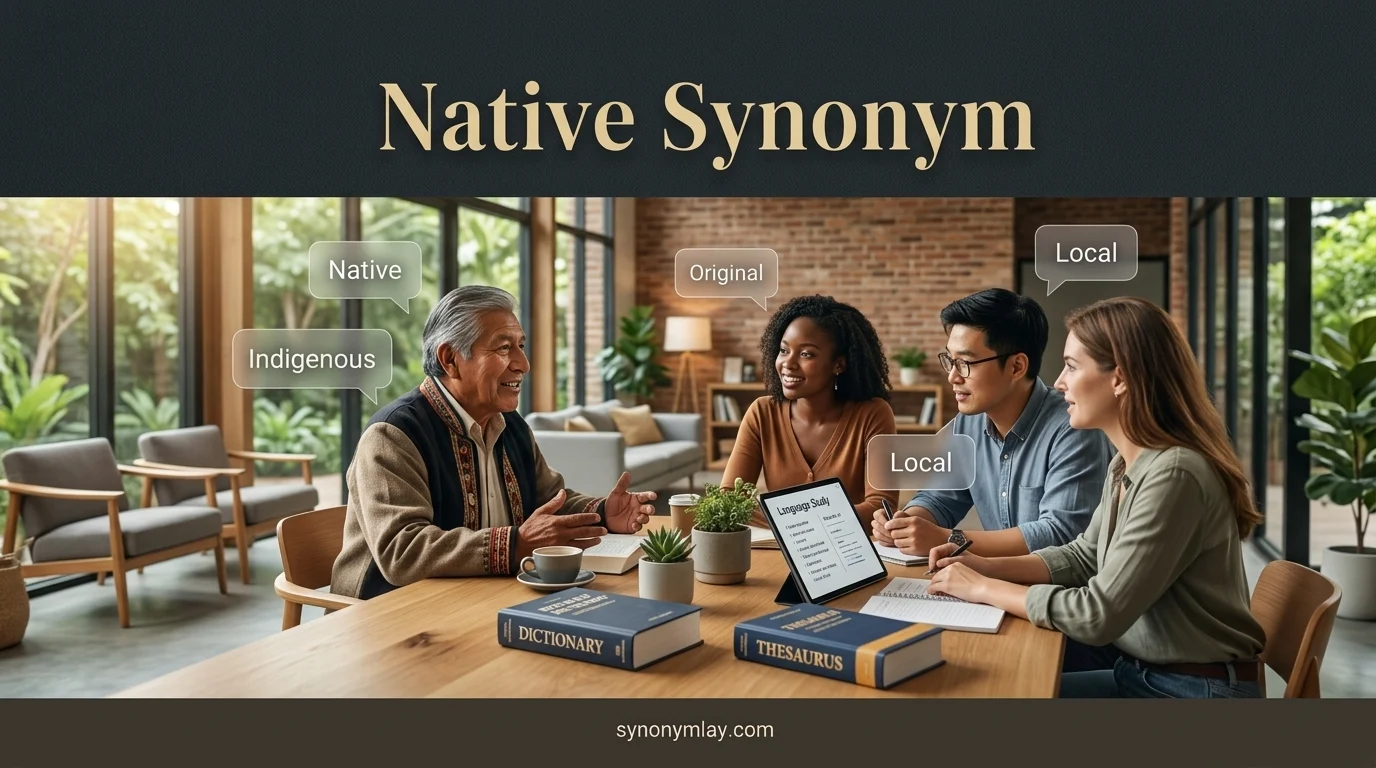
Finding the right native synonym can make your writing clearer, more natural, and more precise. The word “native” has several meanings, so the best alternative depends on whether you are talking about a person, language, place, animal, plant, or something that naturally belongs to a particular environment.
For example, “native” can describe someone born in a particular country, a language learned from childhood, or a plant that naturally grows in a region. Words such as indigenous, local, original, domestic, natural, resident, and aboriginal may work in certain contexts, but they are not always interchangeable.
This guide explains the most useful synonyms for “native” in simple English. You will also learn how each word differs in tone and meaning, making it easier to choose the right vocabulary for essays, conversations, professional writing, and creative content.
What Does “Native” Mean?
The word native generally means someone or something that originally belongs to a particular place.
Example:
“She is a native of Lahore.”
It can also describe a language that someone learned naturally from childhood.
Example:
“He is a native English speaker.”
For plants and animals, “native” usually means naturally occurring in a particular area rather than being introduced from somewhere else.
Example:
“This tree is native to South Asia.”
Because “native” has several meanings, choosing a synonym requires attention to context.
Native Synonym List
Here are 30 useful alternatives and related words for “native.”
1. Indigenous
Meaning: Something that naturally originated in or belongs to a particular region.
Example:
“The kangaroo is indigenous to Australia.”
Best usage: Geography, culture, history, plants, animals, and academic writing.
2. Local
Meaning: Someone or something connected with a particular nearby place.
Example:
“We bought fresh vegetables from a local farmer.”
Best usage: Everyday conversation and informal writing.
3. Original
Meaning: Existing from the beginning or coming from the first source.
Example:
“The original inhabitants lived near the river.”
Best usage: History, descriptions, and discussions about sources.
4. Aboriginal
Meaning: Relating to the earliest known inhabitants of a particular region.
Example:
“The museum displays Aboriginal artwork.”
Best usage: Historical and cultural contexts, especially when referring to Indigenous peoples.
5. Autochthonous
Meaning: Originating naturally in the place where it is found.
Example:
“The researchers studied autochthonous plant species.”
Best usage: Academic, scientific, and formal writing.
6. Local-born
Meaning: Born in the place being discussed.
Example:
“She is local-born and knows the city extremely well.”
Best usage: Describing people in a specific location.
7. Indigenous-born
Meaning: Born among or belonging to the original population of a place.
Example:
“The program supports indigenous-born community leaders.”
Best usage: Formal or demographic discussions.
8. Domestic
Meaning: Belonging to a particular country rather than coming from another country.
Example:
“The company sells both domestic and imported products.”
Best usage: Business, economics, trade, and products.
9. Regional
Meaning: Connected with a particular geographical area.
Example:
“The restaurant specializes in regional cuisine.”
Best usage: Food, culture, geography, and economics.
10. Traditional
Meaning: Connected with the customs or practices of a particular culture or community.
Example:
“They prepared a traditional native dish.”
Best usage: Culture, food, clothing, customs, and heritage.
11. Aboriginal
Meaning: Belonging to the earliest inhabitants of a region.
Example:
“The area has a long Aboriginal history.”
Best usage: Indigenous history and cultural discussions.
12. Inborn
Meaning: Present naturally from birth.
Example:
“She has an inborn talent for music.”
Best usage: Abilities, characteristics, and qualities rather than geographical origin.
13. Innate
Meaning: Naturally present rather than learned.
Example:
“He has an innate understanding of languages.”
Best usage: Skills, abilities, qualities, and academic writing.
14. Natural
Meaning: Existing or occurring without being artificially created or introduced.
Example:
“She has a natural ability to communicate with people.”
Best usage: Abilities, environments, qualities, and everyday language.
15. Homegrown
Meaning: Produced or developed locally.
Example:
“The festival promotes homegrown musical talent.”
Best usage: Food, businesses, talent, products, and informal writing.
16. Resident
Meaning: A person who lives in a particular place.
Example:
“Local residents welcomed the new community center.”
Best usage: People who live somewhere, whether or not they were born there.
17. Inhabitant
Meaning: A person or animal that lives in a particular place.
Example:
“The island’s inhabitants depend heavily on fishing.”
Best usage: Geography, formal writing, people, and animals.
18. Citizen
Meaning: A legally recognized member of a country.
Example:
“She became a citizen after completing the required process.”
Best usage: Legal, political, and governmental contexts.
19. Countryman
Meaning: A person from the same country as another person.
Example:
“He met a fellow countryman while traveling abroad.”
Best usage: Literary or conversational contexts.
20. National
Meaning: Relating to a particular country or its people.
Example:
“The team celebrated its national achievement.”
Best usage: Government, culture, sports, and national identity.
21. Ethnic
Meaning: Relating to a particular cultural or ancestral group.
Example:
“The city has many ethnic communities.”
Best usage: Culture, ancestry, demographics, and sociology.
22. Ancestral
Meaning: Connected with one’s ancestors or family origins.
Example:
“They returned to their ancestral homeland.”
Best usage: Family history, heritage, and genealogy.
23. Hereditary
Meaning: Passed from parents or ancestors to descendants.
Example:
“The family has a hereditary tradition of craftsmanship.”
Best usage: Traits, traditions, titles, and family characteristics.
24. Native-born
Meaning: Born in the country or place being discussed.
Example:
“The native-born population has grown steadily.”
Best usage: Demographics and formal descriptions of people.
25. Originating
Meaning: Beginning or developing in a particular place.
Example:
“The dish is believed to be originating from the coastal region.”
Best usage: History, food, ideas, products, and cultural development.
26. Indigenous-origin
Meaning: Having its original source among the people or environment of a particular region.
Example:
“The study focuses on plants of indigenous origin.”
Best usage: Academic and scientific contexts.
27. Endemic
Meaning: Naturally found only in a particular geographical area.
Example:
“This bird is endemic to the island.”
Best usage: Biology, ecology, animals, plants, and scientific writing.
28. Established
Meaning: Already existing or firmly connected with a place or community.
Example:
“The city has an established cultural tradition.”
Best usage: Institutions, traditions, businesses, and communities.
29. Home-based
Meaning: Developed, produced, or operated within one’s own country or community.
Example:
“The company supports home-based businesses.”
Best usage: Business, entrepreneurship, and local production.
30. Localized
Meaning: Adapted or specifically connected to a particular place.
Example:
“The company created a localized version of its software.”
Best usage: Technology, business, marketing, and regional adaptation.
Native Synonym Comparison Table
| Synonym | Main Meaning | Best Context | Formality |
|---|---|---|---|
| Indigenous | Originally belonging to a place | People, animals, plants, culture | Formal |
| Local | Connected with a nearby place | Everyday language | Casual |
| Original | First or earliest source | History, sources | Neutral |
| Aboriginal | Earliest inhabitants | Culture and history | Formal |
| Domestic | From one’s own country | Business and trade | Formal |
| Regional | Related to an area | Geography and culture | Neutral |
| Natural | Existing naturally | General use | Neutral |
| Homegrown | Produced locally | Business, food, talent | Casual |
| Resident | Person living somewhere | People | Neutral |
| Inhabitant | Someone or something living in a place | Geography | Formal |
| Citizen | Legal member of a country | Government and law | Formal |
| Endemic | Naturally restricted to an area | Biology | Scientific |
| Native-born | Born in a particular country | Demographics | Formal |
| Ancestral | Related to ancestors | Heritage and family | Formal |
Native vs. Indigenous
“Native” and “indigenous” can sometimes be used similarly, but they are not always identical.
Native is a broad word. It can refer to someone born in a place or a species naturally found there.
Indigenous is more specific and often refers to peoples, cultures, plants, or animals that originated in a particular region.
Example:
- “She is a native of Canada.”
- “The region has several Indigenous communities.”
For sensitive cultural or historical contexts, Indigenous may be the more precise term when discussing original peoples.
Native vs. Local
These words are often confused.
Native usually emphasizes origin or birth.
Local emphasizes connection with a place, not necessarily birth.
For example, someone may be a local resident of London without being a native of London.
Native: Originally from the place.
Local: Connected with or living in the place.
Native vs. Resident
A native is generally someone who was born in a particular place.
A resident is simply someone who lives there.
Example:
“Ali is a native of Karachi, but he is now a resident of Islamabad.”
This sentence shows the important difference clearly.
Native vs. Citizen
A native is connected with a place by birth or natural origin.
A citizen has a legal relationship with a country.
Someone can become a citizen of a country without being native-born there.
Example:
“She is a native of France but became a citizen of another country later.”
Native vs. Endemic
These terms are particularly important in science.
A species that is native to an area naturally occurs there.
A species that is endemic to an area is naturally found there and nowhere else.
Therefore, “endemic” has a narrower meaning than “native.”
Native Synonyms for Different Situations
For a Person
Use:
- Native
- Native-born
- Resident
- Inhabitant
- Citizen
- Local
For a Plant or Animal
Use:
- Indigenous
- Native
- Endemic
- Autochthonous
- Natural
For Culture
Use:
- Indigenous
- Traditional
- Ancestral
- Original
- Regional
For Products
Use:
- Domestic
- Homegrown
- Local
- Regional
- Home-based
For Language
Use:
- First language
- Mother tongue
- Native language
- Original language
How to Choose the Right Native Synonym
Choosing the right word depends mainly on what you mean by “native.”
If You Mean “Born There”
Choose native-born or native.
Example:
“She is native-born and has lived here all her life.”
If You Mean “Originally Belonging There”
Choose indigenous or autochthonous.
Example:
“These plants are indigenous to the region.”
If You Mean “Living There”
Choose resident or inhabitant.
Example:
“Residents gathered at the town hall.”
If You Mean “Produced There”
Choose domestic, local, or homegrown.
Example:
“The store supports local producers.”
If You Mean “Found Only There”
Choose endemic.
Example:
“The species is endemic to this island.”
If You Mean “Connected to Heritage”
Choose ancestral, traditional, or indigenous.
Example:
“They preserved their ancestral traditions.”
Native Synonyms for Students and ESL Learners
If you are an English learner, do not try to replace “native” with a complicated word every time.
The simplest choices are often the best.
Easy alternatives:
- Local
- Natural
- Original
- Resident
- Citizen
- Indigenous
- Regional
For formal essays, indigenous, domestic, regional, native-born, and ancestral may be useful when their meanings fit.
For everyday conversation, local is often more natural.
Common Mistakes When Using Native Synonyms
Mistake 1: Using “Resident” to Mean “Born There”
A resident may have moved to a place later in life.
Mistake 2: Using “Citizen” to Mean “Native”
Citizenship is a legal status, not necessarily a place of birth.
Mistake 3: Using “Endemic” for People
“Endemic” is mainly used for species, diseases, and biological or geographical phenomena.
Mistake 4: Using “Indigenous” Everywhere
Although “indigenous” is a strong synonym in many contexts, it carries cultural and historical meaning that “native” does not always carry.
Mistake 5: Choosing a Synonym Only Because It Sounds Formal
A sophisticated word is not automatically a better word. The synonym should match your intended meaning.
What Does “Demure” Mean?
Demure is an adjective describing someone who behaves in a quiet, modest, reserved, and somewhat shy way.
It is often used to describe a person’s appearance, manner, or behavior.
Example:
“She gave a demure smile during the ceremony.”
The tone of “demure” is usually gentle and somewhat old-fashioned or literary. It can suggest modesty, quietness, or restrained behavior.
30 Synonyms of Demure
Because “demure” can mean modest, shy, reserved, or quiet depending on context, no single synonym works perfectly in every sentence.
1. Modest
Meaning: Not showing off or seeking attention.
Example:
“She wore a modest dress to the event.
Best usage: Appearance, behavior, and personality.
2. Shy
Meaning: Uncomfortable or nervous around other people.
Example:
“The shy child avoided speaking in front of the class.”
Best usage: Personality and social situations.
3. Reserved
Meaning: Quiet and not openly expressing feelings.
Example:
“He is reserved when meeting new people.”
Best usage: Personality and behavior.
4. Bashful
Meaning: Easily embarrassed or shy.
Example:
“She became bashful when everyone praised her.”
Best usage: Friendly and informal descriptions.
5. Retiring
Meaning: Avoiding attention and preferring quiet situations.
Example:
“Her retiring personality made her uncomfortable at large parties.”
Best usage: Formal or literary writing.
6. Quiet
Meaning: Not loud, talkative, or attention-seeking.
Example:
“She has a quiet and thoughtful personality.”
Best usage: Everyday English.
7. Gentle
Meaning: Calm, kind, and soft in behavior.
Example:
“He has a gentle manner.”
Best usage: Personality and behavior.
8. Mild
Meaning: Calm and not aggressive or extreme.
Example:
“She has a mild and pleasant personality.”
Best usage: Personality and temperament.
9. Unassuming
Meaning: Not trying to impress others.
Example:
“Despite his success, he remains unassuming.”
Best usage: Personality and professional writing.
10. Humble
Meaning: Not believing you are more important than others.
Example:
“She remained humble after winning the award.”
Best usage: Character and achievements.
11. Meek
Meaning: Very quiet and unlikely to argue or challenge others.
Example:
“The meek student rarely spoke during debates.”
Best usage: Personality, although it can suggest excessive submissiveness.
12. Subdued
Meaning: Quiet, restrained, or less energetic than usual.
Example:
“She gave a subdued response to the announcement.”
Best usage: Emotions, behavior, and atmosphere.
13. Unobtrusive
Meaning: Not attracting attention.
Example:
“He chose an unobtrusive seat near the back.”
Best usage: Objects, behavior, and formal writing.
14. Discreet
Meaning: Careful not to attract attention or reveal private information.
Example:
“She was discreet about her personal affairs.”
Best usage: Behavior and privacy.
15. Unpretentious
Meaning: Simple and not designed to impress others.
Example:
“The restaurant has a comfortable, unpretentious atmosphere.”
Best usage: People, places, and lifestyles.
16. Coy
Meaning: Shy or pretending to be shy, sometimes in a playful way.
Example:
“She gave a coy smile.”
Best usage: Facial expressions and social behavior.
17. Soft-spoken
Meaning: Speaking quietly and gently.
Example:
“The teacher was soft-spoken but confident.”
Best usage: Voice and personality.
18. Demure
Meaning: Quiet, modest, and reserved.
Example:
“She gave a demure smile.”
Best usage: Modest appearance or restrained behavior.
19. Sedate
Meaning: Calm, quiet, and serious.
Example:
“The ceremony had a sedate atmosphere.”
Best usage: Formal writing and settings.
20. Calm
Meaning: Peaceful and not easily excited.
Example:
“She remained calm throughout the discussion.”
Best usage: General situations.
21. Composed
Meaning: Calm and in control of emotions.
Example:
“He remained composed under pressure.”
Best usage: Professional and formal contexts.
22. Proper
Meaning: Behaving in a socially acceptable and respectable way.
Example:
“She was known for her proper manners.”
Best usage: Manners and traditional behavior.
23. Prim
Meaning: Very proper and careful about behavior.
Example:
“She had a prim and formal manner.”
Best usage: Appearance and personality; sometimes slightly critical.
24. Ladylike
Meaning: Traditionally associated with polite, graceful, or refined feminine behavior.
Example:
“She carried herself in a ladylike manner.”
Best usage: Traditional or descriptive writing.
25. Modest-looking
Meaning: Having a simple and restrained appearance.
Example:
“She chose a modest-looking outfit for the ceremony.”
Best usage: Clothing and appearance.
26. Unpretending
Meaning: Simple and without an attempt to appear impressive.
Example:
“His unpretending manner made everyone feel comfortable.”
Best usage: Personality and literary writing.
27. Restrained
Meaning: Controlled and not overly expressive.
Example:
“She maintained a restrained expression during the meeting.”
Best usage: Formal writing and emotional behavior.
28. Unassertive
Meaning: Not forceful or demanding attention.
Example:
“His unassertive personality sometimes made it difficult for others to hear his ideas.”
Best usage: Personality and workplace contexts.
29. Dignified
Meaning: Calm, serious, and worthy of respect.
Example:
“She maintained a dignified appearance throughout the ceremony.”
Best usage: Formal situations and appearance.
30. Demurely Modest
Meaning: Quietly and noticeably modest in behavior or appearance.
Example:
“She smiled demurely after receiving the compliment.”
Best usage: Descriptive and literary writing.
Quick Guide: Native and Demure Synonyms
Remember that native and demure belong to completely different semantic groups.
Native-related words describe origin, location, belonging, or natural occurrence:
- Indigenous
- Local
- Domestic
- Regional
- Resident
- Native-born
- Endemic
- Ancestral
Demure-related words describe behavior, personality, modesty, or appearance:
- Modest
- Shy
- Reserved
- Bashful
- Quiet
- Coy
- Restrained
- Unassuming
- Soft-spoken
This distinction is important when building vocabulary because a synonym must match both the meaning and the grammatical context of the original word.
FAQs:
What is the best synonym for native?
The best synonym depends on context. Indigenous works well for something originally belonging to a region, while local is better for everyday situations. Native-born is useful when specifically discussing birthplace.
What is a synonym for native person?
Depending on the intended meaning, you can use native-born person, local, inhabitant, resident, citizen, or indigenous person. These words are not always interchangeable.
Is indigenous the same as native?
They can overlap, especially when discussing people, plants, animals, and places. However, indigenous often carries a stronger meaning connected to original peoples, cultures, and historical relationships with a region.
What is the opposite of native?
Possible opposites include foreign, non-native, imported, introduced, alien, or nonnative, depending on context.
What is the simplest synonym for native?
Local is often the simplest everyday alternative, but it does not always mean exactly the same thing. “Native” usually emphasizes origin, while “local” emphasizes connection with a place.
Final Thoughts
The best native synonym depends on what you are trying to communicate. Use indigenous when emphasizing original connection to a region, local for everyday geographical connections, resident for someone who lives somewhere, citizen for legal nationality, and endemic for species naturally restricted to a specific area.
The same principle applies to other vocabulary. A good synonym is not simply a word with a similar dictionary definition. It should also fit the sentence, tone, audience, and intended meaning.
When you understand these differences, your writing becomes more precise and natural. Instead of repeatedly using “native,” you can choose the exact word that communicates your idea clearly.

I am Joel David, a passionate writer who loves exploring synonyms and helping readers discover clear, meaningful, and engaging word choices. I enjoy making language simple, useful, and interesting for everyone.