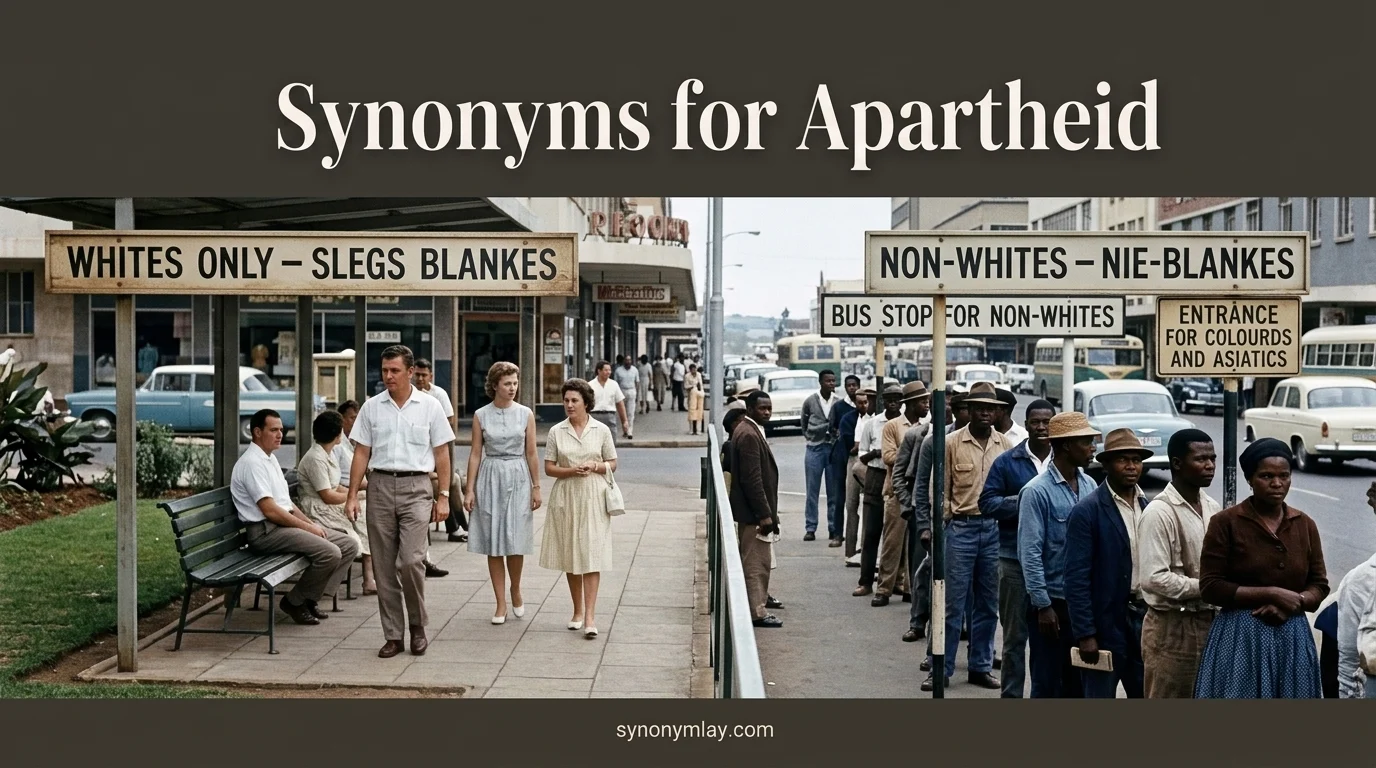
When looking for synonyms for apartheid, it is important to understand that apartheid is a specific historical and political system, not simply a general word for unfair treatment. The term is strongly associated with the former system of institutionalized racial segregation and discrimination in South Africa.
Writers, students, and ESL learners may search for alternative words because they want to avoid repetition, explain the concept in simpler language, or choose a term that fits a particular context. However, many alternatives are only related terms, rather than exact synonyms. Understanding these differences helps you write accurately and respectfully.
This guide explains the meaning of apartheid, provides useful related terms, and shows when each expression works best. It also includes a separate vocabulary section explaining demure and 30 synonyms for that word, as requested.
What Does Apartheid Mean?
Apartheid was a system of institutionalized racial segregation and discrimination that existed in South Africa, particularly under the National Party government from 1948 until the early 1990s.
Under apartheid, laws separated people according to racial classifications and restricted where people could live, work, study, travel, and participate in political life. The system gave significant political and social privileges to the white minority while discriminating against Black South Africans and other racial groups.
The word apartheid comes from Afrikaans and means approximately “apartness” or “separateness.”
Because apartheid describes a particular historical system, replacing it with an ordinary synonym can sometimes weaken the meaning. In many cases, phrases such as racial segregation, institutionalized discrimination, or racial oppression are more appropriate depending on the context.
30 Synonyms and Related Terms for Apartheid
The following terms are useful alternatives or closely related expressions. They are not all exact dictionary synonyms, so context matters.
1. Racial Segregation
Meaning: Separating people into different groups based on race.
Example: Racial segregation restricted where different communities could live and study.
Best usage context: Use this when describing legally or socially enforced racial separation.
2. Institutionalized Racism
Meaning: Racism built into the rules, policies, or institutions of society.
Example: The country struggled with the effects of institutionalized racism for decades.
Best usage context: Useful when focusing on discrimination embedded in institutions.
3. Racial Discrimination
Meaning: Treating people unfairly because of their race.
Example: Laws enforcing racial discrimination affected employment and education.
Best usage context: A broad term suitable for academic and general writing.
4. Racial Oppression
Meaning: Systematic control or mistreatment of people because of their race.
Example: The movement challenged decades of racial oppression.
Best usage context: Appropriate when emphasizing power, control, and suffering.
5. Systemic Racism
Meaning: Racism that operates through systems, institutions, or established practices.
Example: Researchers examined the lasting effects of systemic racism.
Best usage context: Useful in modern academic and social discussions.
6. Institutional Segregation
Meaning: Separation between groups that is established or supported by institutions.
Example: Institutional segregation affected schools, neighborhoods, and public facilities.
Best usage context: Good for formal or historical writing.
7. Racial Apartness
Meaning: The enforced separation of people according to race.
Example: The policy promoted racial apartness throughout society.
Best usage context: Useful when explaining the literal idea behind apartheid.
8. Legal Segregation
Meaning: Separation between groups required by law.
Example: Legal segregation created unequal opportunities for different communities.
Best usage context: Best when discussing discriminatory laws.
9. Racial Separation
Meaning: Keeping people from different racial groups separate.
Example: Racial separation influenced housing and education.
Best usage context: Simple and ESL-friendly wording.
10. Discriminatory System
Meaning: A system that treats certain people unfairly.
Example: Apartheid was a discriminatory system based heavily on racial classification.
Best usage context: Useful when explaining apartheid to beginners.
11. Racial Inequality
Meaning: Unequal treatment, opportunities, or outcomes among racial groups.
Example: The end of apartheid did not immediately remove every form of racial inequality.
Best usage context: Good for discussing consequences and long-term effects.
12. Racial Domination
Meaning: Control of one racial group by another.
Example: The movement opposed a system of racial domination.
Best usage context: Use when emphasizing political power and control.
13. Systematic Discrimination
Meaning: Unfair treatment that happens according to an organized or repeated system.
Example: Systematic discrimination affected access to education and employment.
Best usage context: Suitable for academic and explanatory writing.
14. Institutional Discrimination
Meaning: Discrimination created or maintained by institutions.
Example: Institutional discrimination can remain influential even after laws change.
Best usage context: Useful in sociology, history, and political discussions.
15. Racial Subjugation
Meaning: Keeping a racial group under the control or authority of another group.
Example: The struggle was aimed at ending racial subjugation.
Best usage context: Strong formal term for historical or political writing.
16. Racial Oppression System
Meaning: An organized system that restricts and disadvantages people because of race.
Example: Activists worked for decades against the racial oppression system.
Best usage context: Useful when emphasizing systematic injustice.
17. Segregationist Policy
Meaning: A policy designed to separate groups, especially racial groups.
Example: Segregationist policies shaped many aspects of daily life.
Best usage context: Best for discussing specific government policies.
18. Segregationist Regime
Meaning: A government or political system that enforces segregation.
Example: The segregationist regime faced growing domestic and international opposition.
Best usage context: Appropriate for historical and political writing.
19. Racial Hierarchy
Meaning: A social or political structure that ranks racial groups unequally.
Example: The system established a racial hierarchy with unequal rights.
Best usage context: Useful when discussing unequal status and privilege.
20. Racial Exclusion
Meaning: Preventing people from participating fully because of their race.
Example: Racial exclusion limited access to political institutions.
Best usage context: Good when focusing on exclusion from society or government.
21. Social Segregation
Meaning: Separation of groups within society.
Example: Social segregation influenced neighborhoods and schools.
Best usage context: Useful when discussing broader social separation.
22. Enforced Segregation
Meaning: Separation that is imposed through authority, rules, or laws.
Example: Enforced segregation affected where people could live and travel.
Best usage context: Strong alternative when emphasizing compulsory separation.
23. Racialized Oppression
Meaning: Oppression directed at people based on racial identity or classification.
Example: The history of racialized oppression shaped later social debates.
Best usage context: More suitable for academic and sociological writing.
24. Discriminatory Governance
Meaning: Government that uses policies or laws that unfairly disadvantage certain groups.
Example: Discriminatory governance can create long-lasting social divisions.
Best usage context: Useful in political and academic discussions.
25. Racial Authoritarianism
Meaning: Authoritarian political control organized around racial distinctions.
Example: Scholars have examined the political structure of racial authoritarianism.
Best usage context: Best for advanced historical or political analysis.
26. Race-Based Segregation
Meaning: Separation of people specifically according to race.
Example: Race-based segregation shaped access to public services.
Best usage context: Clear and direct wording for educational content.
27. Systematic Racial Inequality
Meaning: Persistent racial inequality produced by social or institutional systems.
Example: The country continued addressing systematic racial inequality after political reforms.
Best usage context: Useful when discussing long-term consequences.
28. Racialized Social System
Meaning: A social structure in which race strongly influences rights, status, or opportunities.
Example: The old racialized social system affected several generations.
Best usage context: Appropriate for academic analysis.
29. Racial Discriminatory Regime
Meaning: A governing system that systematically discriminates according to race.
Example: The racial discriminatory regime eventually faced major political change.
Best usage context: Useful in formal historical writing.
30. Institutionalized Racial Segregation
Meaning: Racial separation that is established and maintained through institutions and laws.
Example: Apartheid represented an extreme form of institutionalized racial segregation.
Best usage context: One of the clearest formal descriptions of apartheid.
Apartheid vs. Its Related Terms
Not every alternative has exactly the same meaning as apartheid. Choosing the right expression depends on what you are trying to emphasize.
| Term | Main Focus | Tone | Best Use |
|---|---|---|---|
| Apartheid | Specific historical system | Historical/formal | South African history |
| Racial segregation | Separation by race | Neutral/formal | General explanation |
| Institutionalized racism | Racism within institutions | Academic | Social analysis |
| Racial discrimination | Unfair racial treatment | Broad | General writing |
| Racial oppression | Control and mistreatment | Strong | Historical/social analysis |
| Systemic racism | Racism within systems | Modern/academic | Contemporary discussions |
| Legal segregation | Separation enforced by law | Formal | Legal history |
| Racial inequality | Unequal outcomes or opportunities | Neutral | Social analysis |
| Racial domination | Control by one racial group | Strong/formal | Political history |
| Institutional discrimination | Institutional unfairness | Academic | Sociology and research |
Is “Racial Segregation” an Exact Synonym for Apartheid?
Not exactly.
Racial segregation is a broader concept. It can describe many situations in which racial groups are separated. Apartheid, however, refers specifically to the South African system and, more broadly, can describe systems modeled on or resembling that system.
Therefore, if you are writing about South African history, apartheid is usually the most precise word.
Is “Racism” a Synonym for Apartheid?
No.
Racism is a broader concept involving prejudice, discrimination, or beliefs based on race. Apartheid was a particular political and legal system that institutionalized racial separation and unequal treatment.
You can describe apartheid as a system based on institutionalized racism, but the two terms should not automatically be treated as interchangeable.
How to Choose the Right Alternative to Apartheid
For simple explanations
Choose:
- Racial segregation
- Racial separation
- Race-based segregation
- Discriminatory system
These expressions are easy for ESL learners and general readers to understand.
For academic writing
Choose:
- Institutionalized racism
- Systemic racism
- Institutional discrimination
- Systematic discrimination
- Racialized social system
These terms work well in essays, research papers, and social-science discussions.
For historical writing
Choose:
- Segregationist regime
- Enforced segregation
- Legal segregation
- Racial domination
- Institutionalized racial segregation
These phrases help explain how the historical system operated.
For stronger emotional or political emphasis
Choose:
- Racial oppression
- Racial subjugation
- Racial domination
- Racial exclusion
These terms emphasize injustice, control, and unequal power.
Common Mistakes When Using Synonyms for Apartheid
One common mistake is treating every related term as a perfect replacement. Apartheid has a very specific historical meaning, while terms such as racism, inequality, and segregation are much broader.
Another mistake is using a modern term without considering historical context. A phrase may accurately describe one aspect of apartheid without fully describing the entire system.
For precise writing, identify what you want to emphasize first: legal separation, institutional racism, political domination, racial inequality, or historical context.
What Does “Demure” Mean?
The word demure is unrelated to apartheid. It is included here because it was specifically requested in the original instructions.
Demure is an adjective describing someone who behaves in a quiet, modest, reserved, and somewhat shy way.
For example:
She gave a demure smile when everyone complimented her.
The word often describes someone’s appearance, manner, expression, or behavior. Depending on context, demure can suggest modesty and gentleness rather than simply being shy.
30 Synonyms for Demure
1. Modest
Meaning: Not showing off or attracting too much attention.
Example: She wore a modest dress to the formal event.
Best usage context: Clothing, behavior, and personality.
2. Reserved
Meaning: Quiet and not openly expressing feelings.
Example: He was reserved when meeting new people.
Best usage context: Personality and social behavior.
3. Shy
Meaning: Nervous or uncomfortable around other people.
Example: The shy student slowly joined the conversation.
Best usage context: General personality descriptions.
4. Bashful
Meaning: Easily embarrassed, especially when receiving attention.
Example: She became bashful after hearing the compliment.
Best usage context: Friendly or warm descriptions.
5. Quiet
Meaning: Not loud, outspoken, or highly expressive.
Example: She has a quiet and gentle personality.
Best usage context: Everyday English.
6. Unassuming
Meaning: Not trying to appear important or impressive.
Example: Despite his success, he remained unassuming.
Best usage context: Personality and behavior.
7. Retiring
Meaning: Avoiding attention and preferring a private life.
Example: Her retiring nature made public speaking difficult.
Best usage context: Formal descriptions of personality.
8. Gentle
Meaning: Calm, kind, and soft in manner.
Example: She had a gentle way of speaking.
Best usage context: Personality and behavior.
9. Mild
Meaning: Calm and not aggressive or extreme.
Example: He has a mild and pleasant personality.
Best usage context: Character descriptions.
10. Soft-Spoken
Meaning: Speaking quietly and gently.
Example: The soft-spoken teacher explained the lesson patiently.
Best usage context: Speech and personality.
11. Meek
Meaning: Quiet and unlikely to challenge others.
Example: He appeared meek during the discussion.
Best usage context: Character descriptions; sometimes slightly negative.
12. Subdued
Meaning: Quiet, restrained, or less energetic than usual.
Example: Her subdued expression suggested that something was wrong.
Best usage context: Mood, appearance, and behavior.
13. Coy
Meaning: Shy or pretending to be shy, often playfully.
Example: She gave him a coy smile.
Best usage context: Playful or romantic situations.
14. Unobtrusive
Meaning: Not attracting attention.
Example: She chose an unobtrusive style for the ceremony.
Best usage context: Appearance and behavior.
15. Proper
Meaning: Behaving according to accepted standards of politeness or respectability.
Example: Her proper manners impressed the guests.
Best usage context: Manners and formal settings.
16. Well-Mannered
Meaning: Polite and respectful.
Example: The well-mannered child thanked everyone.
Best usage context: Behavior and etiquette.
17. Polite
Meaning: Showing good manners and respect.
Example: She gave a polite response.
Best usage context: Everyday communication.
18. Dignified
Meaning: Calm, serious, and worthy of respect.
Example: She remained dignified throughout the ceremony.
Best usage context: Formal situations.
19. Composed
Meaning: Calm and in control of one’s emotions.
Example: She remained composed during the difficult conversation.
Best usage context: Emotional control and professional settings.
20. Restrained
Meaning: Controlled and not overly expressive.
Example: His restrained response surprised everyone.
Best usage context: Formal writing and emotional behavior.
21. Demurely Modest
Meaning: Quietly and deliberately modest.
Example: She demurely accepted the compliment.
Best usage context: Literary or descriptive writing.
22. Timid
Meaning: Lacking confidence and easily frightened or nervous.
Example: The timid puppy stayed close to its owner.
Best usage context: Personality; often stronger than demure.
23. Gentle-Mannered
Meaning: Having a calm and pleasant way of behaving.
Example: The gentle-mannered guest made everyone comfortable.
Best usage context: Descriptive writing.
24. Discreet
Meaning: Careful not to attract attention or reveal too much.
Example: She was discreet about her personal affairs.
Best usage context: Privacy and behavior.
25. Unpretentious
Meaning: Not trying to impress others.
Example: His unpretentious attitude made him approachable.
Best usage context: Personality and lifestyle.
26. Self-Effacing
Meaning: Avoiding praise or attention and making oneself seem less important.
Example: Her self-effacing humor made the interview enjoyable.
Best usage context: Personality and communication.
27. Modulated
Meaning: Controlled or carefully adjusted in tone or expression.
Example: She answered in a calm, modulated voice.
Best usage context: Speech and formal descriptions.
28. Calm
Meaning: Peaceful and not easily excited.
Example: She remained calm throughout the meeting.
Best usage context: Everyday English.
29. Unexpressive
Meaning: Showing very little emotion.
Example: His unexpressive face made his feelings difficult to understand.
Best usage context: Facial expressions and emotional behavior.
30. Unpretentious
Meaning: Simple and not designed to attract admiration.
Example: She preferred an unpretentious style.
Best usage context: Appearance, personality, and lifestyle.
Demure Synonyms: Quick Comparison
| Word | Main Meaning | Tone |
|---|---|---|
| Modest | Not showing off | Positive |
| Reserved | Not openly expressive | Neutral |
| Shy | Nervous socially | Neutral |
| Bashful | Easily embarrassed | Warm |
| Coy | Playfully shy | Playful |
| Dignified | Calm and respectable | Formal |
| Composed | Emotionally controlled | Positive |
| Timid | Lacking confidence | Slightly negative |
| Unassuming | Not seeking attention | Positive |
| Restrained | Controlled expression | Formal |
| Soft-spoken | Quiet manner of speaking | Positive |
| Discreet | Avoiding unwanted attention | Neutral |
How to Choose the Right Synonym for Demure
If you mean quiet and shy, use shy, bashful, or timid.
If you mean modest and respectable, choose modest, proper, or dignified.
If you mean quiet and emotionally controlled, use reserved, composed, or restrained.
If you mean playfully shy, coy is usually the best choice.
If you mean not seeking attention, try unassuming, unobtrusive, or unpretentious.cture.
FAQs:
What does demure mean in simple English?
Demure means quiet, modest, reserved, and sometimes shy in behavior or appearance.
Is demure a positive word?
Usually, yes. It often suggests modesty, gentleness, and good manners, although its meaning depends on context.
What is the best synonym for demure?
There is no single perfect synonym. Modest, reserved, and shy are among the most useful alternatives, depending on the intended meaning.
Is demure the same as shy?
Not exactly. Someone who is shy may feel nervous around others, while someone described as demure is usually quiet, modest, and restrained in manner.
Final Thoughts
Finding the right synonyms for apartheid requires more than replacing one word with another. Because apartheid describes a specific historical and political system, terms such as racial segregation, institutionalized racism, racial oppression, systemic discrimination, and racial domination each highlight different aspects of the concept.
For accurate writing, always consider the context before choosing an alternative. If you are discussing South African history, apartheid is generally the most precise term. If you are explaining a particular characteristic of the system, a more specific related expression may communicate the idea more clearly.
The word demure, meanwhile, belongs to a completely different area of vocabulary. Its closest alternatives include modest, reserved, shy, bashful, coy, composed, and unassuming, but each carries its own shade of meaning. Choosing the right synonym ultimately depends on the exact idea, tone, and audience you want your writing to convey.

I am Andre James, an experienced administrator passionate about language and clear communication. I manage SynonymLay to help readers discover accurate, useful synonyms and improve their vocabulary.