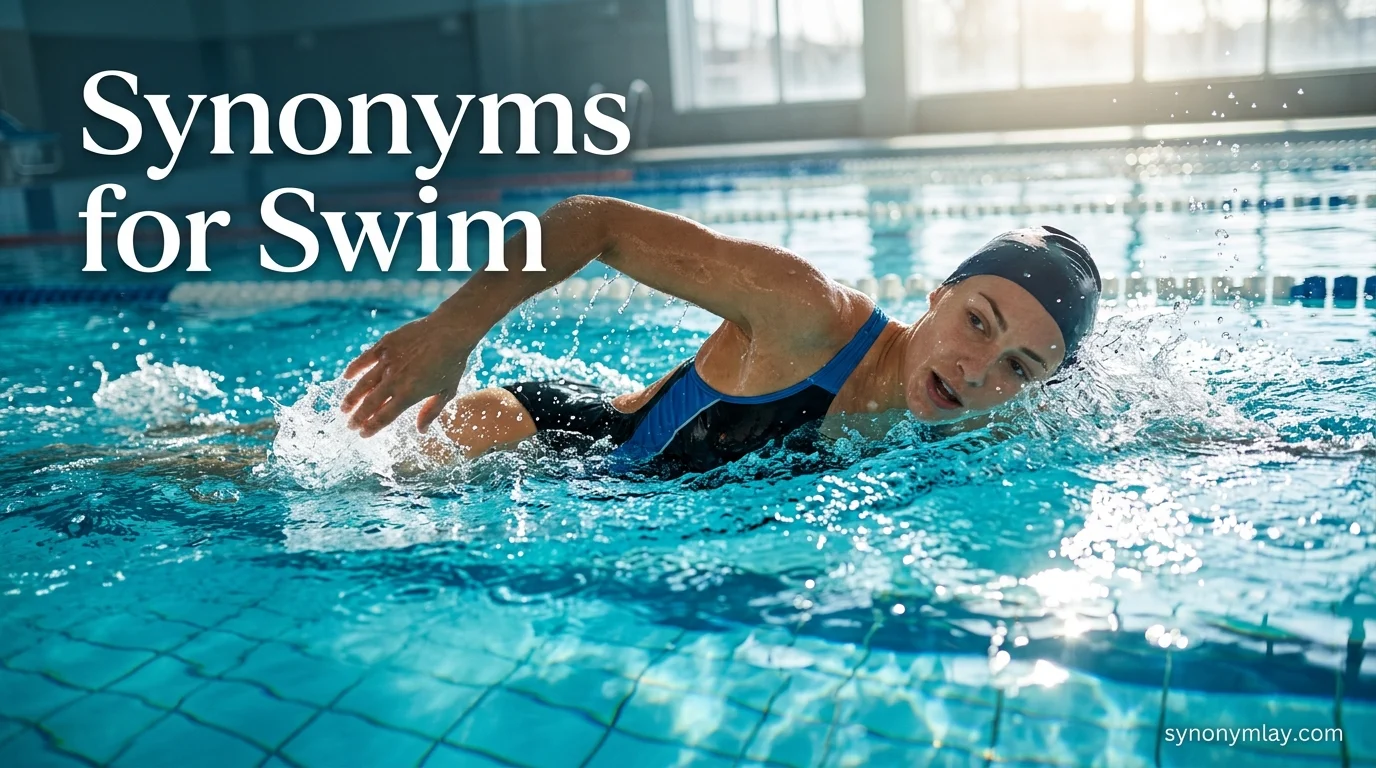
Finding the right synonyms for swim can make your writing more precise, natural, and interesting. While “swim” is the most common word for moving through water, English offers many alternatives that describe different movements, styles, speeds, and situations.
For students, ESL learners, writers, and content creators, learning these alternatives is especially useful. Words such as paddle, float, dive, glide, and wade may be related to swimming, but they do not always mean exactly the same thing. Choosing the right word helps readers understand precisely what is happening.
What Does “Swim” Mean?
Swim means to move through water by using your arms, legs, or body. It can describe recreational swimming, competitive swimming, survival, or simply moving through water.
For example:
- She loves to swim in the ocean.
- The children swam across the pool.
The word can also be used figuratively. For example, someone may say, “My head is swimming with ideas,” meaning they have many thoughts at once.
30 Synonyms for Swim
Here are useful alternatives to “swim,” with simple meanings, examples, and guidance about when each word works best.
1. Paddle
Meaning: To move through water using your hands, feet, or a paddle.
Example: The children paddled around in the shallow pool.
Best usage context: Casual swimming or slow movement in water.
2. Float
Meaning: To stay or move gently on the surface of water without sinking.
Example: She floated peacefully on her back.
Best usage context: When describing staying on top of water.
3. Glide
Meaning: To move smoothly and quietly through water.
Example: The swimmer glided effortlessly across the pool.
Best usage context: Elegant, smooth, or controlled swimming.
4. Dive
Meaning: To jump or move headfirst into water.
Example: He dived into the lake from the dock.
Best usage context: Entering water quickly or moving underwater.
5. Wade
Meaning: To walk through relatively shallow water.
Example: We waded through the stream to reach the other side.
Best usage context: Shallow water where your feet can touch the bottom.
6. Bathe
Meaning: To wash or spend time in water.
Example: They bathed in the warm river during the afternoon.
Best usage context: Traditional or literary descriptions of being in water.
7. Splash
Meaning: To move through water while causing water to scatter.
Example: The children splashed happily in the pool.
Best usage context: Playful or energetic movement.
8. Frolic
Meaning: To play or move energetically in a happy way.
Example: The kids frolicked in the shallow water.
Best usage context: Playful descriptions, especially for children or animals.
9. Plunge
Meaning: To enter water suddenly and forcefully.
Example: He plunged into the cold water without hesitation.
Best usage context: Sudden or dramatic entry into water.
10. Submerge
Meaning: To put or move completely under water.
Example: She submerged herself beneath the surface.
Best usage context: Underwater movement or complete immersion.
11. Dive into
Meaning: To enter water quickly, usually headfirst.
Example: The athlete dived into the pool at the starting signal.
Best usage context: Sports and dramatic water entry.
12. Breaststroke
Meaning: A swimming style in which the arms and legs move in a particular symmetrical pattern.
Example: She used the breaststroke to conserve energy.
Best usage context: Competitive or instructional swimming.
13. Backstroke
Meaning: A swimming style performed while lying on your back.
Example: He practiced backstroke for the upcoming competition.
Best usage context: Swimming lessons and competitive sports.
14. Freestyle
Meaning: A swimming style commonly associated with the front crawl.
Example: She won the freestyle race.
Best usage context: Competitive swimming.
15. Tread water
Meaning: To remain upright in water by continuously moving your arms and legs.
Example: The lifeguard taught us how to tread water.
Best usage context: Survival swimming or staying in one place.
16. Dog-paddle
Meaning: To swim using short movements of the hands and legs similar to a dog’s movements.
Example: The young child dog-paddled toward her mother.
Best usage context: Beginners and informal descriptions.
17. Crawl
Meaning: To swim using alternating arm movements while kicking the legs.
Example: He crawled quickly toward the finish line.
Best usage context: Informal descriptions of front-crawl swimming.
18. Stroke
Meaning: To swim using a particular arm-and-leg technique.
Example: She stroked steadily toward the shore.
Best usage context: Swimming technique or sports writing.
19. Row
Meaning: To move across water using oars.
Example: They rowed across the quiet lake.
Best usage context: Boat travel rather than body swimming.
20. Sail
Meaning: To travel across water, usually using a boat and wind.
Example: They sailed across the bay before sunset.
Best usage context: Water travel by boat.
21. Drift
Meaning: To move slowly with the current or without a clear direction.
Example: The swimmer drifted gently toward the shore.
Best usage context: Slow, relaxed, or uncontrolled movement.
22. Cruise
Meaning: To move smoothly and comfortably through water.
Example: The swimmer cruised toward the other end of the pool.
Best usage context: Casual descriptions of easy movement.
23. Propel
Meaning: To push or drive yourself forward.
Example: Strong kicks propelled him through the water.
Best usage context: Technical or descriptive writing.
24. Navigate
Meaning: To find and follow a route through an area.
Example: The swimmer navigated the strong river current carefully.
Best usage context: Open-water swimming or challenging conditions.
25. Aquaplane
Meaning: To move across water on a board or similar device.
Example: They aquaplaned across the lake during the vacation.
Best usage context: Water sports.
26. Dive beneath
Meaning: To move downward under the surface of water.
Example: The swimmer dived beneath the waves to retrieve the ball.
Best usage context: Underwater actions.
27. Bob
Meaning: To move gently up and down in water.
Example: The swimmer bobbed in the waves near the shore.
Best usage context: Gentle movement at the water’s surface.
28. Splash around
Meaning: To play or move energetically in water.
Example: The children splashed around in the shallow end.
Best usage context: Informal and playful situations.
29. Make one’s way through the water
Meaning: To move through water, usually with some effort.
Example: The hikers made their way through the river.
Best usage context: Descriptive writing where the exact swimming style is unimportant.
30. Move through the water
Meaning: A general expression for traveling through water.
Example: The dolphin moved gracefully through the water.
Best usage context: Neutral descriptions when you do not need a specific swimming technique.
Quick Comparison: Which Synonym Should You Use?
| Word | Main idea | Best context |
|---|---|---|
| Swim | General movement through water | Everyday use |
| Paddle | Slow movement using hands or feet | Casual swimming |
| Float | Stay on the surface | Relaxing |
| Glide | Smooth movement | Elegant swimming |
| Dive | Enter or move into water | Sports and recreation |
| Wade | Walk through shallow water | Rivers and beaches |
| Splash | Playful movement | Children and casual situations |
| Tread water | Stay in one place | Survival swimming |
| Drift | Move with the water | Gentle or uncontrolled movement |
| Stroke | Use a swimming technique | Sports and training |
| Submerge | Go completely underwater | Underwater actions |
| Plunge | Enter suddenly | Dramatic situations |
How to Choose the Right Synonym for Swim
The best synonym depends on what the person or animal is actually doing in the water.
For General Swimming
Use:
- Swim
- Move through the water
- Navigate
These are useful when you do not need to describe a particular technique.
For Slow or Relaxed Movement
Use:
- Float
- Drift
- Paddle
- Glide
- Bob
These words suggest gentle or controlled movement.
For Fast or Dramatic Movement
Use:
- Dive
- Plunge
- Propel
- Crawl
These words are stronger and create a more energetic image.
For Shallow Water
Use:
- Wade
- Paddle
- Splash around
These are more accurate when someone is not actually swimming.
For Competitive Swimming
Use:
- Stroke
- Freestyle
- Breaststroke
- Backstroke
- Crawl
These terms are particularly useful when discussing swimming techniques and competitions.
Swim Synonyms for Different Writing Styles
Casual Writing
In everyday conversation, swim, paddle, float, and splash around sound natural.
Example: We spent the afternoon swimming and splashing around.
Descriptive Writing
For creative writing, glide, drift, bob, and cruise can create a stronger mental picture.
Example: She glided across the moonlit water.
Academic or Technical Writing
Use more precise terms such as propel, stroke, submerge, and navigate.
Example: The swimmer used powerful leg movements to propel himself forward.
Sports Writing
Words such as freestyle, backstroke, breaststroke, crawl, and stroke are more appropriate.
Example: The athlete used a powerful freestyle stroke during the final lap.
Synonyms for Swim in Figurative English
“Swim” does not always refer to physical movement through water.
For example, “my mind is swimming with ideas” means that someone has many thoughts.
Other expressions include:
- Swim in money — have a very large amount of money
- Swim with the tide — follow the prevailing trend
- Swim against the tide — resist a common trend
- Swim in information — be surrounded by a large amount of information
These expressions are useful because they show how the word “swim” can have meanings beyond physical activity.
Is “Float” a Synonym for Swim?
Not exactly.
Float means to remain on or move across the surface of water without sinking. A person can float without actively swimming.
For example:
She floated peacefully on her back.
This sentence does not necessarily mean that she was swimming.
Is “Wade” a Synonym for Swim?
Wade is related to swimming but has a different meaning.
When you wade, you walk through water while your feet remain on the bottom. The water is usually shallow enough to stand in.
Example:
We waded across the shallow stream.
If the water is too deep to walk through, swim is usually the better word.
Is “Dive” the Same as Swim?
No. Dive usually describes entering water headfirst or moving beneath the surface.
Someone can dive and then swim, but diving itself is a specific action.
Example:
He dived into the pool and swam toward the other side.
Common Mistakes When Using Swim Synonyms
One common mistake is treating every water-related word as a perfect replacement for “swim.” Many alternatives describe only one part of the action.
For example, float does not necessarily involve active movement. Wade means walking through shallow water. Dive normally describes entering or going beneath water.
Another mistake is using technical swimming terms in casual situations. Saying someone used a “breaststroke” is appropriate when discussing technique, but simply saying they “swam across the pool” may sound more natural in everyday conversation.
Synonyms for “Swim” for ESL Learners
If English is your second language, start with the most common alternatives:
- Swim
- Paddle
- Float
- Dive
- Wade
- Splash
- Glide
- Drift
- Tread water
- Submerge
Once these words are comfortable, you can learn more specialized terms such as freestyle, backstroke, breaststroke, and propel.
A Note About “Demure”
The supplied topic combines “synonyms for swim” with a separate requirement about “demure.” These are unrelated vocabulary topics, so they should normally be treated as separate articles for the clearest search intent.
For completeness, demure means quiet, modest, reserved, and somewhat shy in behavior or appearance. It is often used to describe someone who behaves in a calm, modest, or restrained way.
For example:
She gave a demure smile during the introduction.
The tone of demure is generally positive or neutral, although the exact feeling can depend on context. It is more common in descriptions of personality, appearance, manners, or behavior than in casual conversation.
30 Synonyms of Demure
| Word | Simple meaning | Example | Best usage |
|---|---|---|---|
| Modest | Not showing off | She wore a modest outfit. | Appearance or behavior |
| Reserved | Quiet and not overly expressive | He is reserved around strangers. | Personality |
| Shy | Nervous around others | The shy student spoke softly. | Personality |
| Bashful | Easily embarrassed or shy | She became bashful after the compliment. | Friendly descriptions |
| Quiet | Making little noise or showing little expression | He is quiet in class. | General behavior |
| Retiring | Avoiding attention | She had a retiring personality. | Formal writing |
| Unassuming | Not trying to appear important | He was friendly and unassuming. | Personality |
| Restrained | Controlled and not excessive | Her response was restrained. | Behavior or emotion |
| Mild | Gentle and not forceful | She has a mild personality. | Character |
| Gentle | Kind and soft in manner | He has a gentle nature. | Personality |
| Meek | Quiet and not assertive | The meek child rarely complained. | Formal or literary |
| Coy | Pretending to be shy or modest | She gave him a coy smile. | Playful or romantic |
| Proper | Behaving according to social expectations | She remained proper throughout the event. | Formal situations |
| Ladylike | Traditionally graceful and polite | Her manner was considered ladylike. | Traditional descriptions |
| Dignified | Calm and worthy of respect | She remained dignified under pressure. | Formal writing |
| Composed | Calm and in control | He stayed composed during the interview. | Professional situations |
| Self-effacing | Avoiding praise or attention | Her self-effacing nature made her approachable. | Personality |
| Discreet | Careful and not drawing attention | She was discreet about the matter. | Social situations |
| Unobtrusive | Not attracting attention | The decoration was simple and unobtrusive. | Appearance or behavior |
| Soft-spoken | Speaking quietly and gently | The teacher was soft-spoken. | Speech |
| Demure | Modest, quiet, and reserved | She gave a demure smile. | General description |
| Subdued | Quiet or restrained | He wore a subdued expression. | Mood or appearance |
| Serene | Peaceful and calm | Her serene manner reassured everyone. | Mood |
| Docile | Easy to manage or teach | The dog was gentle and docile. | Animals or behavior |
| Compliant | Willing to follow instructions | The child was cooperative and compliant. | Behavior |
| Timid | Lacking confidence | The timid student hesitated to answer. | Personality |
| Unassertive | Not strongly expressing opinions | He has an unassertive manner. | Personality |
| Polite | Showing good manners | She was polite to every guest. | Social behavior |
| Courteous | Respectful and considerate | He was courteous to the staff. | Formal interactions |
| Graceful | Elegant and smooth in manner | Her graceful movements attracted attention. | Appearance or movement |
Final Takeaway
The best synonyms for swim depend on the exact action you want to describe. Swim is the broad, everyday term, while paddle, float, glide, dive, wade, drift, and tread water provide more specific meanings.
For academic and sports writing, technical words such as stroke, freestyle, breaststroke, and backstroke can add precision. For creative writing, words such as glide, drift, and cruise can make descriptions more vivid.
The key is not to replace “swim” simply because another word looks similar. Choose the word that accurately describes the person’s movement, the water conditions, and the tone of your sentence. That small distinction can make your English clearer, more natural, and much more expressive.

I am Camila Marie, a passionate writer who loves exploring synonyms and making language simple, clear, and engaging. I enjoy helping readers discover better words and express their ideas confidently.