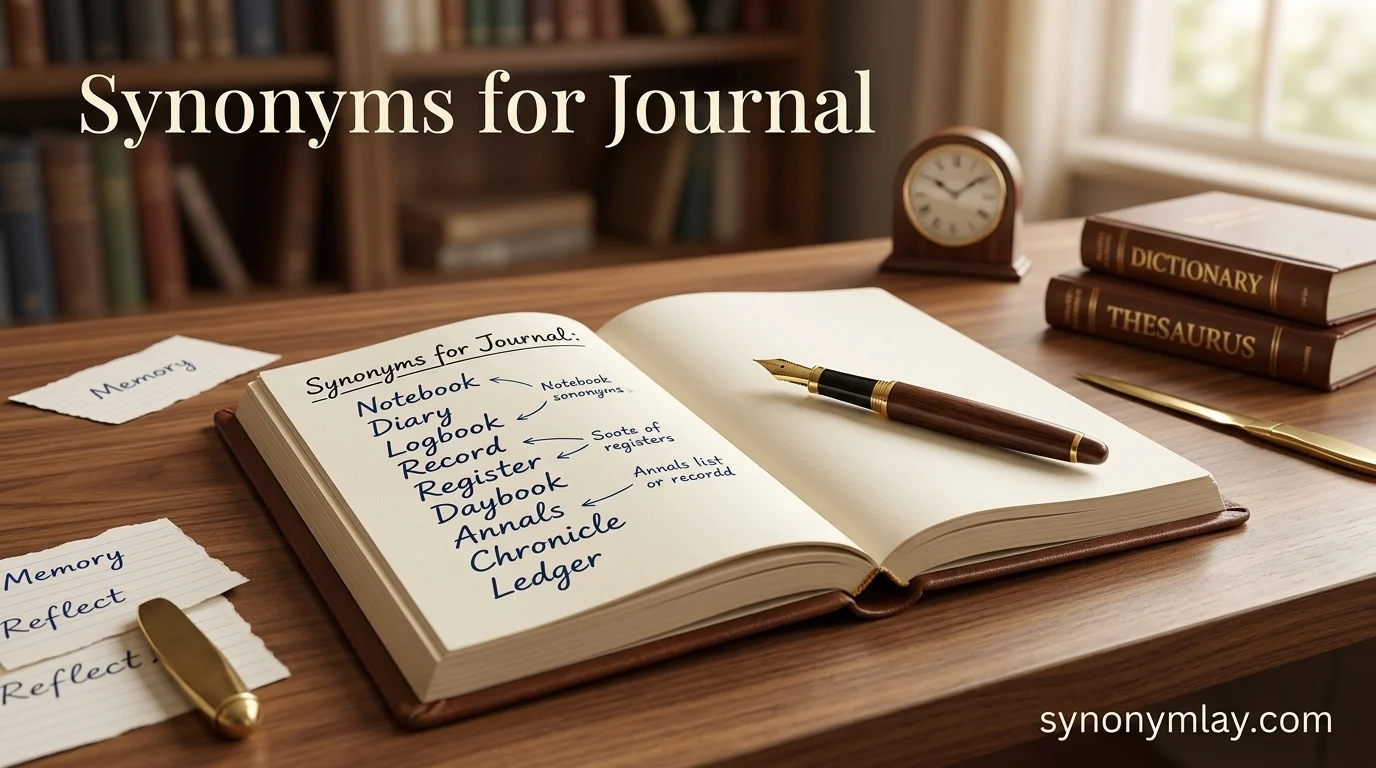
A journal can mean different things depending on context. It may be a personal diary where someone records thoughts and experiences, a daily record of events, or a scholarly publication containing research and academic articles. Because of these different meanings, the best synonym depends on how the word is being used.
Knowing synonyms for journal can help students, writers, researchers, and ESL learners choose more precise vocabulary. For example, diary works well for personal writing, while log is better for recording events, and periodical is more suitable for a regularly published magazine or academic publication.
Note: Your prompt mentions explaining “demure,” but the target keyword is “synonyms for journal.” To keep the article aligned with your actual SEO keyword and search intent, the explanations below focus on journal.
What Does “Journal” Mean?
A journal is a written record of thoughts, experiences, activities, observations, or information. A person may write in a journal every day to record personal experiences or feelings.
In academic and professional contexts, a journal can also refer to a publication containing research papers, studies, reviews, and expert discussions. The meaning changes according to the situation.
30 Synonyms for Journal
1. Diary
Meaning: A personal book or document where someone writes about daily experiences, thoughts, or feelings.
Example:
She writes in her diary every night before going to bed.
Best usage: Personal thoughts, emotions, and everyday experiences.
2. Log
Meaning: A written record of events, activities, or information over a period of time.
Example:
The engineer kept a detailed log of the machine’s performance.
Best usage: Work, travel, technical activities, and official records.
3. Record
Meaning: Information written down so it can be remembered or reviewed later.
Example:
The nurse made a record of the patient’s daily progress.
Best usage: General, professional, and official contexts.
4. Chronicle
Meaning: A detailed account of events arranged in the order they happened.
Example:
The book chronicles the family’s journey across several generations.
Best usage: Historical events and long-term accounts.
5. Notebook
Meaning: A book used for writing notes, ideas, observations, or information.
Example:
He kept a notebook filled with ideas for his next novel.
Best usage: General writing, study notes, and personal ideas.
6. Memoir
Meaning: A personal account of important experiences from someone’s life.
Example:
The author published a memoir about growing up in a small town.
Best usage: Life experiences and reflective personal writing.
7. Account
Meaning: A description or report of something that happened.
Example:
She gave an honest account of what happened during the meeting.
Best usage: Describing events or experiences.
8. Report
Meaning: A formal written description of information, findings, or events.
Example:
The researcher prepared a report about the study’s results.
Best usage: Academic, business, scientific, and professional writing.
9. Diary Book
Meaning: A book used to regularly record personal experiences and thoughts.
Example:
Her diary book contained memories from her school years.
Best usage: Personal and everyday writing.
10. Daybook
Meaning: A book in which daily activities or transactions are recorded.
Example:
The shopkeeper entered each transaction into the daybook.
Best usage: Business and daily record-keeping.
11. Register
Meaning: An official record containing names, details, or events.
Example:
The school maintains a register of student attendance.
Best usage: Official, administrative, and institutional records.
12. Ledger
Meaning: A book or system used to keep organized financial records.
Example:
The accountant checked the company’s ledger before preparing the report.
Best usage: Accounting and financial information.
13. Gazette
Meaning: A publication containing official or specialized information.
Example:
The announcement appeared in the government gazette.
Best usage: Government notices and official publications.
14. Periodical
Meaning: A publication released regularly, such as weekly, monthly, or quarterly.
Example:
She reads a scientific periodical to stay informed about new research.
Best usage: Academic, scientific, and professional publications.
15. Publication
Meaning: A printed or digital work made available to the public.
Example:
His research appeared in an international publication.
Best usage: Academic, professional, and general publishing.
16. Magazine
Meaning: A regularly published collection of articles, stories, photographs, or other content.
Example:
She found an interesting article in a travel magazine.
Best usage: General-interest publications.
17. Review
Meaning: A publication or article that examines and discusses a subject, work, or research.
Example:
The professor published a review of recent medical studies.
Best usage: Academic criticism, research, books, films, and products.
18. Bulletin
Meaning: A short publication containing news, announcements, or information.
Example:
The university released a monthly bulletin for students.
Best usage: Organizations, schools, institutions, and announcements.
19. Digest
Meaning: A collection or summary of important information from different sources.
Example:
The research digest summarizes important scientific discoveries.
Best usage: Summaries, research, news, and specialized information.
20. Periodical Publication
Meaning: Written material published repeatedly at regular intervals.
Example:
The university produces a periodical publication for its research community.
Best usage: Academic and professional contexts.
21. Manuscript
Meaning: An author’s original written work before or around the time it is published.
Example:
The researcher submitted the manuscript to an academic publisher.
Best usage: Books, research papers, and literary or academic writing.
22. Article
Meaning: A written piece that discusses a particular subject.
Example:
She wrote an article about climate change for the university journal.
Best usage: Newspapers, websites, magazines, and academic publications.
23. Paper
Meaning: A formal written piece, especially one presenting research or an argument.
Example:
The student submitted a research paper on environmental science.
Best usage: Academic and scientific writing.
24. Dissertation
Meaning: A long academic research work written for an advanced degree.
Example:
His dissertation examined the effects of social media on education.
Best usage: University-level research and graduate studies.
25. Research Publication
Meaning: A published work that presents research findings or academic analysis.
Example:
The scientist’s research publication received attention from other researchers.
Best usage: Scientific and academic contexts.
26. Personal Record
Meaning: A written account kept by an individual for personal reference or reflection.
Example:
She kept a personal record of her goals and achievements.
Best usage: Personal development and private documentation.
27. Journal Entry
Meaning: A single piece of writing added to a journal.
Example:
His first journal entry described his excitement about starting college.
Best usage: Personal diaries and regular journal writing.
28. Documentation
Meaning: Written information that provides evidence or details about something.
Example:
The researcher kept careful documentation of every experiment.
Best usage: Research, technical work, business, and official records.
29. Archive
Meaning: A collection of historical or preserved records and documents.
Example:
The university’s archive contains journals from the early twentieth century.
Best usage: Historical documents and preserved records.
30. Commentary
Meaning: Written discussion or explanation about a particular subject.
Example:
The journal published commentary on recent developments in education.
Best usage: Analysis, opinions, academic discussion, and professional writing.
Quick Comparison of Synonyms for Journal
| Synonym | Main Meaning | Best Context |
|---|---|---|
| Diary | Personal daily writing | Personal life |
| Log | Record of activities | Work and technical use |
| Record | Written information | General use |
| Chronicle | Detailed historical account | History |
| Notebook | Book for notes | Study and ideas |
| Memoir | Personal life experiences | Biography |
| Account | Description of events | General/professional |
| Report | Formal information | Business and research |
| Register | Official record | Institutions |
| Ledger | Financial record | Accounting |
| Periodical | Regular publication | Academic publishing |
| Magazine | General publication | Media |
| Bulletin | Short information publication | Organizations |
| Manuscript | Original written work | Publishing/research |
| Article | Individual written piece | Media and academia |
| Paper | Academic written work | Education/research |
| Dissertation | Advanced research work | University |
| Archive | Collection of records | History |
How to Choose the Right Synonym for “Journal”
The easiest way to select the right synonym is to first identify what journal means in your sentence.
For Personal Writing
Use:
- Diary
- Notebook
- Personal record
- Journal entry
These words work when someone is writing about feelings, memories, daily activities, or personal experiences.
Example:
Instead of saying, “I wrote in my journal,” you could say, “I wrote in my diary.”
For Daily or Activity Records
Use:
- Log
- Record
- Daybook
- Register
These are useful when information needs to be documented in an organized way.
Example:
A pilot may keep a log of flights, while a teacher may maintain a register of attendance.
For Historical Writing
Use:
- Chronicle
- Account
- Memoir
- Archive
These words are appropriate when discussing past events, memories, or preserved information.
Example:
“The book is a chronicle of the country’s development.”
For Academic Writing
Use:
- Paper
- Article
- Research publication
- Dissertation
- Periodical
These terms are more appropriate for university, scientific, and scholarly contexts.
Example:
“The researcher published a paper in an international academic journal.”
For Professional and Official Records
Use:
- Report
- Documentation
- Record
- Register
- Bulletin
These words are commonly used in workplaces, institutions, and organizations.
Journal Synonyms by Tone
| Tone | Useful Synonyms |
|---|---|
| Casual | Diary, notebook |
| Personal | Diary, memoir, personal record |
| Formal | Report, record, documentation |
| Academic | Paper, article, periodical |
| Historical | Chronicle, account, archive |
| Technical | Log, documentation, record |
| Financial | Ledger, daybook |
| Official | Register, bulletin, gazette |
Journal vs. Diary: Are They the Same?
Journal and diary are closely related, but they are not always interchangeable.
A diary usually focuses on a person’s daily experiences, feelings, and private thoughts. A journal can also contain personal writing, but it may be broader and include ideas, observations, goals, research notes, or creative thoughts.
For example:
Diary:
“I had a difficult day at school today.”
Journal:
“Today I learned an interesting lesson about how plants respond to sunlight.”
Both can be personal, but journal has a wider range of uses.
Journal vs. Log
A log usually focuses on recording activities, events, measurements, or progress. It is often more factual and structured than a personal journal.
For example:
- A journal may contain personal reflections.
- A log may contain exact details about what happened and when.
- A research journal may contain observations and ideas.
- A work log may document completed tasks.
Choosing between these words depends on whether the writing is reflective or primarily factual.
Journal vs. Periodical
These words can overlap in academic contexts, but they are not identical.
A journal often refers to a scholarly publication containing research articles. A periodical is a broader term for any publication that appears regularly.
Therefore, newspapers, magazines, newsletters, and journals can all be described as periodicals.
Common Mistakes When Using Journal Synonyms
One common mistake is assuming that every synonym can replace journal in every sentence. Context matters.
For example, replacing “journal” with ledger in a sentence about personal thoughts would sound incorrect because a ledger is primarily associated with financial records.
Similarly, diary would not normally replace journal when referring to an academic publication.
Another mistake is choosing a word simply because it looks similar. Good vocabulary depends on meaning, tone, and purpose—not just dictionary similarity.
FAQs:
What is the best synonym for journal?
Diary is one of the closest synonyms when journal means a personal record of thoughts and experiences. For academic writing, periodical, publication, or academic journal may be more appropriate.
What is another word for a personal journal?
Common alternatives include diary, notebook, personal record, and memoir, depending on the type of personal writing.
What is a synonym for journal in academic writing?
In academic contexts, useful related terms include periodical, publication, research publication, academic paper, and scholarly article.
Is “diary” the same as “journal”?
They can have the same meaning when referring to personal writing. However, journal can have additional meanings, including a research publication or a record of observations.
What is the difference between a journal and a log?
A journal often includes thoughts, observations, and reflections, while a log generally records activities, events, measurements, or progress in a structured way.
Conclusion
The best synonyms for journal depend on what you are trying to describe. Diary is useful for personal thoughts, log works for structured activity records, and chronicle suits historical accounts. In academic contexts, words such as periodical, publication, article, paper, and research publication can be more precise.
Understanding these differences helps you avoid repetitive vocabulary and communicate more clearly. Instead of replacing journal with any random similar word, consider the purpose, tone, and audience of your writing first. That small choice can make your English sound much more natural and accurate.

I am Marcus Thomas, a passionate word enthusiast and writer who enjoys exploring synonyms. I create clear, useful language resources that help readers improve vocabulary, writing, communication, and expression.