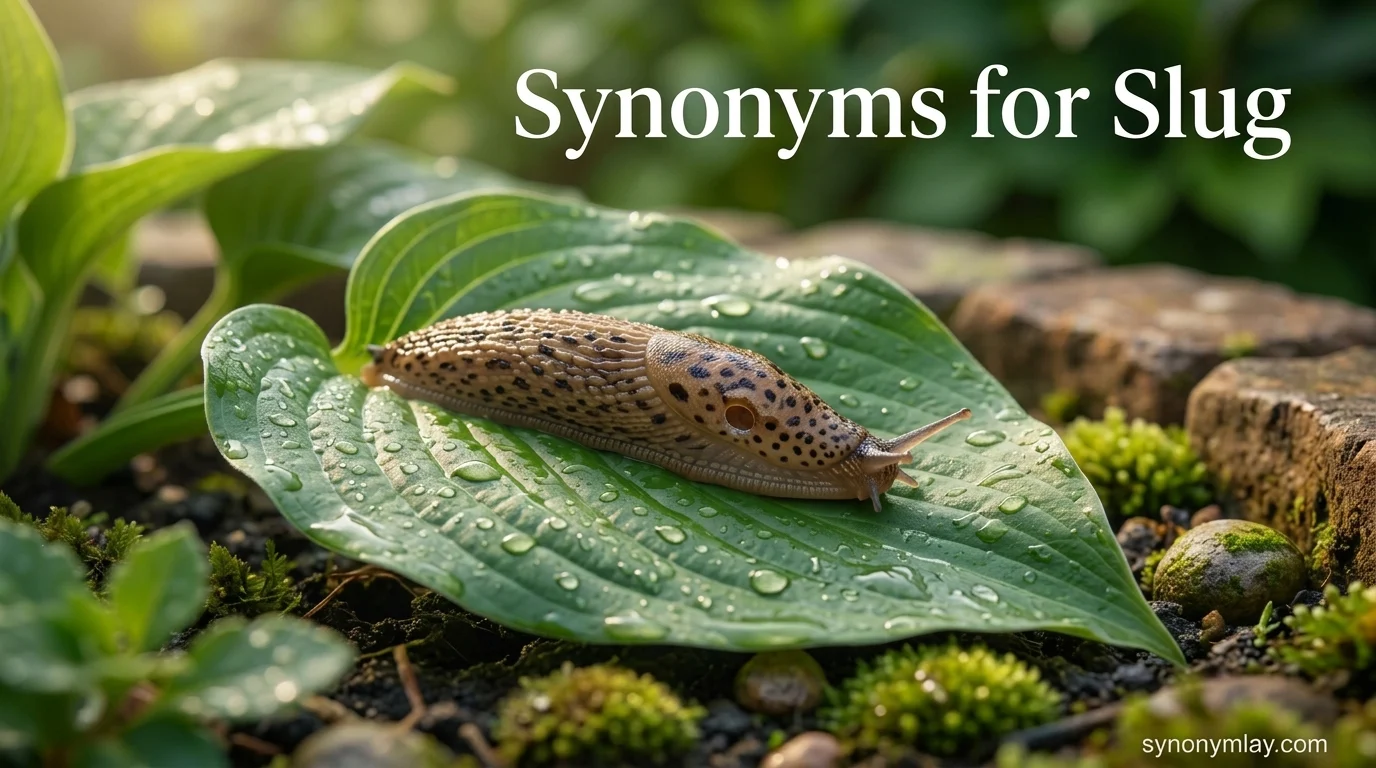
The word slug can have several meanings depending on the sentence. It may describe a slow-moving person, a hard punch, a soft-bodied garden creature, or even a heavy piece of metal. Because of these different meanings, finding the right synonym depends on what you actually want to say.
Learning synonyms for slug can make your writing more precise and interesting. Instead of repeating the same word, you can choose an alternative that clearly expresses movement, physical action, personality, or another intended meaning.
In this guide, you will find 30 useful alternatives to slug, explained in simple English. Each word includes an easy meaning, an example sentence, and a note about when it works best.
What Does “Slug” Mean?
Slug is a word with several meanings.
As a verb, to slug can mean to hit someone hard, usually with a punch. For example, “He slugged the ball” can also mean he hit a ball with considerable force.
As a noun, a slug can refer to a slow or lazy person, a hard punch, or a small soft-bodied creature similar to a snail but without a visible shell.
The correct synonym therefore depends heavily on context. A word that works for slug meaning “hit” will not necessarily work for slug meaning “slow person” or “garden creature.”
30 Synonyms for Slug
1. Punch
Meaning: A strong hit made with the hand or fist.
Example:
He threw a powerful punch during the fight.
Best usage: Use punch when slug means a physical blow.
2. Hit
Meaning: To strike someone or something.
Example:
The player hit the ball over the fence.
Best usage: A simple and common alternative for physical impact.
3. Strike
Meaning: To hit something or someone with force.
Example:
The boxer struck his opponent with his right hand.
Best usage: Useful in formal, sports, and action-related writing.
4. Smack
Meaning: To hit something or someone sharply.
Example:
The ball smacked against the wall.
Best usage: Good for informal writing and vivid descriptions.
5. Bash
Meaning: To hit something very hard.
Example:
He bashed the old door with a heavy tool.
Best usage: Use it when emphasizing a forceful or rough hit.
6. Wallop
Meaning: To hit very hard.
Example:
The boxer walloped his opponent with a powerful punch.
Best usage: Informal and expressive writing.
7. Whack
Meaning: To hit something with force.
Example:
She whacked the ball with the bat.
Best usage: Casual conversations and descriptions of strong hits.
8. Clobber
Meaning: To hit or defeat someone very badly.
Example:
The champion clobbered his opponent in the final round.
Best usage: Informal contexts, especially sports or fights.
9. Thump
Meaning: To hit heavily or repeatedly.
Example:
He thumped the table to make his point clear.
Best usage: Useful when the impact is heavy and noticeable.
10. Batter
Meaning: To hit repeatedly and forcefully.
Example:
The storm battered the coastline throughout the night.
Best usage: Good for repeated physical impact, including non-human subjects.
11. Pound
Meaning: To hit something again and again with force.
Example:
Rain pounded against the windows.
Best usage: Works well for repeated or intense impact.
12. Knock
Meaning: To strike or hit, often with less force than slug.
Example:
Someone knocked on the wooden door.
Best usage: A neutral and everyday alternative to some uses of hit.
13. Blow
Meaning: A forceful hit or strike.
Example:
The boxer landed a heavy blow.
Best usage: Useful as a noun when describing physical attacks.
14. Strikeout
Meaning: In baseball, a strikeout occurs when a batter fails to hit the required pitches.
Example:
The pitcher recorded another strikeout in the seventh inning.
Best usage: Use only in the specific baseball context.
15. Bash Up
Meaning: To hit or damage something badly.
Example:
The children accidentally bashed up the old furniture.
Best usage: Informal speech when describing considerable damage.
16. Slowpoke
Meaning: A person or animal that moves slowly.
Example:
Come on, slowpoke! Everyone else is already outside.
Best usage: Friendly or teasing descriptions of someone who is slow.
17. Slacker
Meaning: A person who avoids work or does less than expected.
Example:
The manager warned the slacker to finish his assignment.
Best usage: Use when slug suggests laziness rather than physical slowness.
18. Idler
Meaning: Someone who spends time doing little or no work.
Example:
The old story described him as an idler who avoided responsibility.
Best usage: More literary or formal than slacker.
19. Layabout
Meaning: A person who spends time relaxing instead of working.
Example:
His friends jokingly called him a lazy layabout.
Best usage: Informal descriptions of a lazy person.
20. Loafer
Meaning: Someone who avoids work or spends time being idle.
Example:
He was criticized as a loafer because he rarely helped around the house.
Best usage: Informal writing about laziness.
21. Lazybones
Meaning: A lazy person.
Example:
Get out of bed, lazybones!
Best usage: Friendly, humorous, or teasing language.
22. Sluggish Person
Meaning: Someone who moves or responds slowly.
Example:
The sluggish person took several minutes to finish the simple task.
Best usage: Useful when slug refers to slow behavior rather than laziness.
23. Mollusk
Meaning: A soft-bodied animal belonging to the mollusk group.
Example:
The slug is a terrestrial mollusk commonly found in damp gardens.
Best usage: Scientific or educational writing about the animal.
24. Gastropod
Meaning: A type of mollusk that includes slugs and snails.
Example:
A slug is a gastropod that typically lacks the external shell found on many snails.
Best usage: Biology, science, and academic contexts.
25. Snail
Meaning: A slow-moving mollusk, usually with a shell.
Example:
The snail moved slowly across the wet leaf.
Best usage: Only use this as a loose alternative when discussing similar slow-moving garden creatures; technically, a slug and snail are not identical.
26. Garden Pest
Meaning: An animal or insect that can damage plants in a garden.
Example:
The gardener used natural methods to protect the vegetables from garden pests.
Best usage: Gardening contexts where the focus is on damage to plants.
27. Creeper
Meaning: Something that moves slowly or close to the ground.
Example:
The little creeper moved slowly through the damp grass.
Best usage: Descriptive or informal writing, although it is broader than slug.
28. Lump
Meaning: An informal word for a heavy, inactive, or unenergetic person.
Example:
He sat on the sofa like a lump all afternoon.
Best usage: Informal descriptions of someone who is inactive.
29. Heavy Hitter
Meaning: A person or thing with considerable power or influence.
Example:
The company hired a heavy hitter to lead the negotiations.
Best usage: Figurative writing when discussing someone powerful or influential.
30. Projectile
Meaning: An object thrown or fired through the air.
Example:
The metal projectile traveled across the field at high speed.
Best usage: Technical or descriptive contexts where slug refers to a solid projectile.
Quick Comparison: Which Synonym Should You Use?
| Synonym | Main Meaning | Tone | Best Context |
|---|---|---|---|
| Punch | A strong hand hit | Neutral | Fighting |
| Hit | Strike something | Neutral | Everyday use |
| Strike | Hit forcefully | Formal | Sports/action |
| Smack | Sharp hit | Informal | Casual writing |
| Bash | Hit very hard | Informal | Damage/action |
| Wallop | Powerful hit | Informal | Sports/fighting |
| Whack | Forceful hit | Casual | Everyday speech |
| Clobber | Hit or defeat badly | Informal | Sports/fighting |
| Thump | Heavy hit | Neutral | Physical impact |
| Batter | Hit repeatedly | Neutral | Strong/repeated impact |
| Pound | Hit repeatedly | Neutral | Heavy impact |
| Slowpoke | Slow person | Informal | Friendly teasing |
| Slacker | Lazy worker | Informal | Work/school |
| Idler | Inactive person | Formal/literary | General writing |
| Layabout | Lazy person | Informal | Casual descriptions |
| Loafer | Person avoiding work | Informal | Everyday language |
| Lazybones | Lazy person | Playful | Friendly speech |
| Mollusk | Soft-bodied animal | Scientific | Biology |
| Gastropod | Animal classification | Scientific | Academic writing |
| Snail | Similar garden creature | Neutral | Nature/gardening |
| Garden pest | Plant-damaging creature | Neutral | Gardening |
| Heavy hitter | Powerful person | Figurative | Business/sports |
| Projectile | Object fired or thrown | Technical | Science/weapon terminology |
How to Choose the Right Synonym for “Slug”
Choosing among synonyms for slug becomes much easier when you first identify the meaning you want.
When “Slug” Means a Hard Hit
Choose words such as:
- Punch
- Strike
- Blow
- Wallop
- Whack
- Bash
- Smack
- Thump
These words are useful when describing physical impact, fighting, sports, or forceful movement.
For example, “He slugged him” can become “He punched him” if you want a straightforward description.
When “Slug” Means a Lazy Person
Choose:
- Slacker
- Idler
- Loafer
- Layabout
- Lazybones
- Lump
- Slowpoke
The best choice depends on whether you want to emphasize laziness, inactivity, or slow movement.
For example, slacker focuses more on avoiding work, while slowpoke focuses on moving slowly.
When “Slug” Refers to the Animal
Use scientific or descriptive alternatives such as:
- Mollusk
- Gastropod
- Garden pest
- Creeper
However, these words are not perfect replacements in every sentence. Slug is a specific animal, while mollusk and gastropod are broader biological classifications.
When “Slug” Has a Technical Meaning
In technical contexts, the appropriate alternative may depend on the subject.
For example, projectile can work when discussing a solid object fired through the air, but it is much broader than slug. Technical writing should therefore use the most precise term rather than replacing every occurrence of slug automatically.
Slug Synonyms by Tone
Casual and Conversational
For everyday conversations, these words can sound natural:
- Hit
- Whack
- Smack
- Bash
- Slowpoke
- Lazybones
- Slacker
Formal and Academic
For educational or professional writing, consider:
- Strike
- Blow
- Mollusk
- Gastropod
- Projectile
- Idler
These words can make your writing more precise when the context supports them.
Humorous or Playful
When you want a lighthearted tone, try:
- Lazybones
- Slowpoke
- Layabout
- Loafer
- Lump
These choices are especially useful when describing someone without sounding overly serious.
Strong or Dramatic
For a powerful physical action, consider:
- Wallop
- Clobber
- Bash
- Batter
- Pound
- Thump
These words create a stronger sense of force than the simple word hit.
Slug vs. Hit
Slug and hit can overlap when describing physical impact, but they do not always carry the same feeling.
Hit is a broad and neutral word. Slug often suggests a harder or more aggressive hit.
Example:
- He hit the punching bag.
- He slugged the punching bag with all his strength.
The second sentence creates a stronger impression of force.
Slug vs. Punch
A punch is specifically a hit made with a closed hand or fist.
Slug can describe a powerful punch, but it can also be used more broadly depending on the sentence.
Example:
- The boxer threw a punch.
- The boxer slugged his opponent.
Both sentences describe fighting, but punch names the specific action while slug emphasizes the forceful nature of the attack.
Slug vs. Slowpoke
These words are related when slug describes someone who is slow.
A slowpoke is someone who takes a long time to move or complete something. It is generally playful and informal.
Example:
“Come on, slowpoke! We are going to be late.”
This would not be appropriate in formal writing, where slow-moving person or another neutral description would be better.
Slug vs. Slacker
A slacker is someone who avoids work or does not make enough effort.
This is different from simply being slow.
For example, someone may work slowly but still be hardworking. Calling that person a slacker would change the meaning because it suggests a lack of effort.
Slug vs. Mollusk
When slug refers to the animal, mollusk is a broader scientific term.
Slugs belong to the mollusk group, but not every mollusk is a slug. Snails, clams, oysters, and squids are also mollusks.
Therefore, use mollusk when you are discussing biological classification rather than identifying the exact animal.
Common Mistakes When Using Slug Synonyms
One common mistake is treating every synonym as interchangeable. A synonym usually shares part of a meaning with another word, but the two words may differ in tone, strength, or context.
For example, punch, mollusk, and slacker cannot replace slug in the same sentence because they represent completely different meanings.
Another mistake is choosing an overly technical word when a simple word would be clearer. In everyday writing, hit may be more natural than strike.
It is also important to consider tone. Words such as clobber, wallop, and lazybones are informal, while gastropod is scientific.
Tips for Using “Slug” Naturally
First, look at the surrounding sentence and determine which meaning of slug is intended.
Second, consider your audience. Students and general readers may understand hit more easily than a specialized term.
Third, think about tone. A funny conversation may benefit from lazybones, while a science assignment should use terms such as mollusk or gastropod.
Finally, choose precision over unnecessary variety. A synonym should improve the sentence, not simply replace a word for the sake of avoiding repetition.
FAQs:
What is the best synonym for slug?
There is no single synonym that works in every situation because slug has several meanings. Punch, hit, slowpoke, slacker, mollusk, and gastropod may be appropriate depending on context.
What is a synonym for slug meaning hit?
Common alternatives include punch, strike, smack, bash, whack, wallop, clobber, thump, batter, and blow.
What is a synonym for slug meaning a lazy person?
Depending on the intended meaning, you can use slacker, idler, loafer, layabout, lazybones, lump, or slowpoke.
What is the scientific term for a slug?
A slug is a type of gastropod mollusk. The term mollusk is broader, while gastropod identifies the biological group that includes slugs and snails.
Is snail a synonym for slug?
Not exactly. Slugs and snails are closely related gastropods, but they are not identical. Most snails have a visible external shell, while slugs generally lack one.
Conclusion
The word slug has several meanings, so the right synonym depends on the context. If you mean a strong physical hit, words such as punch, strike, wallop, bash, whack, and blow can work well.
If you are describing a lazy or slow person, alternatives such as slacker, idler, loafer, slowpoke, and lazybones may be more suitable. When discussing the animal, mollusk and gastropod provide broader scientific descriptions.
The key is not simply to find a word that looks similar to slug. Instead, identify the exact meaning, tone, and situation first. Choosing the right synonym will make your writing clearer, more natural, and more precise.

I am Joel David, a passionate writer who loves exploring synonyms and helping readers discover clear, meaningful, and engaging word choices. I enjoy making language simple, useful, and interesting for everyone.