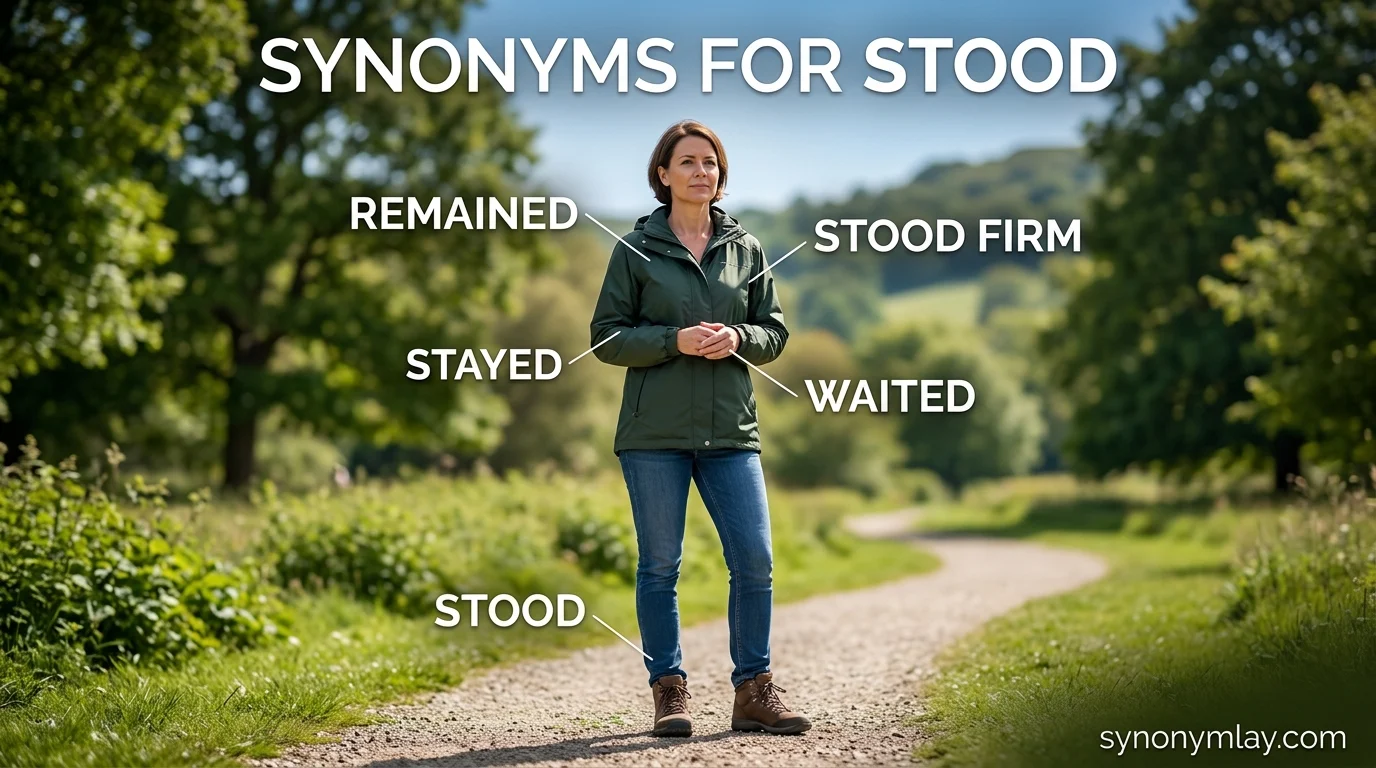
Finding the right synonyms for stood can make your writing clearer, more natural, and more expressive. The word “stood” is simple and common, but its best replacement depends heavily on what you mean. Someone can stand physically, remain in a place, tolerate a difficult situation, represent something, or stop moving.
For students, ESL learners, writers, and content creators, understanding these different meanings is especially useful. Instead of repeatedly writing “stood,” you can choose a more precise word such as remained, rose, endured, waited, positioned, faced, or tolerated.
This guide explains the most useful alternatives to “stood” in simple English. It also covers different tones, example sentences, usage contexts, and a separate explanation of demure, as requested.
What Does “Stood” Mean?
“Stood” is the past tense of stand. Its meaning changes according to the sentence.
For example:
- Physical position: She stood beside the door.
- Remaining somewhere: He stood there for an hour.
- Getting upright: She stood after sitting down.
- Tolerating something: I couldn’t stand the noise.
- Facing something: They stood against injustice.
- Representing something: The building stood as a symbol of hope.
Because “stood” has several meanings, there is no single synonym that works in every sentence.
Best Synonyms for Stood at a Glance
| Synonym | Best meaning | Example |
|---|---|---|
| Remained | Stayed in one place | She remained outside. |
| Rose | Got up | He rose from his chair. |
| Waited | Stayed until something happened | She waited by the door. |
| Stayed | Continued to be somewhere | They stayed near the entrance. |
| Positioned | Was placed somewhere | The statue was positioned near the gate. |
| Rested | Was supported by something | The ladder rested against the wall. |
| Endured | Tolerated difficulty | He endured the pain. |
| Tolerated | Put up with something | She tolerated the criticism. |
| Faced | Confronted something | They faced the challenge bravely. |
| Opposed | Resisted something | He opposed the unfair rule. |
1. Remained
Remained is one of the closest alternatives when “stood” means that someone continued to be in a particular place or condition.
Example:
She remained beside the window until sunset.
Best for: Formal, neutral, and descriptive writing.
2. Rose
Rose means moved from a sitting, lying, or lower position to an upright position.
Example:
He rose from his chair when the teacher entered.
Best for: Describing the action of getting up.
3. Stayed
Stayed works when someone continued to be in a particular location.
Example:
We stayed outside until the rain stopped.
Best for: Everyday conversation and informal writing.
4. Waited
Sometimes “stood” means someone stayed somewhere while expecting something.
Example:
She stood at the bus stop for twenty minutes.
This can become:
She waited at the bus stop for twenty minutes.
Best for: Situations involving expectation or delay.
5. Positioned
Positioned means placed or located in a particular place.
Example:
The guard stood near the entrance.
More formally:
The guard was positioned near the entrance.
Best for: Formal, technical, professional, or descriptive writing.
6. Stationed
Stationed means deliberately placed somewhere, usually for work, protection, or observation.
Example:
Two officers stood outside the building.
Alternative:
Two officers were stationed outside the building.
Best for: Police, military, security, and professional contexts.
7. Rested
Rested can describe something supported against or on another object.
Example:
The ladder stood against the wall.
Alternative:
The ladder rested against the wall.
Best for: Objects that are physically supported.
8. Loomed
Loomed describes something large or noticeable that appears prominently, sometimes in a threatening way.
Example:
A huge mountain stood above the village.
Alternative:
A huge mountain loomed above the village.
Best for: Dramatic or descriptive writing.
9. Towered
Towered means stood much higher than something or someone else.
Example:
The skyscraper stood above the surrounding buildings.
Alternative:
The skyscraper towered over the surrounding buildings.
Best for: Describing height and size.
10. Remained Upright
This phrase is useful when you specifically want to emphasize that someone or something did not fall.
Example:
Despite the strong wind, the tree remained upright.
Best for: Physical descriptions and factual writing.
11. Endured
Endured means continued through something difficult or painful.
Example:
She stood the pain for several hours.
A more natural alternative is:
She endured the pain for several hours.
Best for: Pain, hardship, pressure, or difficult experiences.
12. Tolerated
Tolerated means accepted something unpleasant without stopping it.
Example:
He couldn’t stand the constant noise.
Alternative:
He couldn’t tolerate the constant noise.
Best for: Annoying, unpleasant, or difficult situations.
13. Bore
“Bore” can replace “stood” when the meaning is endured or tolerated something.
Example:
She couldn’t stand the criticism.
Alternative:
She couldn’t bear the criticism.
Best for: Emotional or difficult experiences.
14. Faced
Faced means confronted a person, situation, challenge, or problem.
Example:
The team stood against a difficult opponent.
Depending on meaning:
The team faced a difficult opponent.
Best for: Challenges, conflicts, and difficult situations.
15. Confronted
Confronted means directly faced a problem, person, or difficult situation.
Example:
She stood before the committee and explained her decision.
In a different context:
She confronted the committee about the decision.
Best for: Serious or direct situations.
16. Opposed
Opposed means resisted or disagreed with something.
Example:
Many citizens stood against the proposal.
Alternative:
Many citizens opposed the proposal.
Best for: Arguments, policies, decisions, and disagreements.
17. Resisted
Resisted means refused to accept, obey, or give in to something.
Example:
The workers stood against the unfair policy.
Alternative:
The workers resisted the unfair policy.
Best for: Conflict, pressure, authority, or opposition.
18. Supported
Sometimes “stood by” means supported someone.
Example:
She stood by her friend during the difficult time.
Alternative:
She supported her friend during the difficult time.
Best for: Friendship, loyalty, and emotional support.
19. Defended
Defended means protected someone or something from criticism, attack, or harm.
Example:
He stood up for his colleague.
Alternative:
He defended his colleague.
Best for: Arguments, protection, and social situations.
20. Represented
“Stood for” can mean represented or symbolized something.
Example:
The initials stood for a longer phrase.
Alternative:
The initials represented a longer phrase.
Best for: Abbreviations, symbols, ideas, and meanings.
21. Symbolized
Symbolized means represented an idea or concept.
Example:
The monument stood for freedom.
Alternative:
The monument symbolized freedom.
Best for: Literature, history, art, and symbolic writing.
22. Signified
Signified means showed or represented a particular meaning.
Example:
The white flag stood for peace.
Alternative:
The white flag signified peace.
Best for: Formal and academic writing.
23. Indicated
Indicated means showed or suggested something.
Example:
The sign stood for a restricted area.
Depending on context:
The sign indicated a restricted area.
Best for: Signs, instructions, evidence, and factual writing.
24. Occupied
Occupied means took up a particular place or position.
Example:
A large statue stood in the center of the square.
Alternative:
A large statue occupied the center of the square.
Best for: Formal descriptions of places and spaces.
25. Existed
In some contexts, “stood” can describe something that was present or existed.
Example:
An old castle stood on the hill.
Alternative:
An old castle existed on the hill.
However, “existed” is less vivid.
Best for: Historical or factual writing.
26. Persisted
Persisted means continued despite difficulty or opposition.
Example:
The tradition stood for hundreds of years.
When emphasizing continuation:
The tradition persisted for hundreds of years.
Best for: Traditions, problems, beliefs, and situations that continue.
27. Survived
Survived means continued to exist despite danger, damage, or difficult circumstances.
Example:
The old building stood through several storms.
Alternative:
The old building survived several storms.
Best for: Buildings, traditions, people, organizations, and historical subjects.
28. Held Firm
Held firm means remained strong and did not move, collapse, or surrender.
Example:
The soldiers stood firm during the attack.
Alternative:
The soldiers held firm during the attack.
Best for: Determination, conflict, pressure, and difficult situations.
29. Waited Around
Waited around is an informal phrase for staying somewhere while waiting.
Example:
I stood around outside for an hour.
Alternative:
I waited around outside for an hour.
Best for: Casual conversations.
30. Stayed Put
Stayed put means remained in the same place.
Example:
He stood there until someone came to help.
Alternative:
He stayed put until someone came to help.
Best for: Informal speech and everyday situations.
Synonyms for “Stood” by Meaning
Choosing a synonym becomes easier when you first identify what “stood” means in your sentence.
When “stood” means remained
Use:
- remained
- stayed
- waited
- stayed put
- remained upright
Example:
She stood outside the room.
Better alternatives:
She remained outside the room.
She stayed outside the room.
When “stood” means got up
Use:
- rose
- got up
- arose
- lifted oneself
Example:
He stood from his chair.
Better:
He rose from his chair.
When “stood” means tolerated
Use:
- tolerated
- endured
- bore
- accepted
- put up with
Example:
I couldn’t stand the smell.
Better:
I couldn’t tolerate the smell.
When “stood” means opposed
Use:
- opposed
- resisted
- challenged
- confronted
- fought against
Example:
They stood against the new law.
Better:
They opposed the new law.
When “stood for” means represented
Use:
- represented
- symbolized
- signified
- indicated
- meant
Example:
The letters stood for a scientific term.
Better:
The letters represented a scientific term.
How to Choose the Right Synonym for Stood
The best synonym depends on meaning, tone, and context.
For simple everyday English
Choose:
- stayed
- waited
- remained
- got up
- stood still
These words are easy for ESL learners and work well in casual conversation.
For formal writing
Choose:
- remained
- positioned
- occupied
- indicated
- signified
- represented
These alternatives can make academic and professional writing more precise.
For emotional or difficult situations
Choose:
- endured
- tolerated
- resisted
- confronted
- faced
- persisted
These words communicate more than physical position.
For descriptive writing
Choose:
- towered
- loomed
- rested
- remained upright
- occupied
These words create a stronger visual image.
For opposition
Choose:
- opposed
- resisted
- challenged
- confronted
- defended
The exact word depends on whether the person is disagreeing, fighting back, or protecting something.
Is “Demure” a Synonym for Stood?
No. Demure is not a synonym for stood.
“Demure” is an adjective that describes someone who behaves in a quiet, modest, reserved, or shy way, often in a polite and controlled manner.
For example:
She gave a demure smile.
This means she gave a modest, quiet, or slightly shy smile.
“Demure” is commonly used to describe a person’s behavior, appearance, expression, or manner. It often suggests calmness, modesty, and restraint.
30 Synonyms and Related Words for Demure
Because “demure” has several shades of meaning, some of these words are close synonyms while others are related alternatives that fit particular contexts.
1. Modest
Meaning: Not overly proud, showy, or revealing.
Example: She wore a modest dress to the ceremony.
Best usage: Appearance, behavior, or personality.
2. Reserved
Meaning: Quiet and not very open with emotions.
Example: He was reserved when meeting new people.
Best usage: Personality and social behavior.
3. Shy
Meaning: Nervous or uncomfortable around other people.
Example: The shy girl smiled quietly.
Best usage: Social situations.
4. Bashful
Meaning: Easily embarrassed or shy.
Example: He gave a bashful smile.
Best usage: Friendly and gentle descriptions.
5. Retiring
Meaning: Avoiding attention and preferring a quiet life.
Example: She had a retiring personality.
Best usage: Formal descriptions of personality.
6. Unassuming
Meaning: Not trying to attract attention or appear important.
Example: Despite his success, he remained unassuming.
Best usage: Personality and character.
7. Meek
Meaning: Quiet, gentle, and unlikely to argue or fight.
Example: He was a meek and gentle child.
Best usage: Personality, though it can sometimes suggest weakness.
8. Quiet
Meaning: Not loud, talkative, or attention-seeking.
Example: She was quiet during the meeting.
Best usage: Everyday English.
9. Subdued
Meaning: Calm, restrained, or less energetic than usual.
Example: Her expression was subdued.
Best usage: Mood, behavior, voice, and appearance.
10. Restrained
Meaning: Controlled and not showing strong emotions.
Example: He gave a restrained response.
Best usage: Formal and professional writing.
11. Decorous
Meaning: Polite and behaving according to accepted standards.
Example: Her decorous behavior impressed the guests.
Best usage: Formal writing.
12. Proper
Meaning: Behaving appropriately and politely.
Example: She maintained a proper manner throughout dinner.
Best usage: Behavior and manners.
13. Ladylike
Meaning: Traditionally associated with polite, graceful, and modest behavior.
Example: She was praised for her ladylike manners.
Best usage: Traditional descriptions; use carefully because the term can sound old-fashioned.
14. Coy
Meaning: Shy or pretending to be shy, sometimes in a playful way.
Example: She gave him a coy smile.
Best usage: Playful or romantic contexts.
15. Timid
Meaning: Lacking confidence or easily frightened.
Example: The timid child stayed close to her mother.
Best usage: Personality and behavior.
16. Diffident
Meaning: Lacking confidence and being hesitant to speak or act.
Example: His diffident manner made him seem uncomfortable.
Best usage: Formal writing.
17. Self-effacing
Meaning: Avoiding praise or attention for yourself.
Example: She remained self-effacing despite her achievements.
Best usage: Humble personalities.
18. Unobtrusive
Meaning: Not attracting unwanted attention.
Example: He chose an unobtrusive seat near the back.
Best usage: People, objects, design, and behavior.
19. Mild
Meaning: Gentle and not aggressive or extreme.
Example: He had a mild and pleasant manner.
Best usage: Personality and behavior.
20. Gentle
Meaning: Kind, calm, and not harsh.
Example: She had a gentle personality.
Best usage: Positive descriptions.
21. Polite
Meaning: Showing good manners and respect.
Example: She was polite and considerate to everyone.
Best usage: Everyday and professional English.
22. Properly Behaved
Meaning: Acting in an acceptable and respectful way.
Example: The children were properly behaved during the ceremony.
Best usage: Formal or instructional contexts.
23. Prim
Meaning: Very proper, careful, and sometimes overly concerned with manners.
Example: She had a prim and carefully controlled manner.
Best usage: Descriptions that may carry a slightly critical tone.
24. Prudish
Meaning: Excessively concerned about what is considered proper or acceptable.
Example: His prudish attitude made the conversation uncomfortable.
Best usage: Critical descriptions; not always a positive synonym.
25. Unpretentious
Meaning: Simple and not trying to impress others.
Example: She had an unpretentious personality.
Best usage: Personality, lifestyle, and appearance.
26. Modest-Mannered
Meaning: Behaving quietly and without showing off.
Example: The modest-mannered student rarely sought attention.
Best usage: Descriptive writing.
27. Composed
Meaning: Calm and in control of one’s emotions.
Example: She remained composed during the interview.
Best usage: Professional and emotional situations.
28. Dignified
Meaning: Calm, respectable, and serious in behavior.
Example: She maintained a dignified manner throughout the ceremony.
Best usage: Formal and respectful descriptions.
29. Demure-Looking
Meaning: Having a quiet, modest, or reserved appearance.
Example: She chose a demure-looking outfit for the event.
Best usage: Appearance and fashion descriptions.
30. Unassertive
Meaning: Not forceful or strongly demanding attention.
Example: His unassertive manner made him easy to overlook.
Best usage: Personality and workplace descriptions.
Demure vs. Similar Words
| Word | Main idea | Tone |
|---|---|---|
| Demure | Quiet, modest, reserved | Usually positive/neutral |
| Shy | Uncomfortable or nervous socially | Neutral |
| Reserved | Emotionally private | Neutral |
| Modest | Not showy or boastful | Positive |
| Coy | Playfully shy | Sometimes flirtatious |
| Timid | Lacking confidence | Can be negative |
| Meek | Quiet and submissive | Can be negative |
| Composed | Calm and controlled | Positive |
| Dignified | Respectful and serious | Positive |
| Prudish | Excessively concerned with propriety | Often negative |
Common Mistakes When Replacing “Stood”
One common mistake is assuming every synonym can replace “stood” directly.
For example:
Incorrect: She endured beside the door.
Better: She remained beside the door.
“Endured” only works when “stood” means tolerated or survived something difficult.
Another mistake is using overly formal vocabulary in casual writing. Instead of saying:
He remained stationary while awaiting transportation.
A natural sentence would be:
He stood there waiting for the bus.
Good writing is not about choosing the most complicated synonym. It is about choosing the most accurate and natural word.
“Stood” in Different Common Phrases
Stood up
Usually means got to one’s feet.
Example:
She stood up when the teacher entered.
It can also mean someone failed to appear for an expected meeting or date.
Example:
He stood me up at the restaurant.
Stood by
Usually means supported someone or remained ready to act.
Example:
Her family stood by her during the crisis.
Stood for
Can mean represented or meant.
Example:
What does this abbreviation stand for?
Stood against
Means opposed or resisted.
Example:
They stood against corruption.
Stood out
Means was especially noticeable or impressive.
Example:
Her performance stood out from the others.
Stood still
Means remained motionless.
Example:
The child stood still for the photograph.
Quick Guide: Which Synonym Should You Use?
If you mean “stayed in a place,” use remained or stayed.
If you mean “got to your feet,” use rose.
If you mean “waited,” use waited.
If you mean “was placed somewhere,” use positioned or stationed.
If you mean “tolerated,” use endured, tolerated, or bore.
If you mean “faced a challenge,” use faced or confronted.
If you mean “opposed something,” use opposed or resisted.
If you mean “represented,” use represented, symbolized, or signified.
If you mean “was very tall,” use towered.
If you mean “appeared large or threatening,” use loomed.
Synonyms for Stood in Academic Writing
Academic writing usually benefits from precision rather than repetition.
Instead of:
The researchers stood by their original conclusion.
You might write:
The researchers maintained their original conclusion.
Instead of:
The evidence stood as proof of the theory.
You could write:
The evidence supported the theory.
The correct replacement depends on the intended meaning, not simply on finding a word that looks similar in a thesaurus.
Synonyms for Stood in Creative Writing
Creative writing gives you more freedom to use vivid alternatives.
Instead of:
The castle stood on the hill.
You could write:
The ancient castle loomed over the valley.
Instead of:
The trees stood around the house.
You could write:
The trees towered around the house.
Words such as loomed, towered, rested, remained, and surrounded can create stronger imagery when used correctly.
Synonyms for Stood in Everyday Conversation
For everyday speech, simple alternatives are usually best:
- stayed
- waited
- remained
- got up
- stood still
- stayed put
- hung around
For example:
I stood there waiting for you.
can become:
I waited there for you.
This sounds more natural when waiting is the actual meaning.
FAQs:
What is the best synonym for stood?
There is no single best synonym. Remained, stayed, rose, waited, endured, faced, positioned, and opposed can all replace “stood” in different contexts.
What is another word for stood up?
If you mean physically getting upright, rose or got up are common alternatives.
What is a synonym for stood still?
Useful alternatives include remained motionless, stayed still, remained stationary, and did not move.
What is a synonym for stood by?
Depending on context, supported, remained loyal to, waited, or remained ready may work.
Is demure a synonym for stood?
No. Demure is an adjective meaning modest, reserved, quiet, or shy in manner. It has a completely different meaning from “stood.”
What is the synonym of stood in “stood against”?
Words such as opposed, resisted, challenged, and fought against can work depending on the sentence.
Final Thought
The word “stood” looks simple, but it can communicate many different ideas. It may describe physical position, remaining somewhere, getting upright, tolerating something, opposing an idea, supporting someone, or representing something.
The most useful strategy is to identify the meaning first. Choose remained or stayed for location, rose for getting upright, waited for expectation, endured for hardship, opposed for disagreement, and represented or symbolized when something stands for an idea.
For ESL learners and writers, learning these distinctions is more valuable than memorizing a long list of interchangeable words. The right synonym should make your sentence clearer, more precise, and more natural.
I am Andre James, an experienced administrator passionate about language and clear communication. I manage SynonymLay to help readers discover accurate, useful synonyms and improve their vocabulary.