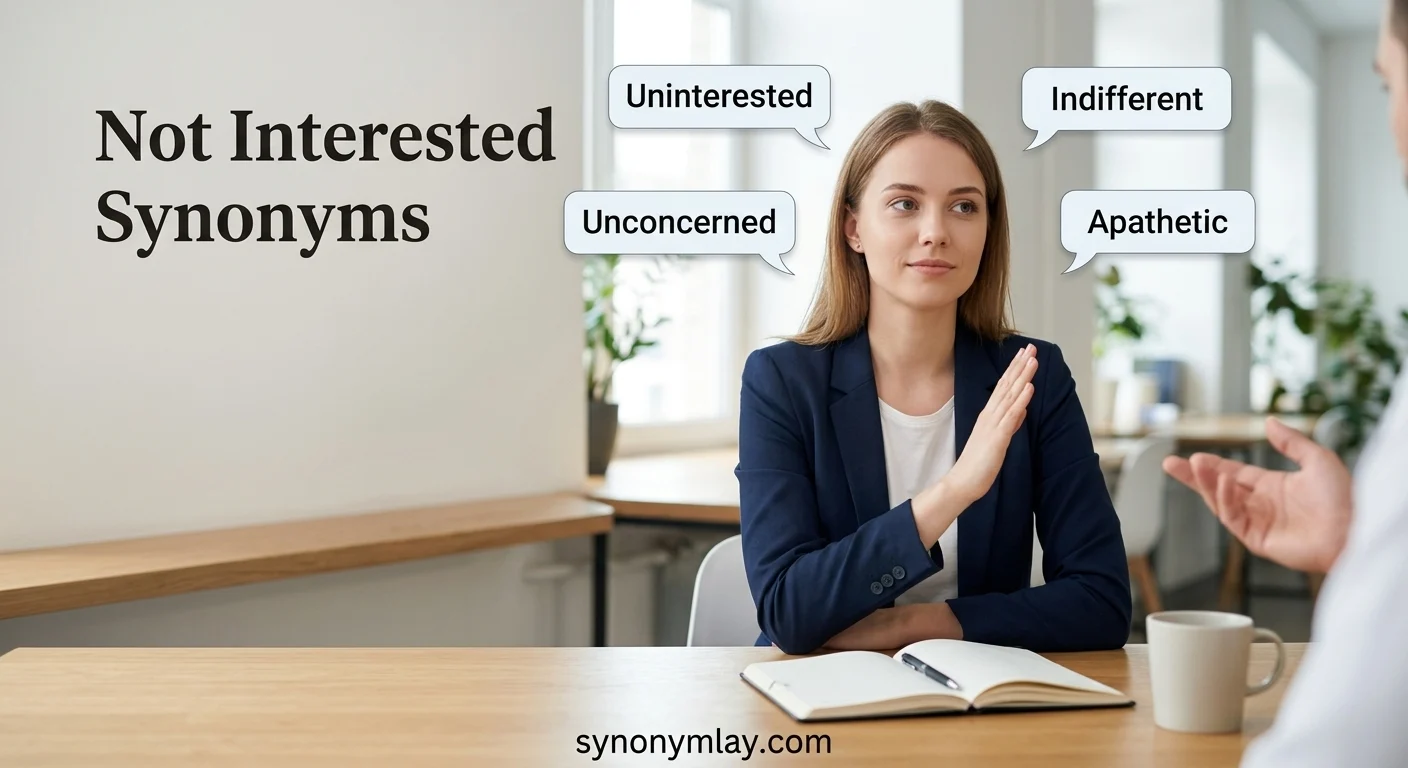
Finding the right not interested synonyms can make your English sound more natural, polite, confident, or expressive. Instead of repeating “I’m not interested,” you can choose different phrases depending on whether you want to sound casual, professional, gentle, firm, or humorous.
The phrase “not interested” generally means that someone does not want to participate in something, does not feel attracted to an idea, or does not want to know more about a particular subject. Learning its alternatives helps students, ESL learners, writers, and content creators communicate their exact meaning more effectively.
What Does “Not Interested” Mean?
“Not interested” means not wanting something, not feeling curious about something, or not wishing to become involved.
For example:
- “I’m not interested in buying the car.”
- “She is not interested in discussing the issue.”
The best alternative depends on the situation. Saying “I’m uninterested” can sound neutral, while “I’m not keen” sounds softer and more conversational. “I decline” is more formal, while “I’ll pass” is casual.
30 Useful Not Interested Synonyms and Alternatives
1. Uninterested
Meaning: Not interested in something or not wanting to become involved.
Example:
“I’m uninterested in joining the competition.”
Best usage context: Neutral writing and everyday English.
2. Indifferent
Meaning: Not caring very much about something either way.
Example:
“He seemed indifferent to the criticism.”
Best usage context: When someone has little emotional reaction.
3. Apathetic
Meaning: Showing little interest, enthusiasm, or concern.
Example:
“She appeared apathetic about the upcoming event.”
Best usage context: Serious or formal situations involving a lack of concern.
4. Unconcerned
Meaning: Not worried or bothered about something.
Example:
“He was unconcerned about the delay.”
Best usage context: When the meaning involves a lack of worry rather than simple refusal.
5. Disinterested
Meaning: Not personally involved or having no personal interest in an issue.
Example:
“The judge remained disinterested while listening to both sides.”
Best usage context: Formal contexts, especially when impartiality is intended.
Important: “Disinterested” traditionally means impartial rather than simply bored. In everyday English, people sometimes use it to mean “not interested,” but “uninterested” is clearer when you mean a lack of interest.
6. Reluctant
Meaning: Not willing or eager to do something.
Example:
“She was reluctant to accept the invitation.”
Best usage context: When someone does not really want to do something but may still agree.
7. Unwilling
Meaning: Not wanting or agreeing to do something.
Example:
“He was unwilling to discuss the matter.”
Best usage context: Firm refusal or lack of willingness.
8. Apathetic
Meaning: Having very little interest, emotion, or enthusiasm.
Example:
“The students seemed apathetic during the long lecture.”
Best usage context: Situations involving low enthusiasm or motivation.
9. Unenthusiastic
Meaning: Not excited or enthusiastic about something.
Example:
“She was unenthusiastic about the proposed plan.”
Best usage context: When someone may accept something but is not excited about it.
10. Unresponsive
Meaning: Showing little or no reaction to something.
Example:
“He remained unresponsive to their suggestions.”
Best usage context: Professional or formal writing.
11. Detached
Meaning: Emotionally separated or not personally involved.
Example:
“She sounded detached when discussing the situation.”
Best usage context: Emotional, professional, or analytical contexts.
12. Aloof
Meaning: Distant and not friendly or interested in interacting with others.
Example:
“He appeared aloof during the meeting.”
Best usage context: Describing someone’s social behavior.
13. Reserved
Meaning: Quiet and unwilling to openly show feelings or opinions.
Example:
“She was reserved when asked about her plans.”
Best usage context: Personality and social situations.
14. Unmoved
Meaning: Not emotionally affected or persuaded by something.
Example:
“He remained unmoved by their emotional appeal.”
Best usage context: When persuasion or emotion fails to create interest.
15. Unconvinced
Meaning: Not persuaded that something is good, true, or worthwhile.
Example:
“I’m still unconvinced by the proposal.”
Best usage context: Ideas, arguments, opinions, and proposals.
16. Hesitant
Meaning: Unsure about doing or accepting something.
Example:
“She was hesitant to participate in the discussion.”
Best usage context: When someone is uncertain rather than completely uninterested.
17. Unwilling to engage
Meaning: Not wanting to participate in a conversation or activity.
Example:
“He was unwilling to engage in an argument.”
Best usage context: Conversations, debates, and social interactions.
18. Not keen
Meaning: Not very interested or enthusiastic.
Example:
“I’m not keen on going out tonight.”
Best usage context: Friendly, casual British-style English.
19. Not enthusiastic
Meaning: Not excited or eager about something.
Example:
“They were not enthusiastic about the new schedule.”
Best usage context: Everyday and professional communication.
20. Not inclined
Meaning: Not feeling willing or likely to do something.
Example:
“I’m not inclined to accept the offer.”
Best usage context: Polite, formal, or thoughtful refusals.
21. Not bothered
Meaning: Not concerned or interested enough to worry about something.
Example:
“I’m not bothered about where we eat.”
Best usage context: Casual conversations.
22. I’ll pass
Meaning: A casual way of saying you do not want something.
Example:
“Thanks for the invitation, but I’ll pass.”
Best usage context: Friendly and informal situations.
23. I’ll sit this one out
Meaning: Choosing not to participate in an activity.
Example:
“You guys go ahead; I’ll sit this one out.”
Best usage context: Casual activities, games, parties, or group events.
24. I’m not into it
Meaning: You do not enjoy, like, or feel interested in something.
Example:
“Everyone loves that show, but I’m not really into it.”
Best usage context: Casual spoken English.
25. It’s not my thing
Meaning: Something does not match your interests or preferences.
Example:
“Camping is fun for some people, but it’s not my thing.”
Best usage context: Friendly, casual conversations.
26. I’m not interested in pursuing it
Meaning: You do not want to continue with an opportunity or idea.
Example:
“Thank you for the offer, but I’m not interested in pursuing it.”
Best usage context: Business, careers, offers, and professional communication.
27. I’d rather not
Meaning: A polite way of saying you do not want to do something.
Example:
“I’d rather not discuss that right now.”
Best usage context: Polite personal boundaries and refusals.
28. I’m going to decline
Meaning: A polite and direct way to refuse an offer or invitation.
Example:
“I appreciate the invitation, but I’m going to decline.”
Best usage context: Professional and formal communication.
29. I’m not available for that
Meaning: You are not willing or able to participate in something.
Example:
“Thank you for asking, but I’m not available for that project.”
Best usage context: Work and professional communication.
30. I’ll have to decline
Meaning: A polite but firm refusal.
Example:
“Thank you for the opportunity, but I’ll have to decline.”
Best usage context: Formal invitations, requests, and professional offers.
Not Interested Synonyms by Tone
Choosing a synonym is not only about meaning. Tone matters, too.
| Alternative | Tone | Best Use |
|---|---|---|
| Uninterested | Neutral | General situations |
| Indifferent | Neutral/formal | Lack of concern |
| Apathetic | Strong/formal | Lack of enthusiasm |
| Reluctant | Gentle | Unwillingness |
| Not keen | Casual | Everyday conversation |
| Not into it | Very casual | Friends and informal chats |
| It’s not my thing | Casual | Personal preferences |
| I’ll pass | Casual | Invitations and offers |
| I’d rather not | Polite | Personal boundaries |
| Not inclined | Formal | Professional situations |
| I’ll have to decline | Formal/polite | Offers and invitations |
| Unconvinced | Formal/neutral | Ideas and arguments |
| Aloof | Descriptive | Social behavior |
How to Choose the Right Synonym
The easiest way to choose among not interested synonyms is to first decide what you actually mean.
If You Simply Have No Interest
Use:
- Uninterested
- Indifferent
- Unenthusiastic
- Not keen
Example:
“I’m not keen on watching that movie.”
This sounds much more natural than repeatedly saying, “I’m not interested.”
If You Do Not Want to Participate
Use:
- Unwilling
- Reluctant
- I’ll pass
- I’ll sit this one out
- I’d rather not
Example:
“Thanks for asking, but I’ll sit this one out.”
If You Want to Sound Polite
Use:
- I’d rather not
- I’m going to decline
- I’ll have to decline
- I’m not inclined to
Example:
“I appreciate the invitation, but I’ll have to decline.”
If You Want to Sound Casual
Use:
- I’ll pass
- I’m not into it
- It’s not my thing
- I’m not keen
Example:
“Thanks, but that’s not really my thing.”
If You Want to Sound Professional
Use:
- I’m not interested in pursuing it
- I’m not inclined to proceed
- I’m going to decline
- I’m not available for that
Example:
“Thank you for the proposal, but I’m not interested in pursuing it at this time.”
If You Mean Someone Does Not Care
Use:
- Indifferent
- Apathetic
- Unconcerned
Example:
“She seemed indifferent to the outcome.”
If You Mean Someone Is Emotionally Distant
Use:
- Detached
- Aloof
- Reserved
Example:
“He remained detached throughout the discussion.”
“Not Interested” vs. “Uninterested”
These two words are closely related but can have slightly different uses.
Not interested is the most common and straightforward phrase. It clearly tells someone that you do not want something or do not want to become involved.
Uninterested is an adjective describing a lack of interest.
Examples:
- “I’m not interested in buying it.”
- “He looked uninterested during the presentation.”
For everyday English, “not interested” is often the safest option because its meaning is immediately clear.
“Uninterested” vs. “Indifferent”
“Uninterested” means you do not have an interest in something.
“Indifferent” usually suggests that you do not care strongly one way or another.
Compare:
“I’m uninterested in football.”
This means football does not attract your attention.
“I’m indifferent to football.”
This suggests that football simply does not matter much to you.
“Not Interested” vs. “Reluctant”
These words should not always be treated as exact synonyms.
Someone who is not interested does not want something.
Someone who is reluctant may actually want it but feel uncertain, nervous, or unwilling.
For example:
“I’m not interested in the job.”
This suggests you simply do not want the job.
“I’m reluctant to accept the job.”
This suggests you are considering it but have concerns.
“Not Interested” vs. “Apathetic”
Apathetic is stronger than simply being uninterested.
If someone says:
“I’m not interested in politics.”
They are describing a personal lack of interest.
If someone is described as:
“He is apathetic about politics.”
It suggests a broader lack of concern, enthusiasm, or emotional involvement.
Polite Ways to Say “Not Interested”
Sometimes saying “I’m not interested” can sound too direct. A softer alternative can protect the other person’s feelings.
Try:
- “Thanks, but I’ll pass.”
- “I appreciate the offer, but I’ll decline.”
- “That’s not really for me.”
- “I’d rather not.”
- “I’m not looking for that right now.”
- “Thank you, but I’m going to pass.”
- “I appreciate you thinking of me, but I’ll have to decline.”
These expressions are especially useful in professional communication and social situations.
Professional Ways to Say “Not Interested”
In emails, interviews, business conversations, and workplace communication, avoid unnecessarily blunt expressions.
Instead of:
“I’m not interested.”
You could say:
“Thank you for the opportunity, but I’m not interested in pursuing it at this time.”
Or:
“I appreciate your offer, but I’ve decided not to proceed.”
These alternatives sound respectful while still communicating a clear decision.
Casual Ways to Say “Not Interested”
When talking with friends, you can use much more relaxed expressions.
For example:
- “I’ll pass.”
- “Not really my thing.”
- “I’m not into that.”
- “I’m good, thanks.”
- “I’ll sit this one out.”
- “Nah, I’m not feeling it.”
- “That’s not really for me.”
The right choice depends on your relationship with the person and the situation.
Strong Ways to Say “Not Interested”
Sometimes you need to communicate a firm boundary.
Examples include:
- “I’m not interested.”
- “I’m not willing to participate.”
- “I’d rather not.”
- “Please don’t ask me again.”
- “I’m not interested in discussing this.”
These expressions are appropriate when a softer response has not worked or when you need to establish a clear boundary.
Gentle Alternatives to “Not Interested”
If you want to reject something without sounding rude, choose a gentle expression.
For example:
“I’m not sure that’s right for me.”
“I appreciate the offer, but I’ll pass.”
“Thank you, but I’m not looking for that right now.”
These phrases communicate the message while maintaining a friendly tone.
Not Interested Synonyms for Writing
Writers often need alternatives to avoid repetition.
Instead of writing:
“She was not interested in the proposal.”
You could write:
“She was unconvinced by the proposal.”
“She showed little enthusiasm for the proposal.”
“She was reluctant to support the proposal.”
“She remained indifferent to the proposal.”
The best choice depends on the character’s exact attitude.
Not Interested Synonyms for Students
Students can use these words to improve essays and assignments:
- Uninterested
- Indifferent
- Apathetic
- Unenthusiastic
- Reluctant
- Unconcerned
- Detached
- Unconvinced
However, students should always check whether the synonym fits the intended meaning. A thesaurus can provide related words, but not every synonym can replace the original phrase in every sentence.
Not Interested Synonyms for ESL Learners
For ESL learners, the easiest alternatives to remember are:
Casual:
“I’ll pass.”
Friendly:
“It’s not my thing.”
Polite:
“I’d rather not.”
Professional:
“I’ll have to decline.”
Neutral:
“I’m uninterested.”
Formal:
“I’m not inclined to proceed.”
Learning these groups makes it easier to choose the right phrase naturally.
Not Interested Synonyms in Relationships
When discussing relationships, “not interested” can mean that someone does not have romantic feelings.
Instead of saying:
“I’m not interested in him.”
You could say:
“I don’t feel that way about him.”
“I don’t see him romantically.”
“I don’t think we’re a match.”
“I’m not looking for a relationship with him.”
These alternatives can sound more considerate and less harsh.
Not Interested Synonyms in Text Messages
Text messages usually work best with short, natural expressions.
Examples:
- “I’ll pass, thanks.”
- “Not really my thing.”
- “I’m not into it.”
- “I’m good, thanks.”
- “Maybe another time.”
- “I’d rather not.”
The appropriate phrase depends on how direct you want to be.
Not Interested Synonyms for Rejecting an Offer
When rejecting an offer, you can remain polite without giving a long explanation.
Examples:
“Thank you for the offer, but I’ll have to decline.”
“I appreciate the opportunity, but I’m going to pass.”
“Thanks for reaching out. I’m not interested in pursuing this at the moment.”
These expressions work particularly well in professional situations.
Not Interested Synonyms for Invitations
If someone invites you somewhere, you can say:
“Thanks for inviting me, but I’ll sit this one out.”
“Thank you, but I won’t be able to join.”
“I appreciate the invitation, but I’ll have to pass.”
These sound more courteous than simply saying “No.”
Not Interested Synonyms for Arguments and Ideas
When you disagree with an idea, “not interested” may not express your meaning accurately.
Try:
- Unconvinced
- Skeptical
- Unpersuaded
- Unenthusiastic
- Reluctant
Example:
“I’m unconvinced that this strategy will work.”
This communicates that you have considered the idea but have not accepted it.
Not Interested Synonyms for Lack of Motivation
If someone has stopped showing enthusiasm, words such as “apathetic,” “unenthusiastic,” and “disengaged” may be better.
Example:
“The students became disengaged during the lecture.”
This is different from saying:
“The students were not interested in the subject.”
“Disengaged” often suggests that someone has stopped actively participating.
Not Interested Synonyms for Social Situations
For social situations, choose words carefully because some alternatives describe personality rather than interest.
Reserved means someone does not openly express themselves.
Aloof suggests someone appears distant or unfriendly.
Detached suggests emotional distance.
Indifferent suggests a lack of concern.
For example:
“She was reserved at the party.”
does not necessarily mean she disliked the party. She may simply have been quiet.
Common Mistakes When Using Not Interested Synonyms
Mistake 1: Treating Every Synonym as Identical
Words that appear in a thesaurus may have different meanings.
“Reluctant” is not exactly the same as “uninterested.”
“Apathetic” is stronger than “unenthusiastic.”
“Aloof” describes social distance rather than simply a lack of interest.
Mistake 2: Using Formal Words in Casual Conversations
Saying “I am not inclined to participate” to a close friend may sound unnecessarily formal.
“I’ll pass” would sound more natural.
Mistake 3: Using Casual Expressions in Professional Writing
“I’m not into it” is perfectly understandable, but it may not be appropriate in a formal business email.
Use “I’ll have to decline” instead.
Mistake 4: Forgetting the Emotional Meaning
Consider what the person actually feels.
Are they bored?
Uncertain?
Unwilling?
Unconcerned?
Unconvinced?
Each situation calls for a different word.
Understanding “Demure” in Simple English
Although demure is unrelated to the phrase “not interested,” it is an important vocabulary word with several useful descriptive applications.
Demure means quiet, modest, reserved, and not showing much emotion or confidence outwardly.
The word is traditionally used to describe someone, especially a woman or girl, who behaves in a modest, gentle, or reserved way.
For example:
“She gave a demure smile when everyone complimented her.”
The tone of “demure” is usually gentle and somewhat formal. It can describe someone’s appearance, behavior, expression, or manner.
Depending on context, it can suggest modesty, shyness, restraint, or quiet elegance.
30 Synonyms of Demure
1. Modest
Meaning: Not showing off and behaving in a restrained way.
Example:
“She wore a modest dress to the ceremony.”
Best usage context: Clothing, behavior, and personality.
2. Reserved
Meaning: Quiet and not very open about feelings.
Example:
“He is reserved around new people.”
Best usage context: Personality and social behavior.
3. Shy
Meaning: Nervous or uncomfortable around other people.
Example:
“The shy student avoided speaking first.”
Best usage context: Everyday English.
4. Bashful
Meaning: Easily embarrassed or shy.
Example:
“She became bashful when everyone praised her.”
Best usage context: Friendly and expressive descriptions.
5. Coy
Meaning: Shy in a playful or slightly secretive way.
Example:
“She gave him a coy smile.”
Best usage context: Social or romantic descriptions.
6. Retiring
Meaning: Quiet and avoiding attention.
Example:
“He had a retiring personality and preferred small groups.”
Best usage context: Formal or literary writing.
7. Unassuming
Meaning: Not trying to attract attention or appear important.
Example:
“Despite her success, she remained unassuming.”
Best usage context: Character descriptions.
8. Mild
Meaning: Gentle and not extreme in behavior.
Example:
“She had a mild and pleasant manner.”
Best usage context: Personality and temperament.
9. Gentle
Meaning: Kind, calm, and soft in manner.
Example:
“She spoke in a gentle voice.”
Best usage context: General descriptions.
10. Quiet
Meaning: Not loud or highly expressive.
Example:
“She was quiet during the discussion.”
Best usage context: Everyday descriptions.
11. Soft-spoken
Meaning: Speaking in a gentle, quiet voice.
Example:
“The soft-spoken teacher answered every question patiently.”
Best usage context: Speech and personality.
12. Sedate
Meaning: Calm, quiet, and controlled.
Example:
“His sedate manner suited the formal occasion.”
Best usage context: Formal writing.
13. Composed
Meaning: Calm and in control of your emotions.
Example:
“She remained composed under pressure.”
Best usage context: Professional and serious situations.
14. Restrained
Meaning: Not showing strong emotions or reactions.
Example:
“He gave a restrained response to the criticism.”
Best usage context: Formal writing.
15. Dignified
Meaning: Calm, serious, and worthy of respect.
Example:
“She maintained a dignified manner throughout the ceremony.”
Best usage context: Formal descriptions.
16. Demurely Behaved
Meaning: Behaving in a quiet, modest, and reserved manner.
Example:
“She demurely accepted the compliment.”
Best usage context: Descriptive and literary writing.
17. Timid
Meaning: Lacking confidence and easily frightened or nervous.
Example:
“The timid child stayed close to her mother.”
Best usage context: Personality descriptions.
18. Meek
Meaning: Quiet and gentle, sometimes suggesting a lack of assertiveness.
Example:
“He had a meek and peaceful manner.”
Best usage context: Character descriptions.
19. Subdued
Meaning: Quiet or less energetic than usual.
Example:
“She gave a subdued smile.”
Best usage context: Mood, emotions, and expressions.
20. Discreet
Meaning: Careful not to attract unwanted attention.
Example:
“She was discreet about her personal affairs.”
Best usage context: Behavior and privacy.
21. Unobtrusive
Meaning: Not noticeable or demanding attention.
Example:
“He chose an unobtrusive seat at the back.”
Best usage context: People, behavior, design, and surroundings.
22. Unassertive
Meaning: Not forceful or confident in expressing opinions.
Example:
“She was polite but somewhat unassertive.”
Best usage context: Personality and communication.
23. Self-effacing
Meaning: Not drawing attention to your own achievements.
Example:
“His self-effacing attitude made him easy to work with.”
Best usage context: Personality and professional descriptions.
24. Unpretentious
Meaning: Simple and not trying to appear more important than you are.
Example:
“She had an unpretentious personality.”
Best usage context: People, places, and lifestyles.
25. Unshowy
Meaning: Not designed to attract attention.
Example:
“Her style was elegant but unshowy.”
Best usage context: Appearance and personal style.
26. Unobtrusive
Meaning: Quiet and unlikely to attract attention.
Example:
“He remained unobtrusive throughout the event.”
Best usage context: Formal and descriptive writing.
27. Unassuming
Meaning: Modest and not self-important.
Example:
“She was surprisingly unassuming despite her achievements.”
Best usage context: Personality descriptions.
28. Calm
Meaning: Peaceful and not easily excited.
Example:
“She remained calm during the interview.”
Best usage context: Everyday and professional English.
29. Demure-looking
Meaning: Having a modest, quiet, or reserved appearance.
Example:
“She had a demure-looking style that suited the occasion.”
Best usage context: Appearance and descriptive writing.
30. Proper
Meaning: Behaving in a socially acceptable and respectable way.
Example:
“She was known for her proper and polite manners.”
Best usage context: Formal, traditional, or social contexts.
Demure Synonyms: Quick Comparison
| Word | Main Idea | Tone |
|---|---|---|
| Modest | Not showy | Neutral |
| Reserved | Quiet and private | Neutral |
| Shy | Nervous socially | Everyday |
| Bashful | Easily embarrassed | Warm |
| Coy | Playfully shy | Romantic/literary |
| Retiring | Avoids attention | Formal |
| Unassuming | Not self-important | Positive |
| Composed | Calm and controlled | Professional |
| Restrained | Emotionally controlled | Formal |
| Dignified | Respectable and calm | Formal |
| Timid | Lacking confidence | Neutral/negative |
| Meek | Gentle and submissive | Neutral/negative |
| Self-effacing | Downplays achievements | Positive |
| Unpretentious | Simple and genuine | Positive |
How to Choose the Right Synonym for “Demure”
Use modest when you want to emphasize appearance or behavior.
Use reserved when someone does not openly express emotions.
Use shy when the person feels nervous around others.
Use bashful when embarrassment is involved.
Use coy when the person is playfully shy, especially in a romantic context.
Use composed when the main idea is emotional control.
Use dignified when the person appears respectable and serious.
Use unassuming when someone does not try to attract attention or show superiority.
Use self-effacing when someone deliberately minimizes their own achievements.
Frequently Asked Questions
What is the best synonym for “not interested”?
“Uninterested” is the closest single-word synonym. However, “indifferent,” “unenthusiastic,” “reluctant,” and “not keen” may be better depending on the exact context.
What is a polite way to say “not interested”?
You can say, “I’d rather not,” “I appreciate the offer, but I’ll pass,” or “I’ll have to decline.”
What is a professional way to say “not interested”?
“I appreciate the opportunity, but I’m not interested in pursuing it at this time” is polite and professional.
What is a casual way to say “not interested”?
“I’ll pass,” “I’m not into it,” and “It’s not my thing” are natural casual alternatives.
Is “uninterested” the same as “not interested”?
They are very similar. “Uninterested” is an adjective describing a lack of interest, while “not interested” is the more common phrase used to directly express that someone does not want or care about something.
What does “demure” mean?
“Demure” generally means quiet, modest, reserved, and not openly expressive. It often describes a person’s behavior, appearance, or manner.
Final Thoughts
Learning different not interested synonyms gives you more control over your English. You can sound casual with “I’ll pass,” polite with “I’d rather not,” professional with “I’ll have to decline,” or neutral with “uninterested.”
The most important lesson is that synonyms are not always interchangeable. Words such as reluctant, indifferent, apathetic, unconvinced, detached, and aloof describe slightly different attitudes. Choosing the right word means thinking about what the person actually feels and what tone the situation requires.
For ESL learners, students, writers, and content creators, building this kind of vocabulary makes communication clearer and more natural. Rather than relying on the same phrase repeatedly, use the alternative that best matches your meaning, audience, and situation.

I am Joel David, a passionate writer who loves exploring synonyms and helping readers discover clear, meaningful, and engaging word choices. I enjoy making language simple, useful, and interesting for everyone.