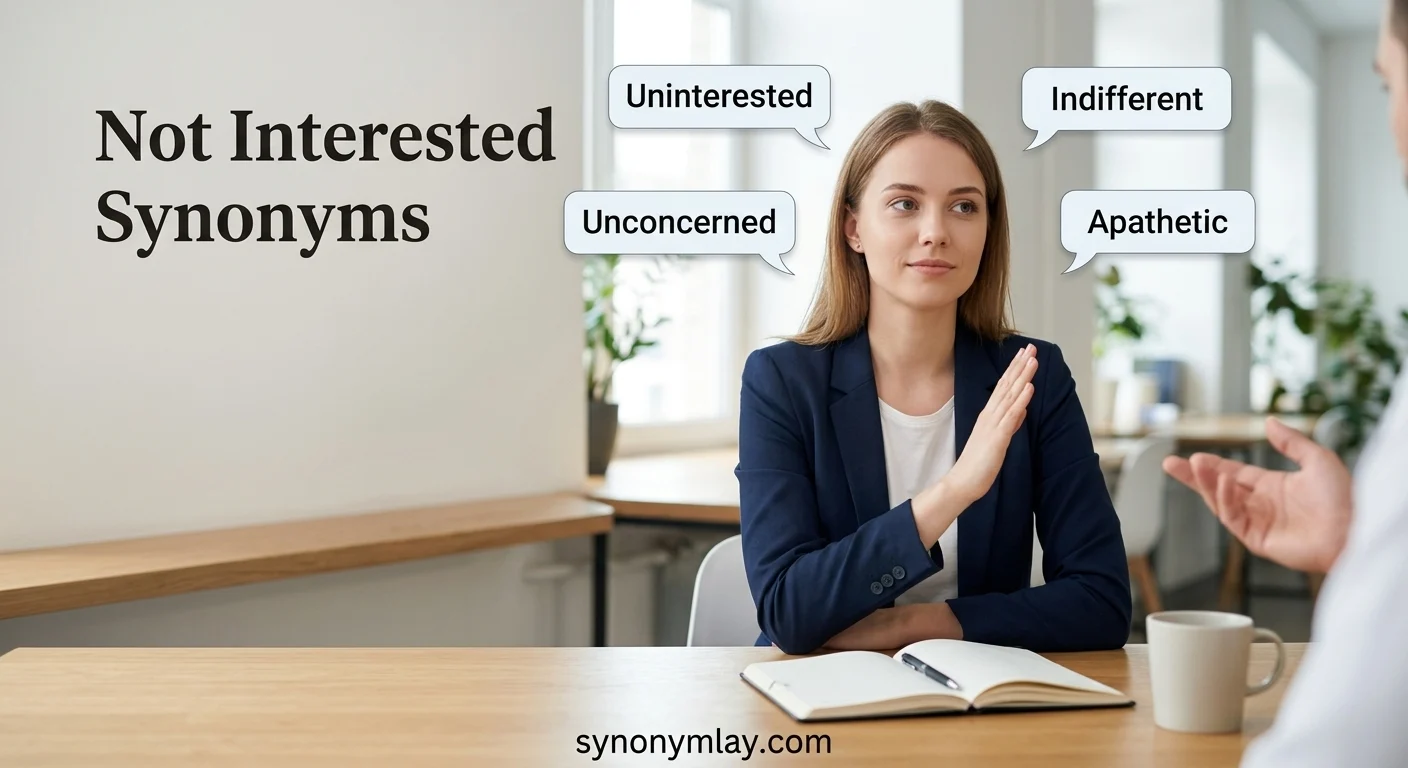
Finding the right not interested synonyms can make your English sound more natural, polite, confident, or direct. Instead of repeating “I’m not interested,” you can choose a phrase that better matches the situation.
Whether you are writing an email, replying to a message, talking with friends, or improving your vocabulary, the right alternative can change the tone of your sentence. Some expressions sound gentle and respectful, while others clearly show that you have no interest.
What Does “Not Interested” Mean?
“Not interested” means that you do not want to participate in, learn about, buy, discuss, or become involved in something. It can describe a lack of curiosity, desire, enthusiasm, or willingness.
For example, you might say, “I’m not interested in buying the product,” when you do not want to purchase it. In a casual conversation, you could simply say, “I’m not really into it.”
The best synonym depends on why you are not interested and how strongly you want to express it.
Quick List of Not Interested Synonyms
Here are useful alternatives to “not interested”:
- Uninterested
- Indifferent
- Unenthusiastic
- Apathetic
- Disinterested
- Unconcerned
- Uninvolved
- Detached
- Unresponsive
- Reluctant
- Unwilling
- Unmoved
- Unimpressed
- Bored
- Inattentive
- Disengaged
- Unmotivated
- Hesitant
- Resistant
- Unexcited
- Cold
- Aloof
- Dismissive
- Apathetic toward
- Have no interest in
- Have no desire to
- Not keen on
- Not into
- Not my thing
- I’ll pass
1. Uninterested
Meaning: Not having interest or curiosity about something.
Example: “She seemed uninterested in the discussion.”
Best usage context: Neutral and straightforward situations.
“Uninterested” is one of the closest alternatives to “not interested.” It works well in everyday English and formal writing.
2. Indifferent
Meaning: Not caring very much about something.
Example: “He was indifferent to the criticism.”
Best usage context: When you want to show a lack of concern rather than simple dislike.
“Indifferent” suggests that something does not matter much to you.
3. Unenthusiastic
Meaning: Showing little excitement or energy.
Example: “The students were unenthusiastic about the extra assignment.”
Best usage context: When someone lacks excitement.
This word is useful when a person may participate but simply does not feel excited about it.
4. Apathetic
Meaning: Showing little interest, emotion, or concern.
Example: “He became apathetic toward the project.”
Best usage context: Stronger or more serious situations.
“Apathetic” can sound more negative than “not interested,” especially when describing someone’s attitude.
5. Disinterested
Meaning: Not personally involved or motivated by personal benefit.
Example: “The mediator remained disinterested during the disagreement.”
Best usage context: Formal or professional English.
Be careful with this word. “Disinterested” traditionally means impartial or unbiased, while “uninterested” means lacking interest.
6. Unconcerned
Meaning: Not worried or concerned about something.
Example: “She appeared unconcerned about the delay.”
Best usage context: When the issue does not seem important to someone.
It is closer to “not bothered” than simply “not interested.”
7. Uninvolved
Meaning: Not taking part in something.
Example: “I prefer to remain uninvolved in their argument.”
Best usage context: Situations involving participation.
Use this when you want to communicate that you do not want to become part of something.
8. Detached
Meaning: Emotionally separate or not strongly connected.
Example: “He remained detached from the debate.”
Best usage context: Emotional, professional, or serious situations.
“Detached” can describe someone who deliberately keeps emotional distance.
9. Unresponsive
Meaning: Showing little or no reaction.
Example: “The customer was unresponsive to several offers.”
Best usage context: Messages, communication, or reactions.
This word does not always mean someone is uninterested; it can simply mean they are not responding.
10. Reluctant
Meaning: Not willing or eager to do something.
Example: “She was reluctant to join the meeting.”
Best usage context: When someone does not want to do something.
“Reluctant” focuses more on unwillingness than lack of curiosity.
11. Unwilling
Meaning: Not wanting or agreeing to do something.
Example: “He was unwilling to discuss the matter.”
Best usage context: Clear refusal or lack of willingness.
This is stronger and more direct than “not interested.”
12. Unmoved
Meaning: Not emotionally affected or impressed.
Example: “She remained unmoved by his apology.”
Best usage context: Emotional reactions.
Use it when an event, argument, speech, or action fails to create an emotional response.
13. Unimpressed
Meaning: Not impressed or excited by something.
Example: “I was unimpressed with the presentation.”
Best usage context: When something fails to meet expectations.
This expression can sound critical, so use it carefully in polite conversations.
14. Bored
Meaning: Feeling that something is dull or uninteresting.
Example: “The children became bored during the long lecture.”
Best usage context: Casual situations.
“Bored” describes a person’s feeling rather than simply stating that they lack interest.
15. Inattentive
Meaning: Not paying attention.
Example: “He was inattentive during the lesson.”
Best usage context: School, work, or situations involving concentration.
It is useful when someone is physically present but mentally distracted.
16. Disengaged
Meaning: No longer interested or actively involved.
Example: “The audience seemed disengaged during the presentation.”
Best usage context: Work, education, meetings, and formal writing.
“Disengaged” is especially useful when describing reduced participation.
17. Unmotivated
Meaning: Having little desire or reason to act.
Example: “She felt unmotivated to continue the project.”
Best usage context: Work, study, goals, and personal activities.
This word focuses on a lack of motivation rather than interest alone.
18. Hesitant
Meaning: Unsure or unwilling to make a decision.
Example: “He was hesitant to accept the invitation.”
Best usage context: When someone has not completely decided.
“Hesitant” is softer than a direct refusal.
19. Resistant
Meaning: Opposed to or unwilling to accept something.
Example: “The team was resistant to the proposed changes.”
Best usage context: Changes, ideas, suggestions, or pressure.
It suggests active opposition rather than simple disinterest.
20. Unexcited
Meaning: Not feeling excitement about something.
Example: “She was unexcited about the upcoming event.”
Best usage context: Casual and conversational English.
It is easy for ESL learners to understand and works well in everyday speech.
21. Cold
Meaning: Unfriendly, distant, or showing little emotional interest.
Example: “His response sounded cold and distant.”
Best usage context: Describing someone’s attitude or response.
“Cold” can sound harsh, so it is usually better for informal descriptions than polite communication.
22. Aloof
Meaning: Distant and not showing much interest in others.
Example: “The new student seemed aloof at first.”
Best usage context: Describing personality or social behavior.
“Aloof” often suggests emotional or social distance.
23. Dismissive
Meaning: Showing that you do not consider something important or worth attention.
Example: “She was dismissive of the suggestion.”
Best usage context: Strong reactions or criticism.
This word can imply disrespect, so it should be used carefully.
24. Apathetic Toward
Meaning: Showing little concern or interest in a particular subject.
Example: “He became apathetic toward politics.”
Best usage context: Specific subjects, issues, or activities.
This construction clearly identifies the thing someone does not care about.
25. Have No Interest In
Meaning: Clearly state that something does not interest you.
Example: “I have no interest in watching that show.”
Best usage context: Direct but natural communication.
This is one of the easiest alternatives for ESL learners.
26. Have No Desire To
Meaning: Not want to do something.
Example: “I have no desire to argue about it.”
Best usage context: Personal decisions or firm statements.
It communicates a stronger lack of willingness than “I’m not interested.”
27. Not Keen On
Meaning: Not particularly interested in or enthusiastic about something.
Example: “I’m not keen on going out tonight.”
Best usage context: Friendly British or international English.
“Not keen on” is a polite way to express mild dislike or lack of enthusiasm.
28. Not Into
Meaning: Not interested in or enthusiastic about something.
Example: “I’m not really into horror movies.”
Best usage context: Casual conversations.
This is a very natural phrase in modern everyday English.
29. Not My Thing
Meaning: Something is not personally appealing to you.
Example: “Camping is not really my thing.”
Best usage context: Friendly, casual conversations.
It is softer than saying that you dislike something.
30. I’ll Pass
Meaning: Politely decline an offer or opportunity.
Example: “Thanks for the invitation, but I’ll pass.”
Best usage context: Casual conversations and offers.
“I’ll pass” is short, natural, and often more polite than a blunt “No.”
Not Interested Synonyms by Tone
Choosing the right expression is easier when you think about tone.
| Expression | Tone | Best Use |
|---|---|---|
| Uninterested | Neutral | General situations |
| Indifferent | Neutral | Lack of concern |
| Unenthusiastic | Mild | Lack of excitement |
| Not keen on | Polite | Soft disagreement |
| Not my thing | Friendly | Casual conversation |
| Not into | Casual | Friends and informal speech |
| I’ll pass | Polite/casual | Declining an offer |
| Reluctant | Mild | Unwillingness |
| Unwilling | Firm | Clear refusal |
| Apathetic | Strong | Lack of concern |
| Dismissive | Strong | Rejecting something |
| Unimpressed | Critical | Something failed to impress |
Polite Ways to Say “I’m Not Interested”
Sometimes you want to decline without sounding rude. Try these expressions:
- “I don’t think that’s for me.”
- “Thanks, but I’ll pass.”
- “I’m not really interested in that.”
- “I appreciate the offer, but I’ll decline.”
- “That’s not something I’m looking for right now.”
- “I’d rather not.”
- “I don’t think I’ll take you up on that.”
- “Thanks, but I’m going to sit this one out.”
These phrases are especially useful in professional conversations, sales situations, invitations, and messages.
Casual Ways to Say “Not Interested”
When talking with friends, you can use more relaxed expressions:
- “I’m not really into it.”
- “That’s not my thing.”
- “I’ll pass.”
- “I’m not feeling it.”
- “Not for me.”
- “I’m good, thanks.”
- “I’m not keen on that.”
- “I’ll skip it.”
The casual expressions usually sound more natural in everyday conversation.
Strong Ways to Say “Not Interested”
Sometimes you need to make your position very clear:
- “I have no interest in that.”
- “I’m not interested at all.”
- “I have no desire to participate.”
- “I’m not willing to do that.”
- “I don’t want to be involved.”
- “I’m not interested in pursuing this.”
These phrases are appropriate when you want to avoid ambiguity.
How to Choose the Right Not Interested Synonym
The best synonym depends on your intention.
When You Want to Sound Polite
Choose:
- Not keen on
- I’ll pass
- Not really for me
- I don’t think that’s for me
- I’d rather not
These expressions soften your response.
When You Want to Sound Casual
Choose:
- Not into
- Not my thing
- I’ll pass
- Not for me
- I’m not feeling it
These work naturally with friends and people you know well.
When You Want to Sound Professional
Choose:
- Uninterested
- Unenthusiastic
- Uninvolved
- Reluctant
- Have no interest in
These are generally more suitable for workplace or academic writing.
When You Want to Show Strong Disinterest
Choose:
- Apathetic
- Unwilling
- Dismissive
- Have no desire to
- Not interested at all
Remember that strong words can sound negative, so consider your audience.
What Is the Meaning of “Demure”?
“Demure” is an adjective used to describe someone who behaves in a quiet, modest, reserved, or shy way. It is often associated with a calm and controlled appearance.
For example:
“She gave a demure smile when everyone complimented her.”
The word usually has a positive or gentle tone, although its meaning can change slightly depending on context. It may describe someone’s clothing, facial expression, manner, or behavior.
“Demure” is not a synonym for “not interested.” The two words describe different ideas. Someone can be demure while being very interested in something.
30 Synonyms of Demure
1. Modest
Meaning: Not showing off or seeking attention.
Example: “She wore a modest dress to the ceremony.”
Best usage context: Clothing, behavior, or personality.
2. Shy
Meaning: Nervous or uncomfortable around other people.
Example: “The shy student avoided speaking in front of the class.”
Best usage context: Social situations.
3. Reserved
Meaning: Quiet and not very expressive.
Example: “He is reserved when meeting new people.”
Best usage context: Personality and social behavior.
4. Bashful
Meaning: Easily embarrassed or shy.
Example: “She became bashful after receiving the compliment.”
Best usage context: Friendly or affectionate descriptions.
5. Retiring
Meaning: Avoiding attention or social activity.
Example: “His retiring nature made him uncomfortable at large gatherings.”
Best usage context: Formal descriptions of personality.
6. Unassuming
Meaning: Not trying to appear important or impressive.
Example: “Despite his success, he remained unassuming.”
Best usage context: Personality and character.
7. Quiet
Meaning: Not loud, active, or expressive.
Example: “She was quiet throughout the meeting.”
Best usage context: Everyday English.
8. Gentle
Meaning: Calm, kind, and soft in manner.
Example: “He spoke in a gentle voice.”
Best usage context: Personality, behavior, and speech.
9. Mild
Meaning: Calm and not intense or aggressive.
Example: “She has a mild and pleasant personality.”
Best usage context: Personality and behavior.
10. Subdued
Meaning: Quiet, restrained, or not very energetic.
Example: “Her subdued reaction surprised everyone.”
Best usage context: Reactions, moods, and behavior.
11. Restrained
Meaning: Controlled and not overly expressive.
Example: “He gave a restrained response to the news.”
Best usage context: Formal writing and emotional reactions.
12. Decorous
Meaning: Polite and behaving appropriately.
Example: “The guests maintained a decorous atmosphere.”
Best usage context: Formal or social settings.
13. Proper
Meaning: Behaving in a socially acceptable way.
Example: “She was known for her proper manners.”
Best usage context: Behavior and etiquette.
14. Dignified
Meaning: Calm, respectable, and controlled.
Example: “She gave a dignified response to the criticism.”
Best usage context: Formal situations.
15. Refined
Meaning: Elegant, polished, and well-mannered.
Example: “Her refined manners impressed the guests.”
Best usage context: Style, manners, and behavior.
16. Ladylike
Meaning: Traditionally associated with polite and graceful feminine behavior.
Example: “Her ladylike manner made a strong impression.”
Best usage context: Traditional descriptions; can sound old-fashioned.
17. Coy
Meaning: Shy or pretending to be shy, especially in a playful way.
Example: “She gave him a coy smile.”
Best usage context: Romantic or playful situations.
18. Demure
Meaning: Quiet, modest, and reserved.
Example: “She had a demure appearance.”
Best usage context: The original word itself.
19. Prim
Meaning: Very proper, neat, and controlled.
Example: “Her prim manner made her seem extremely formal.”
Best usage context: Descriptions of strict manners or appearance.
20. Reserved
Meaning: Not openly expressing thoughts or feelings.
Example: “He remained reserved around strangers.”
Best usage context: Personality.
21. Discreet
Meaning: Careful not to attract attention or reveal private information.
Example: “She was discreet about the personal matter.”
Best usage context: Privacy and behavior.
22. Unobtrusive
Meaning: Not attracting attention.
Example: “The decoration was simple and unobtrusive.”
Best usage context: People, objects, design, and behavior.
23. Soft-Spoken
Meaning: Speaking quietly and gently.
Example: “The soft-spoken teacher was easy to approach.”
Best usage context: Speech and personality.
24. Timid
Meaning: Lacking confidence or easily frightened.
Example: “The timid child stayed close to her mother.”
Best usage context: Shyness or lack of confidence.
25. Meek
Meaning: Very quiet, gentle, and unwilling to argue.
Example: “He had a meek and peaceful manner.”
Best usage context: Personality; can sometimes imply excessive submissiveness.
26. Modest-Mannered
Meaning: Behaving without arrogance or excessive attention-seeking.
Example: “The modest-mannered athlete thanked everyone for the award.”
Best usage context: Character descriptions.
27. Graceful
Meaning: Elegant and pleasant in movement or behavior.
Example: “She gave a graceful greeting to the guests.”
Best usage context: Movement, manners, and appearance.
28. Polite
Meaning: Showing good manners and respect.
Example: “He was polite and respectful to everyone.”
Best usage context: Everyday and professional English.
29. Unpretentious
Meaning: Natural and not trying to seem more important than you are.
Example: “Her unpretentious personality made people feel comfortable.”
Best usage context: Personality and lifestyle.
30. Well-Mannered
Meaning: Behaving politely and respectfully.
Example: “The well-mannered child greeted everyone politely.”
Best usage context: Behavior and social situations.
Demure Synonyms: Quick Comparison
| Synonym | Main Idea | Tone |
|---|---|---|
| Modest | Not attention-seeking | Positive |
| Shy | Uncomfortable socially | Neutral |
| Reserved | Emotionally quiet | Neutral |
| Bashful | Easily embarrassed | Warm |
| Coy | Playfully shy | Playful |
| Timid | Lacking confidence | Often negative |
| Dignified | Calm and respectable | Positive |
| Refined | Elegant and polished | Positive |
| Decorous | Proper and appropriate | Formal |
| Prim | Very proper | Sometimes critical |
| Meek | Gentle and submissive | Can be negative |
| Unassuming | Not showing off | Positive |
| Graceful | Elegant and pleasant | Positive |
Not Interested vs. Uninterested
These two expressions are closely related but can differ slightly in natural usage.
Not interested is usually used to describe a person’s current lack of interest.
Example:
“I’m not interested in joining the club.”
Uninterested describes someone who lacks interest in something.
Example:
“He seemed uninterested in the conversation.”
In everyday English, “not interested” is often the more natural choice when directly responding to an offer or opportunity.
Not Interested vs. Disinterested
These words are frequently confused.
Uninterested means lacking interest.
Disinterested traditionally means impartial or not influenced by personal benefit.
For example:
- “The student was uninterested in the lecture.”
- “The judge must remain disinterested.”
In modern informal usage, some people use “disinterested” to mean “uninterested,” but keeping the traditional distinction is safer in formal writing.
Examples of Not Interested Synonyms in Real Life
At Work
Instead of:
“I’m not interested in this project.”
You could say:
“I’m not in a position to take on another project right now.”
This sounds professional and avoids sounding unnecessarily negative.
With Friends
Instead of:
“I’m not interested in going.”
You could say:
“That’s not really my thing.”
This sounds casual and friendly.
When Declining an Offer
Instead of:
“No, I’m not interested.”
You could say:
“Thanks for the offer, but I’ll pass.”
This is short, polite, and clear.
In Academic Writing
Instead of repeatedly using “not interested,” consider words such as:
- Uninterested
- Unenthusiastic
- Disengaged
- Indifferent
- Apathetic
Choose the word that accurately describes the person’s attitude.
Common Mistakes When Using Not Interested Synonyms
One common mistake is treating every synonym as interchangeable. They are not.
For example, reluctant means unwilling or hesitant, while bored means lacking stimulation. Similarly, indifferent suggests that something does not matter much, while unimpressed means something failed to create a positive impression.
Another mistake is using strong words in polite situations. Calling someone “apathetic” or “dismissive” can sound critical. If you are declining an invitation, “I’ll pass” or “That’s not really my thing” may be much better.
FAQs:
What is the best synonym for “not interested”?
“Uninterested” is one of the closest direct synonyms. However, “not keen on,” “not into,” “indifferent,” and “not my thing” may be more appropriate depending on context.
What is a polite way to say “I’m not interested”?
You can say, “Thanks, but I’ll pass,” “I don’t think that’s for me,” or “I appreciate the offer, but I’ll decline.”
What is a professional way to say “not interested”?
In professional situations, you can say, “I’m not interested in pursuing this at this time,” or “Thank you for the opportunity, but I’ll have to decline.”
Is “uninterested” the same as “not interested”?
They are very similar. “Uninterested” is an adjective describing someone who lacks interest, while “not interested” is a common phrase used to communicate a current lack of interest.
What is the opposite of “interested”?
Common opposites include uninterested, indifferent, apathetic, unconcerned, bored, and disengaged, depending on the exact meaning.
Is “demure” a synonym for “not interested”?
No. “Demure” generally means modest, quiet, reserved, or shy. It describes someone’s manner or appearance rather than their level of interest.
Final Thoughts
The best not interested synonyms depend on the message you want to communicate. If you need a neutral expression, uninterested is a reliable choice. For a polite response, try “I’ll pass,” “not keen on,” or “I don’t think that’s for me.” For casual conversations, “not into it” and “not my thing” sound natural.
Strong words such as apathetic, dismissive, and unwilling should be used more carefully because they can communicate a stronger attitude.
Learning these distinctions helps you move beyond repetitive vocabulary and express your exact meaning. Whether you are an ESL learner, student, writer, or content creator, choosing the right synonym makes your English clearer, more natural, and more effective.

I am Camila Marie, a passionate writer who loves exploring synonyms and making language simple, clear, and engaging. I enjoy helping readers discover better words and express their ideas confidently.