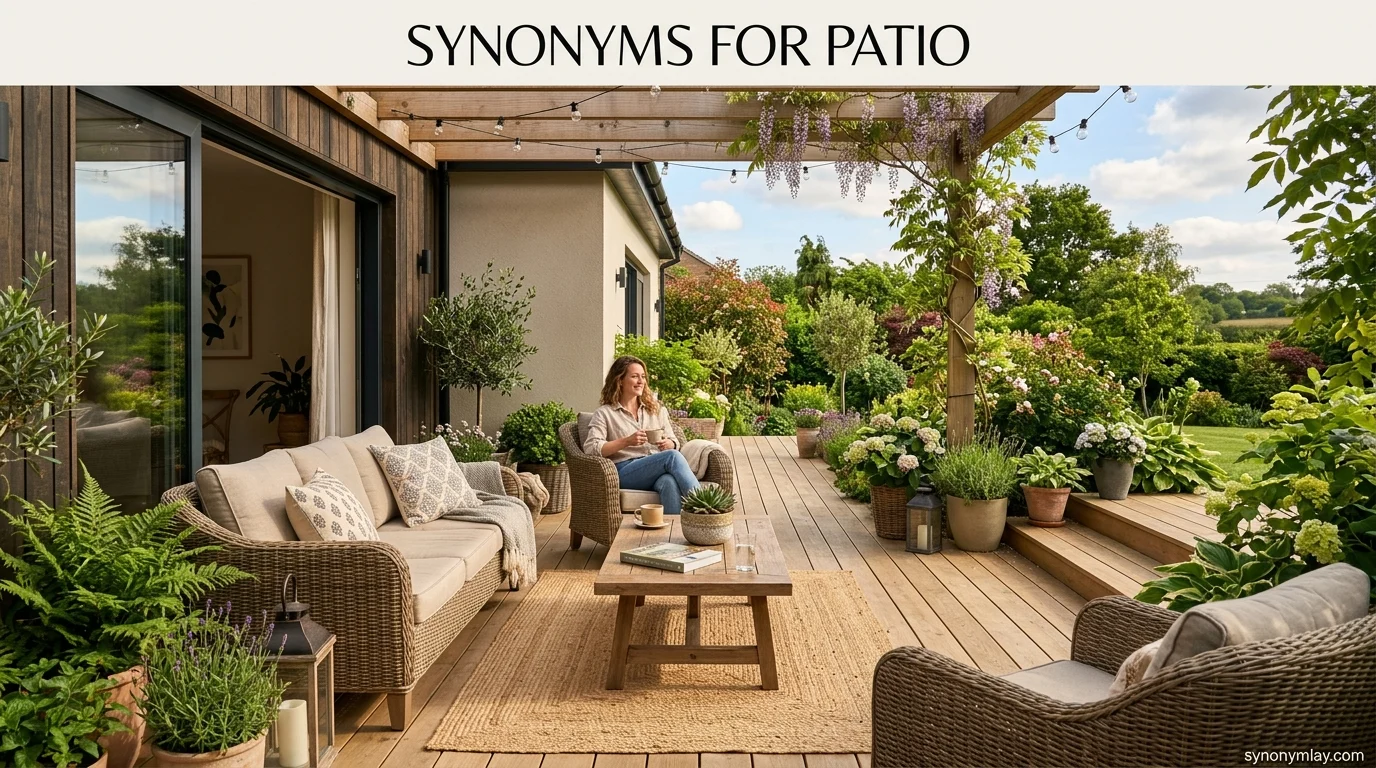
Finding the right synonyms for patio can make your writing more varied, descriptive, and natural. Whether you are writing an essay, describing a home, creating website content, or simply improving your English vocabulary, knowing alternative words for patio can help you express the exact type of outdoor space you mean.
A patio is generally a paved or hard-surfaced outdoor area next to a house or building. People commonly use patios for relaxing, eating, entertaining guests, gardening, or enjoying fresh air. However, not every outdoor sitting area is technically a patio. Words such as terrace, courtyard, veranda, deck, porch, and outdoor area can describe similar spaces, but their meanings and usage can differ.
In this guide, you will learn useful synonyms for patio, their meanings, examples, and the situations where each word works best. You will also find a simple comparison guide to help you choose the most accurate word for your sentence.
What Does “Patio” Mean?
A patio is an outdoor area, usually beside a house or building, that is designed for sitting, dining, relaxing, or entertaining.
Patios are commonly made from materials such as concrete, stone, brick, tiles, or paving slabs.
Example:
“We spent the evening sitting on the patio.”
The word can describe anything from a small paved sitting area to a large outdoor entertainment space.
Why Use Synonyms for Patio?
Using alternative words can prevent repetition and make descriptions more precise.
For example, instead of repeatedly writing:
“The patio was beautiful. We sat on the patio and decorated the patio.”
You could write:
“The terrace was beautiful. We sat outside and enjoyed the peaceful courtyard.”
However, synonyms are not always interchangeable. A deck is usually elevated and made from wood or composite materials, while a courtyard is often an enclosed or partly enclosed open space.
Understanding these differences helps you choose the right word instead of simply replacing one word with another.
30 Useful Synonyms and Alternatives for Patio
1. Terrace
Meaning: A flat outdoor area connected to a building, often used for sitting or entertaining.
Example:
“We had breakfast on the sunny terrace.”
Best usage context: Homes, apartments, hotels, and architectural descriptions.
2. Courtyard
Meaning: An open area surrounded partly or completely by buildings or walls.
Example:
“The hotel has a beautiful courtyard filled with plants.”
Best usage context: Traditional buildings, hotels, schools, and enclosed outdoor spaces.
3. Veranda
Meaning: A roofed platform or outdoor area attached to the outside of a house.
Example:
“She sat on the veranda and watched the rain.”
Best usage context: Homes, especially in British English and descriptions of traditional houses.
4. Porch
Meaning: A covered entrance or outdoor platform attached to a house.
Example:
“We left our shoes on the front porch.”
Best usage context: Residential homes and entrances.
5. Deck
Meaning: A flat outdoor platform, often raised and made from wood or composite material.
Example:
“They built a wooden deck behind the house.”
Best usage context: Modern homes, gardens, pools, and elevated outdoor spaces.
6. Outdoor Living Area
Meaning: An outside space designed for activities normally done indoors.
Example:
“The house has a comfortable outdoor living area.”
Best usage context: Real estate, home design, and lifestyle writing.
7. Outdoor Space
Meaning: A general term for an area outside a building.
Example:
“The restaurant has a large outdoor space.”
Best usage context: General writing when the exact type of area is unknown.
8. Garden Terrace
Meaning: An outdoor terrace connected with or located within a garden.
Example:
“We enjoyed tea on the garden terrace.”
Best usage context: Homes, hotels, landscaping, and travel writing.
9. Sitting Area
Meaning: A place arranged for people to sit and relax.
Example:
“The garden has a comfortable sitting area.”
Best usage context: Casual descriptions and interior or exterior design.
10. Outdoor Lounge
Meaning: An outdoor space furnished for comfortable relaxation.
Example:
“The resort offers a stylish outdoor lounge.”
Best usage context: Hotels, resorts, restaurants, and modern homes.
11. Courtyard Garden
Meaning: A garden located within or around an enclosed outdoor courtyard.
Example:
“The courtyard garden provides a quiet place to relax.”
Best usage context: Landscaping and architectural descriptions.
12. Paved Area
Meaning: An outdoor section covered with concrete, stone, bricks, or other hard materials.
Example:
“The family placed chairs on the paved area.”
Best usage context: Technical, architectural, and landscaping writing.
13. Patio Area
Meaning: The space or section designated as a patio.
Example:
“We added some plants around the patio area.”
Best usage context: Casual and descriptive writing.
14. Outdoor Platform
Meaning: A flat constructed area outside a building.
Example:
“The outdoor platform overlooks the garden.”
Best usage context: Architecture and design descriptions.
15. Sun Terrace
Meaning: An outdoor terrace designed for sitting in the sun.
Example:
“Guests can relax on the hotel’s sun terrace.”
Best usage context: Hotels, resorts, travel content, and homes.
16. Garden Patio
Meaning: A patio situated within or next to a garden.
Example:
“They placed a table on the garden patio.”
Best usage context: Landscaping and residential descriptions.
17. Outdoor Dining Area
Meaning: An outside area specifically arranged for eating.
Example:
“The café has a charming outdoor dining area.”
Best usage context: Restaurants, cafés, homes, and hospitality businesses.
18. Entertainment Area
Meaning: A space designed for socializing and entertaining guests.
Example:
“The backyard entertainment area includes comfortable seating.”
Best usage context: Real estate, home improvement, and lifestyle writing.
19. Recreation Area
Meaning: An area designed for relaxation, leisure, or recreational activities.
Example:
“The property includes a small outdoor recreation area.”
Best usage context: Parks, homes, hotels, and public facilities.
20. Alfresco Area
Meaning: An outdoor area where people eat, relax, or spend time.
Example:
“The restaurant has a lovely alfresco area.”
Best usage context: Restaurants, travel writing, and sophisticated lifestyle descriptions.
21. Open-Air Area
Meaning: A place that is outside and exposed to the open air.
Example:
“We arranged the chairs in an open-air area.”
Best usage context: Events, restaurants, festivals, and general descriptions.
22. Outdoor Retreat
Meaning: A peaceful outdoor space designed for relaxation.
Example:
“The backyard has become a private outdoor retreat.”
Best usage context: Lifestyle, home design, and promotional content.
23. Relaxation Area
Meaning: A place intended for resting and unwinding.
Example:
“The garden includes a shaded relaxation area.”
Best usage context: Hotels, spas, homes, and wellness writing.
24. Entertaining Space
Meaning: An area used for hosting friends, family, or guests.
Example:
“The spacious entertaining space is perfect for summer parties.”
Best usage context: Real estate and home improvement.
25. Outdoor Seating Area
Meaning: An outside space containing chairs, tables, sofas, or other seating.
Example:
“The café’s outdoor seating area is popular in summer.”
Best usage context: Restaurants, cafés, hotels, and commercial spaces.
26. Garden Sitting Area
Meaning: A designated sitting space within a garden.
Example:
“We created a peaceful garden sitting area beneath the tree.”
Best usage context: Gardening, landscaping, and residential writing.
27. Outdoor Pavilion
Meaning: A roofed outdoor structure used for gatherings or relaxation.
Example:
“The resort has an outdoor pavilion beside the pool.”
Best usage context: Parks, resorts, gardens, and large properties.
28. Terrace Garden
Meaning: A garden arranged on or around a terrace.
Example:
“The apartment features a beautiful terrace garden.”
Best usage context: Apartments, rooftops, landscaping, and urban homes.
29. Al Fresco Space
Meaning: An outdoor area where people can eat or relax in the open air.
Example:
“We reserved a table in the restaurant’s al fresco space.”
Best usage context: Dining, travel, restaurants, and lifestyle content.
30. Outdoor Gathering Space
Meaning: An outdoor area intended for groups of people to meet or socialize.
Example:
“The backyard provides an excellent outdoor gathering space.”
Best usage context: Events, homes, restaurants, and community areas.
Quick Comparison: Synonyms for Patio
| Word | Main Meaning | Best Used For |
|---|---|---|
| Patio | Paved outdoor area | Homes and gardens |
| Terrace | Flat outdoor platform | Homes, apartments, hotels |
| Courtyard | Enclosed or partly enclosed open space | Buildings and hotels |
| Veranda | Usually covered outdoor platform | Houses |
| Porch | Outdoor area near an entrance | Homes |
| Deck | Often raised outdoor platform | Gardens and modern homes |
| Outdoor space | General outside area | General writing |
| Alfresco area | Outdoor dining or relaxation area | Restaurants and hotels |
| Sun terrace | Outdoor area for enjoying sunlight | Hotels and resorts |
| Outdoor lounge | Comfortable outdoor sitting area | Homes and hospitality |
| Paved area | Hard-surfaced outdoor space | Landscaping |
| Outdoor dining area | Space for eating outside | Restaurants and cafés |
Patio vs. Terrace
Although patio and terrace are often used similarly, they can describe different structures.
A patio is usually at ground level and commonly consists of paving, concrete, brick, or stone. A terrace can be elevated, attached to a building, or positioned on a higher level.
Patio:
“We put a barbecue on the patio.”
Terrace:
“The apartment has a large rooftop terrace.”
For everyday residential writing, either word may sometimes work, but the physical structure should guide your choice.
Patio vs. Deck
A deck is generally raised above ground level and is traditionally constructed from wood or composite materials.
A patio is normally at ground level and is more commonly made from concrete, stone, brick, or tile.
Use “deck” when the space is elevated.
Use “patio” when describing a ground-level paved outdoor area.
Patio vs. Porch
A porch is usually associated with the entrance of a house and often has a roof.
A patio is more commonly a recreational or sitting area located beside or behind a home.
Porch:
“We sat on the front porch.”
Patio:
“We had dinner on the backyard patio.”
Patio vs. Courtyard
A courtyard is defined more by its surrounding structure than by its surface.
It may be surrounded by walls or buildings and can contain plants, seating, fountains, or paved areas.
A patio, by comparison, is generally defined as an outdoor paved or hard-surfaced living area.
How to Choose the Right Synonym for Patio
The best alternative depends on what you are trying to communicate.
For a General Outdoor Area
Use:
- Outdoor space
- Outdoor area
- Paved area
- Sitting area
These choices are useful when you do not need to describe the architecture in detail.
For an Elevated Space
Use:
- Terrace
- Deck
- Rooftop terrace
- Outdoor platform
These terms are better when the outdoor space is above ground level.
For a Covered Space
Use:
- Porch
- Veranda
- Covered terrace
These words work when a roof or overhead covering is an important feature.
For an Enclosed Outdoor Space
Use:
- Courtyard
- Courtyard garden
- Garden court
These are especially useful for spaces surrounded by walls or buildings.
For Restaurants
Use:
- Outdoor dining area
- Alfresco area
- Outdoor seating area
- Alfresco space
These phrases immediately tell readers that the space is intended for eating or dining outside.
For Luxury or Lifestyle Writing
Use:
- Outdoor lounge
- Outdoor retreat
- Sun terrace
- Entertaining space
These expressions can create a more polished and descriptive tone.
Synonyms for Patio in Real Estate Writing
Real estate descriptions often benefit from specific vocabulary.
Instead of saying:
“The house has a large patio.”
You could write:
“The property features a spacious outdoor entertaining area.”
Or:
“The home includes a beautifully landscaped garden terrace.”
The best choice depends on the actual design. Accurate terminology is more useful than simply choosing a fancier word.
Synonyms for Patio in Academic Writing
Academic and formal writing usually benefits from clear, precise terms.
Good choices include:
- Outdoor area
- Paved area
- Outdoor space
- Terrace
- Courtyard
Avoid using overly decorative terms when a simple description is clearer.
Synonyms for Patio in Creative Writing
Creative writing gives you more freedom.
You might describe a patio as:
- A quiet outdoor retreat
- A sunlit terrace
- A peaceful garden sitting area
- A shaded courtyard
- An open-air lounge
These phrases focus more on atmosphere than strict architectural terminology.
Synonyms for Patio for ESL Learners
If English is not your first language, remember that synonyms do not always have exactly the same meaning.
For example:
Patio: Usually a ground-level outdoor area.
Deck: Usually a raised outdoor platform.
Porch: Usually near a house entrance.
Veranda: Usually a covered platform along the outside of a house.
Terrace: A flat outdoor area that may be elevated.
Courtyard: An open area enclosed by walls or buildings.
Learning these differences will help you sound more natural in English.
What Does “Demure” Mean?
The word demure is unrelated to patio, but it is useful vocabulary for English learners.
Demure describes someone who behaves in a quiet, modest, reserved, or shy way. It can also describe clothing, facial expressions, or manners that appear modest and understated.
For example:
“She gave a demure smile.”
The word often suggests quiet modesty rather than loud confidence. Depending on the context, it can sound complimentary, old-fashioned, elegant, or slightly playful.
30 Synonyms of Demure
1. Modest
Meaning: Not showing off or drawing too much attention.
Example:
“She wore a modest dress to the ceremony.”
Best usage context: Clothing, behavior, and personality.
2. Shy
Meaning: Nervous or uncomfortable around other people.
Example:
“The shy student rarely spoke in class.”
Best usage context: Personality and social behavior.
3. Reserved
Meaning: Quiet and not very open about feelings.
Example:
“He was reserved when meeting new people.”
Best usage context: Personality and behavior.
4. Quiet
Meaning: Not loud, talkative, or attention-seeking.
Example:
“She has a quiet and gentle personality.”
Best usage context: Everyday English.
5. Retiring
Meaning: Avoiding attention and preferring to remain private.
Example:
“Her retiring nature made her uncomfortable at large parties.”
Best usage context: Formal or literary writing.
6. Unassuming
Meaning: Not trying to appear important or impressive.
Example:
“Despite his success, he remained unassuming.”
Best usage context: Personality and character descriptions.
7. Subdued
Meaning: Quiet, restrained, or not very noticeable.
Example:
“She gave a subdued response to the compliment.”
Best usage context: Behavior, emotions, colors, and atmosphere.
8. Reserved
Meaning: Showing little emotion or personal information.
Example:
“She remained reserved during the discussion.”
Best usage context: Formal descriptions of personality.
9. Mild
Meaning: Gentle and not extreme.
Example:
“He has a mild and friendly manner.”
Best usage context: Personality and behavior.
10. Gentle
Meaning: Kind, calm, and not harsh.
Example:
“She spoke in a gentle voice.”
Best usage context: Personality, voice, and behavior.
11. Timid
Meaning: Lacking confidence and easily frightened or nervous.
Example:
“The timid child stood quietly beside her mother.”
Best usage context: Personality and behavior.
12. Bashful
Meaning: Shy or easily embarrassed.
Example:
“She became bashful when everyone praised her.”
Best usage context: Casual and warm descriptions.
13. Coy
Meaning: Shy in a playful or deliberately reserved way.
Example:
“She gave him a coy smile.”
Best usage context: Facial expressions and playful behavior.
14. Unobtrusive
Meaning: Not attracting attention or causing disturbance.
Example:
“She chose an unobtrusive seat at the back.”
Best usage context: Formal writing and behavior.
15. Unpretentious
Meaning: Simple and not designed to impress others.
Example:
“His unpretentious personality made him easy to talk to.”
Best usage context: People, places, and lifestyles.
16. Soft-Spoken
Meaning: Speaking quietly and gently.
Example:
“She was a soft-spoken teacher.”
Best usage context: Voice and personality.
17. Demurely Behaved
Meaning: Behaving with quiet modesty and restraint.
Example:
“She demurely accepted the compliment.”
Best usage context: Formal or literary descriptions.
18. Dignified
Meaning: Calm, serious, and worthy of respect.
Example:
“She maintained a dignified manner throughout the ceremony.”
Best usage context: Formal situations.
19. Proper
Meaning: Behaving according to accepted social standards.
Example:
“He was careful to remain proper during the formal dinner.”
Best usage context: Social behavior and etiquette.
20. Composed
Meaning: Calm and in control of emotions.
Example:
“She remained composed despite the difficult question.”
Best usage context: Professional and formal situations.
21. Restrained
Meaning: Controlled and not excessive.
Example:
“Her restrained reaction surprised everyone.”
Best usage context: Emotions, behavior, and writing.
22. Unassertive
Meaning: Not forceful or demanding attention.
Example:
“He has an unassertive communication style.”
Best usage context: Personality and communication.
23. Bashful
Meaning: Easily embarrassed or shy.
Example:
“The bashful girl looked down when complimented.”
Best usage context: Friendly and informal writing.
24. Modest-Mannered
Meaning: Behaving in a humble and reserved way.
Example:
“She is modest-mannered and rarely seeks praise.”
Best usage context: Character descriptions.
25. Humble
Meaning: Not believing that you are better or more important than others.
Example:
“Despite winning the award, she remained humble.”
Best usage context: Personality and achievements.
26. Unpretending
Meaning: Natural and free from attempts to impress.
Example:
“His unpretending manner made him approachable.”
Best usage context: Literary and descriptive writing.
27. Discreet
Meaning: Careful not to attract unnecessary attention.
Example:
“She was discreet about the private conversation.”
Best usage context: Behavior and sensitive situations.
28. Meek
Meaning: Very gentle and unlikely to challenge others.
Example:
“The meek character rarely expressed disagreement.”
Best usage context: Character descriptions; use carefully because it can imply weakness.
29. Unshowy
Meaning: Simple and not designed to attract attention.
Example:
“She preferred an unshowy style of clothing.”
Best usage context: Fashion, appearance, and lifestyle.
30. Unpretentious
Meaning: Natural, simple, and without an attempt to seem impressive.
Example:
“The restaurant has an unpretentious atmosphere.”
Best usage context: People, places, writing, and lifestyle descriptions.
Demure Synonyms: Quick Guide
| Synonym | Main Idea | Tone |
|---|---|---|
| Modest | Not attention-seeking | Neutral |
| Shy | Lacking social confidence | Casual |
| Reserved | Emotionally private | Neutral |
| Coy | Playfully shy | Playful |
| Bashful | Easily embarrassed | Warm |
| Timid | Lacking confidence | Often negative |
| Composed | Calm and controlled | Positive |
| Dignified | Calm and respectable | Formal |
| Restrained | Controlled | Formal |
| Unassuming | Not trying to impress | Positive |
| Meek | Very gentle/submissive | Potentially negative |
| Soft-spoken | Quiet and gentle voice | Positive |
How to Choose the Right Demure Synonym
The correct synonym depends on the exact quality you want to emphasize.
If You Mean “Quiet and Shy”
Choose:
- Shy
- Bashful
- Timid
- Reserved
If You Mean “Modest”
Choose:
- Modest
- Unassuming
- Humble
- Unpretentious
If You Mean “Calm and Controlled”
Choose:
- Composed
- Restrained
- Dignified
- Subdued
If You Mean “Playfully Shy”
Choose:
- Coy
- Bashful
- Shy
If You Mean “Not Seeking Attention”
Choose:
- Unobtrusive
- Unshowy
- Unassuming
- Unpretentious
This distinction matters because a synonym can change the emotional meaning of a sentence. For example, timid can suggest a lack of confidence, while dignified suggests confidence expressed in a calm and controlled manner.
Common Mistakes When Using Patio Synonyms
One common mistake is assuming every outdoor space is a patio.
A deck is not necessarily a patio because it is usually raised. A porch is not simply another word for patio because it is generally associated with a building entrance. Similarly, a courtyard has a different structural meaning.
Another mistake is choosing a word because it sounds sophisticated rather than because it is accurate. In good writing, precision is more important than complexity.
FAQs:
What is the closest synonym for patio?
Terrace is often one of the closest alternatives, although the two words can describe slightly different types of outdoor spaces.
What is another word for an outdoor sitting area?
You can use outdoor seating area, sitting area, outdoor lounge, outdoor living area, or outdoor retreat, depending on the context.
Is a deck the same as a patio?
No. A patio is generally at ground level, while a deck is usually raised and often made from wood or composite materials.
Is a veranda the same as a patio?
Not exactly. A veranda is typically a covered platform along the outside of a building, while a patio is generally an outdoor paved area.
What is a fancy word for patio?
Depending on the context, terrace, alfresco area, sun terrace, outdoor lounge, or garden terrace can sound more polished than the basic word “patio.”
Final Thoughts
There are many useful synonyms for patio, but the best choice depends on the physical design and purpose of the space. Terrace, deck, porch, veranda, courtyard, outdoor seating area, and alfresco area may all describe outdoor spaces, but each carries a slightly different meaning.
For clear writing, choose the word that accurately describes the space rather than simply choosing the most sophisticated-sounding alternative. If you are writing for ESL learners, students, or general readers, simple terms such as outdoor space, sitting area, paved area, and terrace are often the easiest to understand.
The same principle applies to vocabulary generally. Learning synonyms is not only about memorizing replacement words—it is about understanding their tone, meaning, and context. Once you know those differences, your writing becomes more natural, precise, and engaging.

I am Andre James, an experienced administrator passionate about language and clear communication. I manage SynonymLay to help readers discover accurate, useful synonyms and improve their vocabulary.