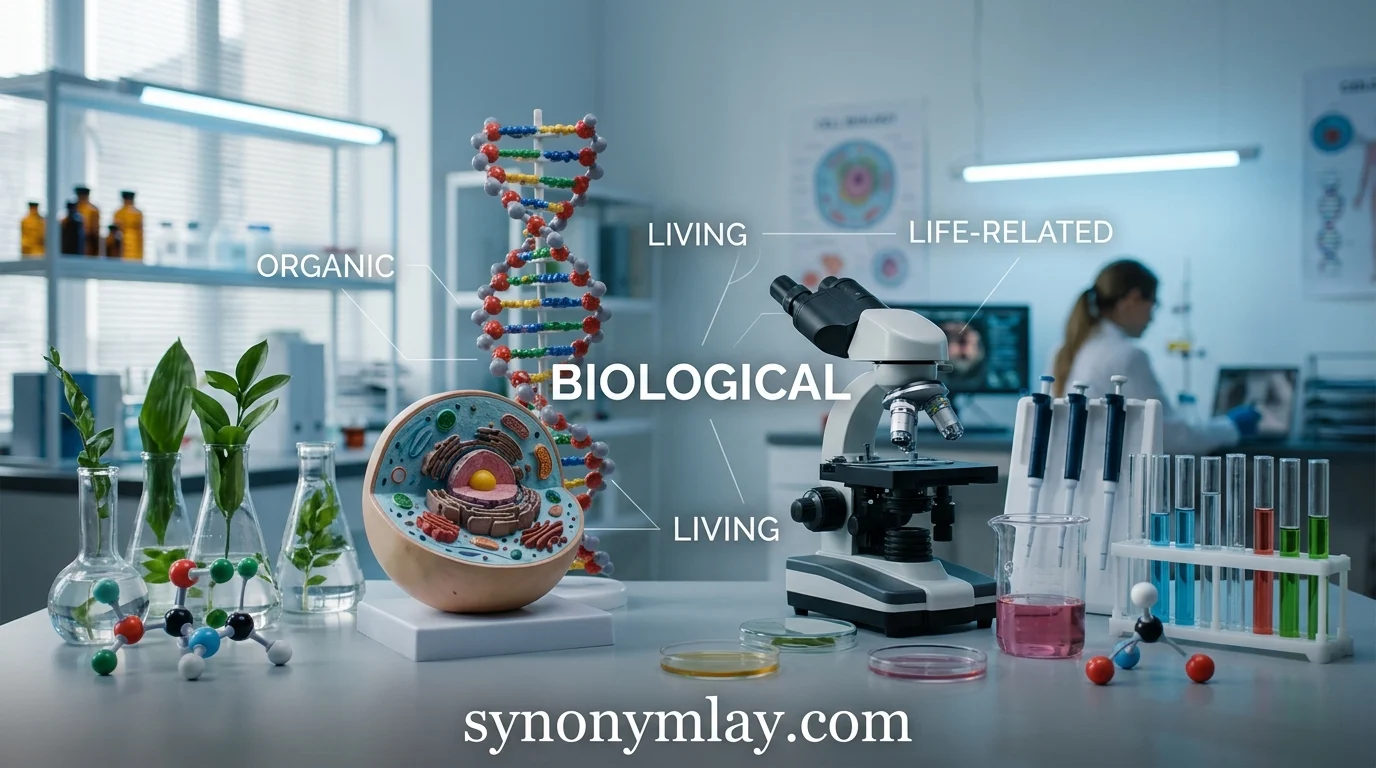
The word biological is commonly used when talking about living organisms, life processes, genetics, nature, and the scientific study of life. However, repeating the same word can make writing feel less precise or interesting. Learning suitable synonyms for biological can help students, writers, researchers, and ESL learners express ideas more naturally.
The best alternative depends on what you mean. For example, organic may work when discussing naturally occurring matter, while physiological is more suitable for body functions. Words such as genetic, cellular, and ecological are more specific and should only be used when the context supports them.
This guide explains useful alternatives to biological in simple English. It also includes examples and usage notes so you can choose a word that fits your sentence instead of simply replacing one word with another.
What Does “Biological” Mean?
Biological means related to living things or the science of life.
It can describe plants, animals, humans, cells, genes, ecosystems, body processes, and other aspects of life.
Example:
Scientists studied the biological effects of the new treatment.
Here, “biological” means the effects connected with living organisms or their bodies.
Synonyms for Biological
There is no single synonym that works perfectly in every sentence. The following alternatives have related meanings, but each has its own area of use.
1. Organic
Meaning: Related to living matter or naturally produced substances.
Example: Organic materials can come from plants and animals.
Best usage context: Use it when discussing natural substances, living matter, or materials produced by living organisms.
2. Living
Meaning: Having life or being connected with something that is alive.
Example: The forest contains many living organisms.
Best usage context: Use it in simple, everyday English when referring directly to things that have life.
3. Natural
Meaning: Existing in nature rather than being artificially created.
Example: The researchers examined natural processes in the ecosystem.
Best usage context: Useful when contrasting something found in nature with something artificial.
4. Physiological
Meaning: Related to the normal functions of a living body.
Example: Exercise causes several physiological changes in the body.
Best usage context: Best for medicine, biology, health science, and discussions of body functions.
5. Genetic
Meaning: Related to genes or inherited characteristics.
Example: Some diseases have a strong genetic component.
Best usage context: Use when the biological subject specifically involves genes or heredity.
6. Cellular
Meaning: Related to cells, the basic units of living organisms.
Example: The medicine produces changes at the cellular level.
Best usage context: Ideal for biology, medicine, microbiology, and scientific writing about cells.
7. Ecological
Meaning: Related to relationships between living things and their environment.
Example: The project examines the ecological effects of pollution.
Best usage context: Use when discussing ecosystems, habitats, environmental relationships, or organisms in nature.
8. Anatomical
Meaning: Related to the structure of a body or organism.
Example: The doctor identified an anatomical difference between the two structures.
Best usage context: Appropriate for anatomy, medicine, and descriptions of physical structures.
9. Biotic
Meaning: Related to living organisms in an ecosystem.
Example: Plants and animals are important biotic components of an ecosystem.
Best usage context: Mainly used in ecology and environmental science.
10. Physiologic
Meaning: Related to normal bodily functions and processes.
Example: The researchers recorded physiologic responses during exercise.
Best usage context: Common in medical and scientific writing, especially in American English.
11. Hereditary
Meaning: Passed from parents to children through genes.
Example: The condition may be hereditary.
Best usage context: Use when the focus is on inherited traits or conditions.
12. Evolutionary
Meaning: Related to evolution and changes in living organisms over generations.
Example: The researchers proposed an evolutionary explanation for the trait.
Best usage context: Best when discussing adaptation, natural selection, or changes across generations.
13. Zoological
Meaning: Related specifically to animals and their scientific study.
Example: The museum has an extensive zoological collection.
Best usage context: Use when the subject is animals rather than living things generally.
14. Botanical
Meaning: Related specifically to plants and the study of plants.
Example: She conducted botanical research in the tropical forest.
Best usage context: Best for plants, plant science, gardens, and botany.
15. Microbiological
Meaning: Related to microorganisms such as bacteria, fungi, and some other microscopic life forms.
Example: The laboratory performs microbiological tests on water samples.
Best usage context: Use in microbiology, medicine, food science, and laboratory contexts.
16. Biochemical
Meaning: Related to chemical processes occurring inside living organisms.
Example: The researchers examined biochemical reactions inside the cells.
Best usage context: Ideal for biology and chemistry topics involving chemical processes in organisms.
17. Molecular
Meaning: Related to molecules and their structure or behavior.
Example: The team investigated the molecular structure of the protein.
Best usage context: Use when discussing biology at the molecular level.
18. Environmental
Meaning: Related to the natural surroundings and conditions affecting living things.
Example: Environmental factors can influence plant growth.
Best usage context: Useful when biological processes are connected to surroundings or environmental conditions.
19. Organic-life
Meaning: Connected with living organisms or life forms.
Example: The planet may contain evidence of organic life.
Best usage context: Useful in scientific, environmental, and astronomy-related discussions.
20. Life-related
Meaning: Connected with life or living organisms.
Example: The course covers several life-related scientific topics.
Best usage context: A simple, informal alternative when technical vocabulary is unnecessary.
21. Vital
Meaning: Related to life or essential bodily functions.
Example: The doctor checked the patient’s vital functions.
Best usage context: Suitable when discussing essential processes necessary for life.
22. Life-science
Meaning: Connected with the scientific study of living organisms.
Example: She plans to pursue a life-science degree.
Best usage context: Useful in education, academic programs, and broad scientific discussions.
23. Organismic
Meaning: Related to a whole living organism.
Example: The researchers considered the organismic response to environmental stress.
Best usage context: Mainly appropriate for specialized academic or biological writing.
24. Developmental
Meaning: Related to the growth and development of an organism.
Example: The study explored developmental changes during childhood.
Best usage context: Use when discussing growth, maturation, embryos, or stages of development.
25. Reproductive
Meaning: Related to reproduction and the production of offspring.
Example: The researchers studied reproductive behavior in birds.
Best usage context: Appropriate for biology, zoology, medicine, and population studies.
26. Biomedical
Meaning: Related to biology and medicine, especially research concerning health and disease.
Example: The university has invested heavily in biomedical research.
Best usage context: Best for medical research, healthcare technology, and biological studies related to human health.
27. Immunological
Meaning: Related to the immune system and its responses.
Example: The treatment produced an immunological response.
Best usage context: Use in medical and scientific contexts involving immunity.
28. Neurological
Meaning: Related to the nervous system, especially the brain and nerves.
Example: The patient underwent several neurological tests.
Best usage context: Best for medical discussions involving the brain, spinal cord, or nerves.
29. Pathological
Meaning: Related to disease or abnormal conditions in the body.
Example: The laboratory examined the pathological changes in the tissue.
Best usage context: Use in medical and scientific writing about disease or abnormal biological processes.
30. Biological-scientific
Meaning: Related to scientific knowledge or investigation concerning living organisms.
Example: The paper presents a biological-scientific explanation of the phenomenon.
Best usage context: Use sparingly when emphasizing the scientific nature of a biological subject.
Quick Comparison of Synonyms for Biological
| Word | Main Meaning | Best Context |
|---|---|---|
| Biological | Related to life | General science |
| Organic | Related to natural or living matter | Nature and materials |
| Physiological | Related to body functions | Medicine |
| Genetic | Related to genes | Heredity |
| Cellular | Related to cells | Cell biology |
| Ecological | Related to organisms and environment | Ecology |
| Anatomical | Related to body structure | Anatomy |
| Biotic | Related to living components | Ecology |
| Biochemical | Related to chemical processes in organisms | Biochemistry |
| Molecular | Related to molecules | Molecular biology |
| Botanical | Related to plants | Botany |
| Zoological | Related to animals | Zoology |
| Biomedical | Related to biology and medicine | Medical research |
| Evolutionary | Related to evolution | Evolutionary science |
| Reproductive | Related to reproduction | Reproductive biology |
Biological vs. Organic
These two words can overlap, but they are not always interchangeable.
Biological generally means related to living organisms or life processes.
Organic can refer to living matter, natural substances, or chemistry. It also has special meanings in agriculture and food.
Biological example:
The researchers studied biological changes in the animal.
Organic example:
The soil contains a large amount of organic material.
Biological vs. Physiological
Biological is broad, while physiological is more specific.
If you are talking generally about life or living organisms, biological is usually appropriate.
If you are discussing how a body normally functions, physiological is usually better.
Biological: The study examined biological responses.
Physiological: The study examined physiological responses to exercise.
Biological vs. Genetic
Genetic is a narrower term.
Every genetic process is biological, but not every biological process is genetic.
For example, digestion is biological, while an inherited characteristic is genetic.
Biological vs. Ecological
Use ecological when your subject involves relationships between organisms and their environment.
Biological: The researcher studied biological diversity.
Ecological: The researcher studied ecological relationships within the forest.
How to Choose the Right Synonym
Choosing the right synonym is easier when you first identify what part of biology you are discussing.
For General References to Life
Choose:
- Biological
- Living
- Natural
- Life-related
These are useful when you do not need a highly technical word.
For Genes and Heredity
Choose:
- Genetic
- Hereditary
Use these when discussing inherited characteristics, DNA, genes, or family-linked traits.
For Body Functions
Choose:
- Physiological
- Physiologic
- Vital
These work well in medical and health-related writing.
For Cells and Molecules
Choose:
- Cellular
- Molecular
- Biochemical
These are more precise for scientific and laboratory contexts.
For Plants and Animals
Choose:
- Botanical — plants
- Zoological — animals
These words make your writing more specific.
For Ecosystems and Nature
Choose:
- Ecological
- Environmental
- Biotic
These are particularly useful when discussing habitats, ecosystems, and environmental relationships.
For Medical Research
Choose:
- Biomedical
- Immunological
- Neurological
- Pathological
The best choice depends on the specific medical subject.
Common Mistakes When Using Synonyms for Biological
One common mistake is assuming that every related word can replace biological in every sentence. Synonyms often have slightly different meanings.
For example, replacing biological with genetic changes the meaning because genetic specifically refers to genes and heredity.
Another mistake is using highly technical vocabulary when simple English would be clearer. In general writing, living, natural, or biological may be easier for readers to understand than organismic or biochemical.
Always consider the audience and subject before selecting an alternative.
Why Learning Synonyms for Biological Matters
Learning related vocabulary can make your writing more precise. Instead of repeatedly using biological, you can identify exactly what you mean.
It is especially helpful for:
- Students writing assignments
- ESL learners expanding vocabulary
- Researchers writing academic papers
- Content creators improving readability
- Writers avoiding repetition
- Teachers explaining scientific concepts
- Professionals working with scientific terminology
A strong vocabulary is not simply about knowing more words. It is about knowing which word fits the situation best.
Meaning of “Demure”
The word demure describes someone who behaves in a quiet, modest, reserved, and somewhat shy way.
It is often used to describe a person’s appearance, manner, expression, or behavior.
Example:
She gave a demure smile when everyone praised her.
The tone of demure is usually gentle and positive, although the exact feeling depends on context. It can suggest modesty, quietness, or restrained behavior.
It is more formal and literary than simply saying shy or quiet.
30 Synonyms of Demure
Because your requested template specifically asks for demure synonyms, here are 30 useful alternatives with simple explanations.
1. Modest
Meaning: Not showing off or drawing too much attention to yourself.
Example: She wore a modest dress to the formal event.
Best usage context: Clothing, behavior, personality, and appearance.
2. Shy
Meaning: Nervous or uncomfortable around other people.
Example: The shy student rarely spoke in class.
Best usage context: Everyday conversations about personality.
3. Reserved
Meaning: Quiet and not likely to show feelings openly.
Example: He was reserved when meeting new people.
Best usage context: Personality and social behavior.
4. Bashful
Meaning: Easily embarrassed or shy.
Example: She became bashful when her friends complimented her.
Best usage context: Friendly or slightly playful descriptions.
5. Quiet
Meaning: Not loud or talkative.
Example: She is a quiet person who enjoys reading.
Best usage context: Everyday English.
6. Retiring
Meaning: Shy and avoiding attention.
Example: His retiring nature made him uncomfortable at large parties.
Best usage context: Formal or literary writing.
7. Unassuming
Meaning: Not trying to appear important or impressive.
Example: Despite his success, he remained unassuming.
Best usage context: Personality and character descriptions.
8. Meek
Meaning: Gentle and not aggressive or demanding.
Example: The meek child quietly followed the teacher’s instructions.
Best usage context: Gentle personality descriptions.
9. Mild
Meaning: Gentle and not extreme.
Example: She has a mild and pleasant personality.
Best usage context: Personality, behavior, and temperament.
10. Gentle
Meaning: Kind, calm, and soft in behavior.
Example: His gentle manner made everyone feel comfortable.
Best usage context: Personality and behavior.
11. Soft-spoken
Meaning: Speaking quietly and gently.
Example: The soft-spoken teacher carefully answered every question.
Best usage context: Speech and personality.
12. Subdued
Meaning: Quiet, restrained, or less energetic than usual.
Example: She gave a subdued response to the announcement.
Best usage context: Emotions, behavior, and atmosphere.
13. Unobtrusive
Meaning: Not attracting attention or causing disturbance.
Example: The unobtrusive guest stayed quietly in the background.
Best usage context: Behavior and physical presence.
14. Self-effacing
Meaning: Avoiding praise or attention for yourself.
Example: He was self-effacing despite receiving several awards.
Best usage context: Humility and personality.
15. Humble
Meaning: Not believing that you are better or more important than others.
Example: She remained humble after winning the competition.
Best usage context: Character and personal achievements.
16. Demure
Meaning: Quiet, modest, and reserved.
Example: She had a demure smile during the ceremony.
Best usage context: Appearance, manner, and behavior.
17. Coy
Meaning: Shy or pretending to be shy in a playful way.
Example: She gave a coy smile before answering.
Best usage context: Playful or flirtatious contexts.
18. Modest-minded
Meaning: Having a restrained and humble attitude.
Example: His modest-minded approach made him easy to work with.
Best usage context: Descriptive writing.
19. Dignified
Meaning: Calm, serious, and worthy of respect.
Example: She maintained a dignified manner throughout the ceremony.
Best usage context: Formal behavior and public situations.
20. Composed
Meaning: Calm and in control of your emotions.
Example: She remained composed during the difficult conversation.
Best usage context: Professional and emotional situations.
21. Restrained
Meaning: Controlled and not excessive.
Example: His restrained reaction surprised everyone.
Best usage context: Emotions, speech, and behavior.
22. Discreet
Meaning: Careful not to attract attention or reveal private information.
Example: She was discreet when discussing the sensitive matter.
Best usage context: Privacy and careful behavior.
23. Unpretentious
Meaning: Simple and not designed to impress others.
Example: Her unpretentious personality made her approachable.
Best usage context: People, lifestyles, and personalities.
24. Timid
Meaning: Lacking confidence or easily frightened.
Example: The timid child hesitated before joining the group.
Best usage context: Shyness, fear, and lack of confidence.
25. Introverted
Meaning: More comfortable spending time alone or with a small group.
Example: He is introverted but enjoys meaningful conversations.
Best usage context: Personality discussions.
26. Innocent
Meaning: Showing a lack of experience, guilt, or harmful intention.
Example: She had an innocent expression on her face.
Best usage context: Appearance, behavior, and character.
27. Unassertive
Meaning: Not forceful about expressing opinions or demands.
Example: His unassertive manner sometimes made it difficult for him to speak up.
Best usage context: Workplace and personality descriptions.
28. Serene
Meaning: Peaceful, calm, and untroubled.
Example: She maintained a serene expression throughout the ceremony.
Best usage context: Appearance, mood, and atmosphere.
29. Calm
Meaning: Peaceful and not nervous or excited.
Example: She stayed calm when the situation became difficult.
Best usage context: Everyday English.
30. Unpretentious
Meaning: Simple, natural, and free from attempts to impress.
Example: Her unpretentious style made her seem approachable.
Best usage context: Style, personality, and social behavior.
Demure Synonyms: Quick Comparison
| Synonym | Main Idea | Tone |
|---|---|---|
| Modest | Not showing off | Positive |
| Shy | Uncomfortable socially | Neutral |
| Reserved | Emotionally quiet | Neutral |
| Bashful | Easily embarrassed | Gentle |
| Coy | Playfully shy | Playful |
| Timid | Lacking confidence | Slightly negative |
| Humble | Not boastful | Positive |
| Gentle | Kind and calm | Positive |
| Dignified | Calm and respectable | Formal |
| Composed | Emotionally controlled | Positive |
| Restrained | Controlled | Formal |
| Unassuming | Not seeking attention | Positive |
| Soft-spoken | Quiet manner of speaking | Positive |
| Unobtrusive | Avoiding attention | Neutral |
| Self-effacing | Avoiding personal praise | Positive |
Final Takeaway
The best synonyms for biological depend on the exact idea you want to communicate. Genetic is appropriate for genes and heredity, physiological for body functions, cellular for cells, ecological for relationships between organisms and their environment, and biochemical for chemical processes within living systems.
The key is to choose precision over simple word replacement. A good synonym should preserve the intended meaning while making your writing clearer and more natural.
For ESL learners, students, writers, and content creators, learning these distinctions can make scientific and everyday writing more accurate. Instead of searching for one word that replaces biological everywhere, think about the specific meaning behind your sentence and select the term that communicates it best.

I am Joel David, a passionate writer who loves exploring synonyms and helping readers discover clear, meaningful, and engaging word choices. I enjoy making language simple, useful, and interesting for everyone.