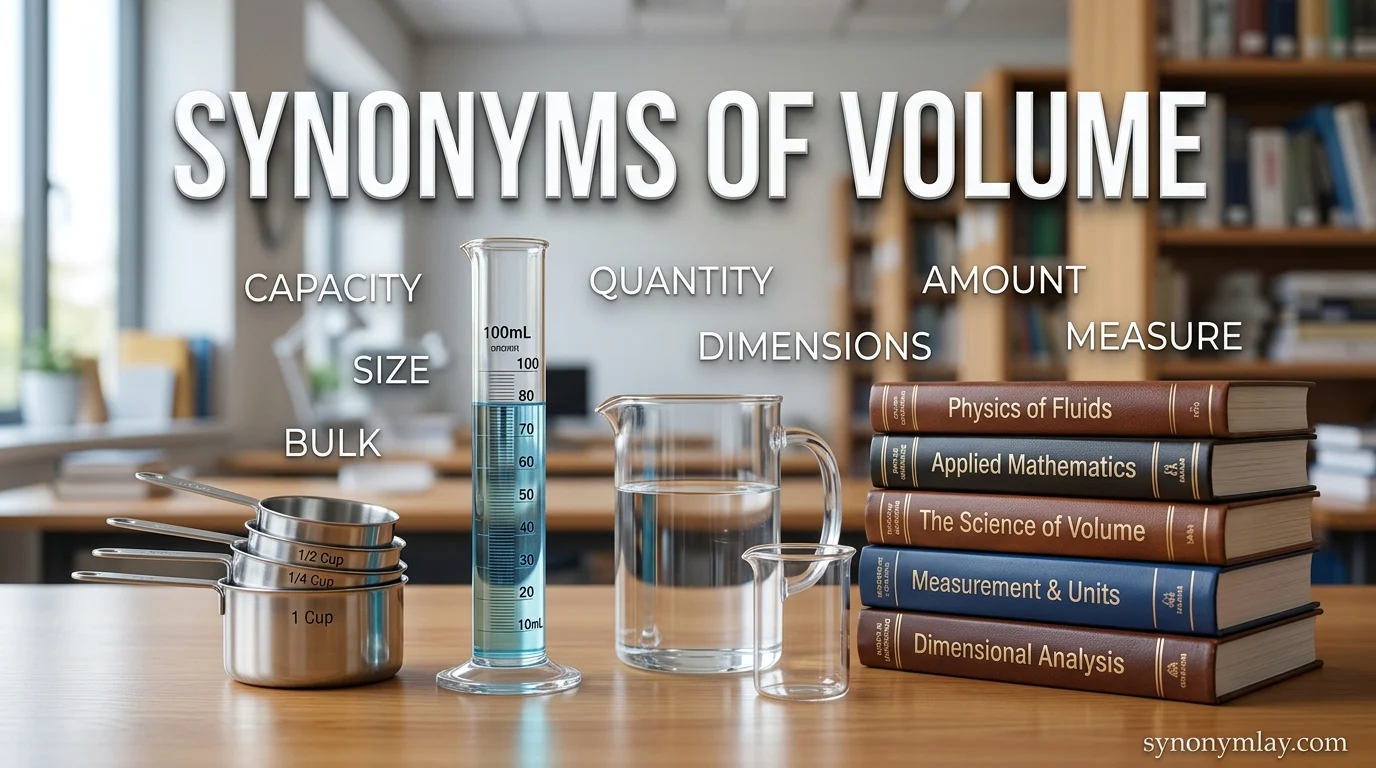
Finding the right word can make your writing clearer, more precise, and more engaging. The word volume has several meanings, so its best synonym depends on what you are describing. You might use volume to talk about the amount of something, the loudness of a sound, the space occupied by an object, or even a book in a series.
Understanding the synonyms of volume helps students, ESL learners, writers, and content creators choose words that communicate their exact meaning. For example, “quantity” works well when discussing an amount, while “loudness” is better when discussing sound. In mathematics and science, terms such as “capacity” and “cubic measure” may be more appropriate.
This guide explains useful alternatives to volume in simple English. It also covers different meanings, usage contexts, examples, and practical tips for choosing the right synonym.
What Does “Volume” Mean?
The word volume has several common meanings.
It can mean the amount or quantity of something.
Example:
The company produces a large volume of products every month.
It can also describe how loud a sound is.
Example:
Please turn down the volume on the television.
In mathematics and science, volume means the amount of three-dimensional space occupied by an object.
Example:
The volume of the box is 20 cubic meters.
Volume can also refer to a book that is part of a larger collection.
Example:
I borrowed the second volume of the encyclopedia.
Because “volume” has multiple meanings, there is no single synonym that works in every sentence.
30 Synonyms of Volume
Here are 30 useful alternatives, grouped according to the different meanings of volume.
1. Quantity
Meaning: The amount of something.
Example sentence:
The store received a large quantity of new products.
Best usage context: Use it when talking about how much of something exists.
2. Amount
Meaning: How much of something there is.
Example sentence:
The amount of water in the tank is decreasing.
Best usage context: Everyday writing and general descriptions.
3. Number
Meaning: A count of people or things.
Example sentence:
A large number of students attended the event.
Best usage context: Use it mainly with countable nouns.
4. Capacity
Meaning: The maximum amount something can hold.
Example sentence:
The bottle has a capacity of one liter.
Best usage context: Containers, buildings, machines, and storage.
5. Size
Meaning: How large something is.
Example sentence:
The size of the container determines how much it can hold.
Best usage context: General descriptions of physical dimensions.
6. Bulk
Meaning: A large amount or large physical size.
Example sentence:
The bulk of the shipment arrived yesterday.
Best usage context: Large quantities or physical masses.
7. Mass
Meaning: The amount of matter in an object.
Example sentence:
The scientist measured the mass of the sample.
Best usage context: Physics and scientific writing.
8. Magnitude
Meaning: The size, strength, or importance of something.
Example sentence:
The magnitude of the problem became clear after the investigation.
Best usage context: Formal, scientific, or technical writing.
9. Extent
Meaning: The degree or range to which something exists.
Example sentence:
We were surprised by the extent of the damage.
Best usage context: Formal writing and discussions of scale.
10. Scale
Meaning: The size or level of something compared with a standard.
Example sentence:
The project was enormous in scale.
Best usage context: Projects, operations, measurements, and comparisons.
11. Abundance
Meaning: A very large amount of something.
Example sentence:
The garden contains an abundance of flowers.
Best usage context: When emphasizing plenty or more than enough.
12. Supply
Meaning: The amount of something available for use.
Example sentence:
The hospital has a limited supply of medicine.
Best usage context: Resources, goods, food, and materials.
13. Stock
Meaning: A stored amount of goods or materials.
Example sentence:
The shop has a large stock of winter clothing.
Best usage context: Business, retail, and inventory.
14. Load
Meaning: The amount carried or placed on something.
Example sentence:
The truck was carrying a heavy load.
Best usage context: Transportation, machines, and physical weight.
15. Content
Meaning: The material or amount contained inside something.
Example sentence:
The bottle’s contents were spilled on the floor.
Best usage context: Containers, books, websites, and digital material.
16. Space
Meaning: The area or room available for something.
Example sentence:
There is not enough space in the warehouse.
Best usage context: Physical areas and storage.
17. Cubic Measure
Meaning: A measurement of three-dimensional space.
Example sentence:
The engineer calculated the cubic measure of the tank.
Best usage context: Mathematics, engineering, and science.
18. Cubic Capacity
Meaning: The amount of three-dimensional space an object can contain or occupy.
Example sentence:
The cubic capacity of the container is carefully calculated.
Best usage context: Technical and mathematical contexts.
19. Loudness
Meaning: How loud or quiet a sound is.
Example sentence:
You can adjust the loudness of the speaker.
Best usage context: Audio, music, television, and everyday speech.
20. Sound Level
Meaning: The measured strength or loudness of a sound.
Example sentence:
The sound level became uncomfortable during the concert.
Best usage context: Audio technology and technical discussions.
21. Intensity
Meaning: The strength or force of something.
Example sentence:
The intensity of the music increased during the final section.
Best usage context: Sound, light, emotions, exercise, and scientific contexts.
22. Strength
Meaning: The degree of force or power.
Example sentence:
The strength of the signal was surprisingly high.
Best usage context: Signals, sounds, forces, and abstract ideas.
23. Amplitude
Meaning: The size or strength of a wave or vibration.
Example sentence:
The amplitude of the sound wave increased.
Best usage context: Physics, acoustics, engineering, and mathematics.
24. Register
Meaning: A setting or level used to control sound loudness.
Example sentence:
She lowered the register on the audio equipment.
Best usage context: Specialized audio or musical contexts.
25. Edition
Meaning: A particular version of a book or publication.
Example sentence:
I bought the latest edition of the textbook.
Best usage context: Books, newspapers, magazines, and publications.
26. Tome
Meaning: A large or important book.
Example sentence:
He spent months reading the historical tome.
Best usage context: Formal or literary writing.
27. Book
Meaning: A written or printed work.
Example sentence:
The library has an old book about astronomy.
Best usage context: General references to a volume as a publication.
28. Part
Meaning: One section of a larger work.
Example sentence:
The final part of the series explains the main theory.
Best usage context: Multi-part books, stories, or collections.
29. Portion
Meaning: A particular amount or section of something.
Example sentence:
Only a small portion of the volume was available online.
Best usage context: Amounts, sections, and parts of larger things.
30. Degree
Meaning: The level or extent of something.
Example sentence:
The degree of noise in the room was difficult to tolerate.
Best usage context: Formal descriptions of level, intensity, or extent.
Synonyms of Volume by Meaning
The easiest way to select the correct synonym is to identify what volume means in your sentence.
| Meaning of Volume | Best Synonyms | Example |
|---|---|---|
| Amount | Quantity, amount, supply | A large quantity of water |
| Number | Number, count | A high number of visitors |
| Physical space | Capacity, cubic measure | The tank has a large capacity |
| Sound level | Loudness, sound level | Lower the loudness |
| Strength | Intensity, strength | The intensity of the sound |
| Wave measurement | Amplitude | The wave has greater amplitude |
| Book | Edition, tome, part | The second edition |
| Large physical amount | Bulk, mass | The bulk of the material |
Volume Synonyms for Quantity
When volume means “a large amount,” the most natural alternatives are quantity, amount, supply, abundance, bulk, and stock.
For example:
- “The company handles a high volume of orders.”
- “The company handles a high quantity of orders.”
Both can work, although “volume of orders” sounds especially natural in business writing.
For everyday situations, amount is usually simpler.
Volume Synonyms for Sound
When volume refers to sound, the strongest alternatives include:
- Loudness
- Sound level
- Intensity
- Strength
- Amplitude
However, these words are not always interchangeable.
Loudness is the closest everyday alternative.
Sound level is more technical.
Amplitude is a scientific term related to wave size rather than simply perceived loudness.
Volume Synonyms in Mathematics
In mathematics, volume refers to the amount of three-dimensional space occupied by an object.
Useful related terms include:
- Capacity
- Cubic measure
- Cubic capacity
- Space occupied
For example:
Volume: The volume of the cube is 64 cubic centimeters.
Cubic measure: The cubic measure of the object is 64 cubic centimeters.
In mathematical writing, however, volume remains the standard and most precise term.
Volume Synonyms in Business
Businesses often use “volume” to describe the amount of activity.
For example:
- Sales volume
- Production volume
- Order volume
- Traffic volume
- Transaction volume
Possible alternatives include quantity, amount, number, scale, level, and extent.
Example
“The website experienced a high volume of visitors.”
A natural alternative is:
“The website experienced a large number of visitors.”
Volume Synonyms for Books
When volume means a book that belongs to a series or collection, alternatives include:
- Edition
- Tome
- Part
- Book
- Section
For example:
“I read Volume 2 of the series.”
You could write:
“I read the second book in the series.”
However, volume and edition are not always identical. An edition usually means a particular version or printing, while a volume is commonly one book within a larger set.
How to Choose the Right Synonym
Choosing the right synonym depends on meaning, tone, audience, and context.
For Everyday English
Use:
- Amount
- Quantity
- Number
- Size
- Loudness
These words are easy for most readers to understand.
For Academic Writing
Use:
- Magnitude
- Extent
- Capacity
- Intensity
- Mass
- Scale
These terms can make academic explanations more precise when used correctly.
For Scientific Writing
Use:
- Mass
- Amplitude
- Intensity
- Cubic measure
- Capacity
Always choose the term according to the exact scientific concept.
For Business Writing
Use:
- Quantity
- Number
- Scale
- Supply
- Stock
- Level
For example, “sales volume” can sometimes be replaced with “number of sales” or “sales quantity,” depending on the intended meaning.
For Describing Sound
Use:
- Loudness
- Sound level
- Intensity
- Strength
“Loudness” is usually the easiest choice for general readers.
For Literary Writing
Use:
- Tome
- Bulk
- Magnitude
- Extent
- Abundance
These can add a more formal or expressive tone.
Volume vs. Quantity
Volume and quantity can both describe an amount, but they are not always interchangeable.
“Volume” often emphasizes the overall amount or level of activity, while “quantity” usually refers to a specific amount.
Volume:
The store handles a high volume of orders.
Quantity:
The customer ordered a large quantity of products.
Volume vs. Capacity
These words are closely related but have different meanings.
Capacity describes how much something can hold.
Volume can describe how much space something actually occupies.
For example:
“The tank has a capacity of 500 liters.”
“The volume of water in the tank is 400 liters.”
Volume vs. Amount
Amount is a broad everyday word for how much of something exists.
Volume is more specific and can suggest quantity, physical space, or activity level.
For simple everyday writing, “amount” is often easier.
Volume vs. Loudness
When discussing sound, loudness is a direct everyday synonym for one meaning of volume.
For example:
“Turn down the volume.”
“Turn down the loudness.”
The first sentence is much more natural in ordinary conversation, while “loudness” is useful when explaining the concept itself.
Common Mistakes When Using Volume Synonyms
One common mistake is assuming that every synonym can replace “volume” in every sentence.
For example, mass does not mean the same thing as volume in physics. Mass measures the amount of matter, while volume measures the amount of space occupied.
Another mistake is using edition whenever volume refers to a book. A volume can be one book in a series, while an edition describes a particular version of a publication.
Context matters more than simply finding a word with a similar dictionary definition.
Quick Guide to Volume Alternatives
If you mean “amount,” choose quantity or amount.
If you mean “how much something can hold,” choose capacity.
If you mean “physical three-dimensional space,” use volume or cubic measure.
If you mean “sound level,” choose loudness or sound level.
If you mean “strength,” consider intensity or magnitude.
If you mean “a book in a series,” choose book, part, tome, or simply volume, depending on context.
Understanding “Demure” in Simple English
Although demure is unrelated to the word volume, it is useful to understand because it has a specific tone and is sometimes confused with similar personality or appearance words.
Demure means quiet, modest, reserved, and somewhat shy in behavior or appearance.
It is often used to describe someone who behaves in a calm, modest, or restrained way.
Example:
She gave a demure smile when everyone complimented her.
The word can sound gentle, elegant, traditional, or slightly old-fashioned, depending on the context.
30 Synonyms of Demure
1. Modest
Meaning: Not showing off or attracting too much attention.
Example:
She wore a modest dress to the formal event.
Best usage context: Clothing, behavior, and personality.
2. Shy
Meaning: Nervous or uncomfortable around other people.
Example:
The shy student rarely spoke in class.
Best usage context: Personality and social behavior.
3. Reserved
Meaning: Quiet and not openly expressing feelings.
Example:
He was reserved during the meeting.
Best usage context: Personality and professional situations.
4. Bashful
Meaning: Easily embarrassed or shy.
Example:
The bashful child hid behind her mother.
Best usage context: Friendly or affectionate descriptions.
5. Retiring
Meaning: Avoiding attention or social activity.
Example:
She had a retiring personality.
Best usage context: Formal or literary writing.
6. Unassuming
Meaning: Not trying to appear important or impressive.
Example:
Despite his success, he remained unassuming.
Best usage context: Personality and character.
7. Quiet
Meaning: Not loud, talkative, or attention-seeking.
Example:
She was a quiet and thoughtful person.
Best usage context: Everyday English.
8. Mild
Meaning: Gentle and not extreme.
Example:
He has a mild and pleasant personality.
Best usage context: Personality and behavior.
9. Gentle
Meaning: Kind, calm, and soft in behavior.
Example:
Her gentle manner made everyone comfortable.
Best usage context: Personality and behavior.
10. Subdued
Meaning: Calm, restrained, or less energetic than usual.
Example:
She gave a subdued response to the announcement.
Best usage context: Emotions, behavior, and atmosphere.
11. Restrained
Meaning: Controlled and not excessive.
Example:
His restrained reaction surprised everyone.
Best usage context: Emotions and behavior.
12. Unobtrusive
Meaning: Not attracting unnecessary attention.
Example:
She chose an unobtrusive style for the event.
Best usage context: Appearance, behavior, and design.
13. Proper
Meaning: Appropriate and socially acceptable.
Example:
She maintained a proper manner throughout the ceremony.
Best usage context: Formal and traditional contexts.
14. Decent
Meaning: Respectable and appropriate.
Example:
She chose a decent outfit for the occasion.
Best usage context: Clothing, behavior, and general conduct.
15. Ladylike
Meaning: Traditionally associated with polite and graceful feminine behavior.
Example:
Her ladylike manners impressed the guests.
Best usage context: Traditional or literary descriptions.
16. Dignified
Meaning: Calm, serious, and worthy of respect.
Example:
She remained dignified during the difficult conversation.
Best usage context: Formal situations and behavior.
17. Graceful
Meaning: Elegant and pleasing in movement or behavior.
Example:
Her graceful manner made her stand out.
Best usage context: Appearance, movement, and personality.
18. Elegant
Meaning: Attractive, refined, and stylish.
Example:
She wore an elegant black dress.
Best usage context: Fashion, appearance, and style.
19. Refined
Meaning: Polished, cultured, and sophisticated.
Example:
He has a refined sense of style.
Best usage context: Taste, manners, and appearance.
20. Polite
Meaning: Showing good manners and respect.
Example:
The polite child thanked everyone.
Best usage context: Everyday social behavior.
21. Courteous
Meaning: Respectful and considerate toward others.
Example:
The courteous guest thanked the host.
Best usage context: Formal and professional situations.
22. Soft-spoken
Meaning: Speaking quietly and gently.
Example:
The soft-spoken teacher was easy to approach.
Best usage context: Voice and personality.
23. Meek
Meaning: Very gentle and unwilling to argue or challenge others.
Example:
He was too meek to object to the decision.
Best usage context: Personality, though it can sometimes suggest weakness.
24. Demurely Modest
Meaning: Quietly modest without seeking attention.
Example:
She accepted the compliment demurely.
Best usage context: Elegant or literary writing.
25. Reservedly
Meaning: In a quiet and controlled manner.
Example:
He answered the question reservedly.
Best usage context: Formal descriptions of behavior.
26. Modestly
Meaning: Without showing off.
Example:
She modestly accepted the award.
Best usage context: Behavior and reactions.
27. Unpretentious
Meaning: Simple and not designed to impress others.
Example:
The restaurant has an unpretentious atmosphere.
Best usage context: People, places, and styles.
28. Humble
Meaning: Not believing you are better or more important than others.
Example:
Despite winning the competition, she remained humble.
Best usage context: Character and attitude.
29. Reservedly Elegant
Meaning: Attractive or graceful without being flashy.
Example:
Her reservedly elegant style suited the formal occasion.
Best usage context: Fashion and literary descriptions.
30. Composed
Meaning: Calm and in control of emotions.
Example:
She remained composed during the interview.
Best usage context: Behavior, emotions, and formal situations.
How to Choose the Right Demure Synonym
If you mean quiet and socially nervous, use shy or bashful.
If you mean calm and private, use reserved.
If you mean modest and not attention-seeking, use unassuming or unpretentious.
If you mean elegant and graceful, use refined, graceful, or elegant.
If you mean calm under pressure, use composed.
If you mean traditional feminine modesty, words such as ladylike may fit, although the term has a distinctly traditional tone.
FAQs:
What is the best synonym for volume?
The best synonym depends on the meaning. Quantity works for an amount, capacity for how much something can hold, and loudness for sound.
What is another word for a large volume?
Depending on context, you can use large quantity, abundance, bulk, amount, supply, or high level.
What is the synonym of volume in sound?
The closest everyday synonym is loudness. Other related terms include sound level, intensity, and amplitude, although their technical meanings differ.
What is the synonym of volume in mathematics?
In mathematics, capacity and cubic measure can sometimes relate to volume, but volume is the standard technical term for three-dimensional space occupied by an object.
Can quantity and volume be used interchangeably?
Sometimes. Both can refer to an amount, but “volume” often emphasizes the overall amount or level of activity, while “quantity” generally refers to a measurable amount.
Final Thoughts
The word volume is more versatile than it first appears. It can describe an amount, physical space, sound level, activity level, or a book within a collection. Because of these different meanings, choosing the right synonym requires attention to context.
For everyday amounts, amount and quantity are reliable choices. For storage, capacity is usually better. When discussing sound, loudness is natural, while scientific writing may require terms such as amplitude or intensity. In literary and formal writing, words such as magnitude, extent, bulk, and abundance can provide more precise shades of meaning.
The key is not simply to replace “volume” with another word. Instead, identify exactly what you mean first, then choose the alternative that communicates that meaning naturally and accurately. This approach will make your vocabulary stronger and your writing more precise.

I am Marcus Thomas, a passionate word enthusiast and writer who enjoys exploring synonyms. I create clear, useful language resources that help readers improve vocabulary, writing, communication, and expression.