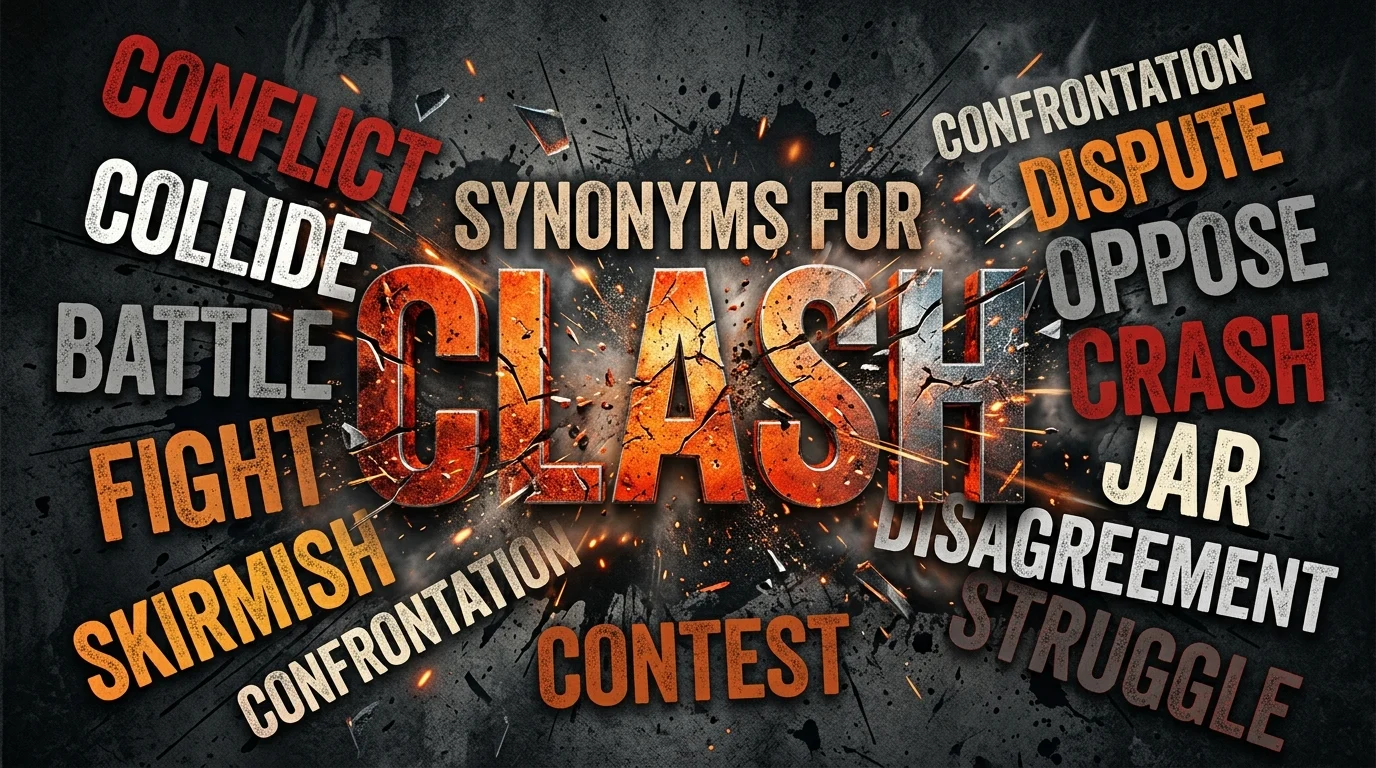
Synonyms for clash can help you express conflict, disagreement, competition, or physical contact more precisely. The word “clash” is common in everyday English, but choosing the right alternative can make your writing clearer and more engaging. Whether you are a student, ESL learner, writer, or content creator, learning different synonyms for clash can help you match your words to the situation and tone.
Understanding the different synonyms for clash helps students, ESL learners, writers, and content creators choose words that match the exact meaning and tone they want. For example, conflict sounds more serious than disagreement, while collide usually describes physical objects coming together.
This guide explains 30 useful alternatives to “clash” in simple English. Each word includes its meaning, an example sentence, and guidance on when it works best.
What Are Synonyms for Clash?
Clash can be used as a noun or a verb.
As a verb, clash means to disagree strongly, fight, or come into physical contact.
The two teams clashed in the final match.
The neighbors often clash over parking spaces.
As a noun, clash means a disagreement, conflict, or physical encounter.
There was a clash between the two groups.
The word can also describe things that do not look or work well together.
The bright orange walls clash with the blue furniture.
So, the best synonym depends on what kind of “clash” you mean.
30 Synonyms for Clash
1. Conflict
Meaning: A serious disagreement or struggle between people, groups, or ideas.
Example:
The two organizations are in conflict over the new policy.
Best usage: Use conflict for serious or ongoing disagreements.
2. Disagreement
Meaning: A situation where people have different opinions.
Example:
The two students had a disagreement about the assignment.
Best usage: Good for everyday situations where people do not agree.
3. Confrontation
Meaning: A direct meeting or argument between people who strongly disagree.
Example:
The discussion turned into a confrontation between the two managers.
Best usage: Use it when disagreement becomes direct or intense.
4. Dispute
Meaning: An argument or disagreement, often involving an important issue.
Example:
The two companies are involved in a dispute over the contract.
Best usage: Common in business, legal, and formal writing.
5. Altercation
Meaning: A noisy or angry argument, sometimes involving physical fighting.
Example:
Police arrived after an altercation outside the stadium.
Best usage: Useful for describing heated public arguments or fights.
6. Argument
Meaning: A disagreement in which people express opposing opinions.
Example:
They had an argument about where to spend the weekend.
Best usage: Very common in everyday English.
7. Quarrel
Meaning: An angry disagreement, usually between people who know each other.
Example:
The siblings had a quarrel over the television remote.
Best usage: Best for personal or informal disagreements.
8. Feud
Meaning: A long-lasting and often bitter conflict between people or groups.
Example:
The two families have been involved in a feud for years.
Best usage: Use feud when the conflict continues over a long period.
9. Fight
Meaning: A physical or verbal struggle between people.
Example:
The two players got into a fight after the match.
Best usage: Simple and informal; useful when the conflict is physical or strongly emotional.
10. Battle
Meaning: A serious struggle between opposing people, groups, or ideas.
Example:
The two candidates began a battle over the proposed changes.
Best usage: Often used literally for warfare or figuratively for serious struggles.
11. Struggle
Meaning: A difficult effort or conflict involving opposing forces or goals.
Example:
The company is struggling with competitors in the international market.
Best usage: Useful when the emphasis is on difficulty rather than anger.
12. Contest
Meaning: A competition between people or groups trying to achieve the same goal.
Example:
The election became a close contest between the two candidates.
Best usage: Best when “clash” means competition rather than hostility.
13. Competition
Meaning: A situation in which people or groups try to be more successful than others.
Example:
There is intense competition between the two brands.
Best usage: Use it for business, sports, education, or other competitive situations.
14. Collision
Meaning: An instance where two physical objects hit each other.
Example:
The accident happened after a collision between two cars.
Best usage: Use collision for physical objects rather than opinions.
15. Impact
Meaning: A forceful contact between two things.
Example:
The vehicle was damaged badly on impact.
Best usage: Appropriate for physical contact, especially in technical or formal writing.
16. Confront
Meaning: To face someone or something directly, especially because of a problem.
Example:
She decided to confront her colleague about the mistake.
Best usage: Use it as a verb when someone directly addresses a conflict.
17. Oppose
Meaning: To disagree with or resist something.
Example:
Several community groups oppose the proposed development.
Best usage: Good for formal writing about ideas, plans, policies, or decisions.
18. Resist
Meaning: To refuse to accept, obey, or support something.
Example:
The workers resisted the company’s proposed changes.
Best usage: Useful when one side actively pushes back against another.
19. Contradict
Meaning: To say the opposite of what another person has said.
Example:
His explanation contradicted the evidence.
Best usage: Best when statements, facts, or claims do not agree.
20. Differ
Meaning: To be different, especially in opinion or position.
Example:
The researchers differ in their interpretation of the results.
Best usage: A softer and more neutral alternative to clash.
21. Disagree
Meaning: To have a different opinion from someone else.
Example:
I disagree with her conclusion.
Best usage: One of the simplest choices for everyday English.
22. Diverge
Meaning: To become different or move in different directions.
Example:
Their opinions began to diverge after the meeting.
Best usage: More formal; useful for academic and professional writing.
23. Opposing
Meaning: Being on different or conflicting sides.
Example:
The two groups presented opposing views.
Best usage: Useful when describing contrasting positions or opinions.
24. Friction
Meaning: Tension or disagreement between people or groups.
Example:
There has been growing friction between the two departments.
Best usage: Good when conflict exists but is not necessarily open or dramatic.
25. Tension
Meaning: A feeling of stress, disagreement, or hostility between people or groups.
Example:
Tension increased after the two teams exchanged accusations.
Best usage: Use it when conflict is present but may not have become an open argument.
26. Discord
Meaning: A lack of agreement or harmony.
Example:
The decision created discord among members of the organization.
Best usage: Formal or literary writing.
27. Strife
Meaning: Serious or prolonged conflict.
Example:
The region experienced years of political strife.
Best usage: Formal writing about long-lasting social, political, or personal conflict.
28. Incompatibility
Meaning: A situation where two things cannot work well together.
Example:
The designers discovered an incompatibility between the two systems.
Best usage: Useful for technology, systems, personalities, ideas, or things that do not work together.
29. Contradiction
Meaning: A situation where two statements, ideas, or facts cannot both be true.
Example:
There is a clear contradiction between the two reports.
Best usage: Best for writing about statements, evidence, arguments, or ideas.
30. Rivalry
Meaning: A situation in which two people, teams, or groups compete strongly against each other.
Example:
The rivalry between the two football clubs has lasted for decades.
Best usage: Use it for repeated competition rather than a single disagreement.
Quick Comparison: Which Synonyms for Clash Should You Use?
| Synonym | Main Meaning | Tone | Best Context |
|---|---|---|---|
| Conflict | Serious disagreement | Neutral/Formal | Work, politics, relationships |
| Disagreement | Different opinions | Neutral | Everyday English |
| Confrontation | Direct conflict | Strong | Arguments, tense situations |
| Dispute | Serious disagreement | Formal | Business, legal issues |
| Altercation | Heated argument or fight | Strong | Public incidents |
| Quarrel | Personal argument | Informal | Friends and family |
| Feud | Long-term conflict | Strong | Families, groups |
| Collision | Physical impact | Neutral | Cars, objects |
| Competition | Struggle to win | Neutral | Sports, business |
| Rivalry | Ongoing competition | Neutral | Sports, business |
| Tension | Hidden or developing conflict | Neutral | Relationships, workplaces |
| Friction | Ongoing irritation | Neutral | Teams, organizations |
| Discord | Lack of harmony | Formal | Groups, society |
| Strife | Prolonged serious conflict | Formal | Politics, society |
| Contradiction | Ideas that do not agree | Formal | Arguments, evidence |
How to Choose the Right Synonym for Clash
Not every synonym for clash can be substituted into every sentence. The key is to identify what kind of clash you are describing.
Synonyms for Clash For a Simple Difference of Opinion
Choose:
- Disagreement
- Disagree
- Differ
- Oppose
Example:
We disagreed about the best solution.
This sounds much more natural than using a strong word such as feud.
Synonyms for Clash For a Serious Conflict
Choose:
- Conflict
- Confrontation
- Dispute
- Strife
- Altercation
Example:
The disagreement developed into a serious conflict.
These words work well when the situation is intense or important.
Synonyms for Clash For a Long-Lasting Conflict
Choose:
- Feud
- Rivalry
- Strife
- Friction
Example:
The two organizations have had a rivalry for many years.
Use feud when the relationship is particularly bitter. Use rivalry when competition is the main idea.
Synonyms for Clash For Competition
Choose:
- Competition
- Contest
- Battle
- Rivalry
- Struggle
Example:
The two companies are competing for the same customers.
Here, competition is more accurate than conflict if the companies are simply trying to outperform each other.
Synonyms for Clash For Physical Contact
Choose:
- Collision
- Impact
- Crash
Example:
The two vehicles collided at the intersection.
In this context, collision is much more precise than disagreement or conflict.
For Things That Do Not Work Well Together
Choose:
- Incompatibility
- Contradiction
- Divergence
Example:
The two software systems have an incompatibility that prevents them from working together.
For colors, clothing, or design, you may also use contrast, mismatch, or be incompatible, depending on the exact meaning.
Clash vs. Conflict: What Is the Difference?
Clash and conflict are closely related, but they are not always interchangeable.
Clash often suggests a noticeable disagreement, confrontation, or meeting between opposing sides.
The two leaders clashed over the proposal.
Conflict is broader and can describe a continuing struggle or serious disagreement.
The two departments are in conflict over resources.
In simple terms:
- Clash = a specific disagreement or confrontation
- Conflict = a broader or continuing struggle
Clash vs. Disagreement
A disagreement is usually softer than a clash.
We had a disagreement about the schedule.
This sentence simply tells us that two people had different opinions.
Compare:
The managers clashed over the new policy.
The second sentence suggests a stronger or more noticeable disagreement.
For polite or professional writing, disagreement is often a safer choice when you do not want to make a situation sound dramatic.
Clash vs. Dispute
A dispute usually refers to a particular issue that two sides disagree about.
The companies are involved in a dispute over payment.
Dispute is especially common in legal, business, academic, and formal contexts.
Clash is more flexible and can sound more conversational.
Clash vs. Collision
These words can sometimes be confused because both can describe things coming together.
A collision is normally physical:
The two cars were involved in a collision.
A clash can be physical, but it is also commonly used figuratively:
Their political views clashed.
Therefore, use collision when physical impact is the central meaning and clash when disagreement or opposition is the main idea.
Common Phrases with “Clash”
Learning common combinations can help ESL learners use the word naturally.
Clash with someone
She often clashes with her manager.
Clash over something
The two groups clashed over the proposed changes.
Clash of opinions
There was a clash of opinions during the meeting.
Clash of cultures
Moving to another country can sometimes create a clash of cultures.
Clash of personalities
Their clash of personalities made teamwork difficult.
Colors clash
The red curtains clash with the green walls.
These expressions show why context matters when choosing a synonym.
Synonyms for Clash in Academic Writing
For essays and academic writing, choose words that clearly describe the relationship between ideas.
Useful choices include:
- Conflict
- Contradiction
- Divergence
- Dispute
- Opposition
- Discord
For example:
Instead of:
The two theories clash.
You could write:
The two theories contradict each other.
Or:
The two theories diverge significantly in their conclusions.
The best choice depends on exactly what the theories are doing.
Synonyms for Clash in Professional Writing
In workplace communication, strong words can sometimes sound unnecessarily aggressive.
Instead of:
The departments clashed over the budget.
You could write:
The departments disagreed over the budget.
Or:
There was friction between the departments over budget priorities.
For formal communication, words such as disagreement, difference, concern, and dispute can communicate the issue without exaggerating its seriousness.
Synonyms for Clash in Creative Writing
Creative writing gives you more freedom to choose words based on emotion and atmosphere.
For example:
The brothers clashed across the dinner table.
could become:
The brothers quarrelled across the dinner table.
Or:
Tension filled the room as the brothers confronted each other.
Each version creates a slightly different feeling.
Clash is energetic and direct.
Quarrel feels personal.
Confrontation feels serious.
Tension creates suspense without describing an open argument.
How to Make Your Vocabulary More Precise
Using a synonym simply to avoid repeating a word is not always the best approach. A good synonym should communicate the exact idea you mean.
Ask yourself:
- Is the conflict serious or minor?
- Is it temporary or long-lasting?
- Is it physical or verbal?
- Are the people arguing, competing, or simply disagreeing?
- Is the writing formal or informal?
- Am I describing people, ideas, objects, or organizations?
For example, if two football teams are competing, rivalry may be more precise than conflict. If two cars hit each other, collision is more precise. If two friends have different opinions, disagreement may be enough.
This approach makes your writing sound more natural and helps you avoid choosing a synonym that technically fits but feels wrong in context.
FAQs
What is the best synonym for “clash”?
There is no single best synonym because the meaning depends on context. Conflict, disagreement, confrontation, dispute, and collision are useful alternatives for different situations.
What is a simple synonym for “clash”?
Disagree or disagreement is a simple choice when you mean that people have different opinions.
What is a strong synonym for “clash”?
Conflict, confrontation, altercation, and feud can express stronger forms of disagreement, depending on the situation.
What is the synonym for a clash between two people?
Depending on the situation, you could use argument, quarrel, disagreement, confrontation, or altercation.
What is a synonym for “clash” in formal English?
Conflict, dispute, discord, divergence, and opposition can work well in formal writing.
What is the opposite of “clash”?
Depending on the meaning, possible opposites include agree, cooperate, harmonize, match, or coincide.
Conclusion
The word “clash” has several meanings, so the right synonym depends on the situation. For a simple difference of opinion, use disagreement or differ. For a serious struggle, conflict or confrontation may be more appropriate. For long-term competition, consider rivalry or feud. When two physical objects hit each other, collision is usually more precise.
For students and ESL learners, the most important lesson is not to memorize synonyms as interchangeable words. Instead, learn the tone, meaning, and context of each word.
A strong vocabulary is not about using the most complicated word. It is about choosing the most accurate word for the idea you want to express. Once you understand that difference, you can use synonyms for “clash” naturally in essays, conversations, professional writing, and creative work.

I am Andre James, an experienced administrator passionate about language and clear communication. I manage SynonymLay to help readers discover accurate, useful synonyms and improve their vocabulary.